Rhinelander Mansion
867 Madison Avenue | also 26 East 72nd Street | Upper East Side | built 1900
Open on the map15 entries

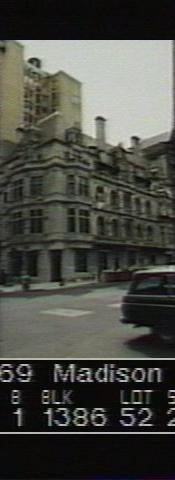
The city photographed every building for its tax records around 1940 and again in the 1980s. NYC Municipal Archives.
Written with AI from the source each entry cites, then fact-checked.
- 1898
Kimball & Thompson finish a limestone chateau modeled on the Loire valley
The house at Madison Avenue and 72nd Street is neo-French Renaissance, with red roofs, copper dormers and a tall stone dormer in front of a steep roof. Five round-arched windows at the second and third floors sit behind carved balustrades recalling Blois, and four canopied niches hold statuettes of saints. Two cartouches on the third story are inscribed A.D. 1895.
“Four canopied stone niches which contain statuettes depicting saints appear at the second story between the windows…”
- 1898
Gertrude Waldo stocks her new chateau with European treasures and never moves in
As the house rose, Gertrude Rhinelander Waldo toured Europe buying furniture and art. Crates of statuary, paintings, tapestries and antiques were delivered and stacked in the finished house but never opened. She never lived there. She stayed with her unmarried sister Laura at 31 East 72nd Street, within view of the empty mansion, which sat dark for about a decade.
Source: Daytonian in Manhattan
- 1905
Water ruins $15,000 worth of books in Waldo's empty chateau as a broker prices its repairs at $40,000
By 1904 the abandoned mansion's roof was damaged, and one source reported that some of its paintings and gold-leaf decoration could not be saved. Mold had spread over the bronze ornament and mosaics, and water had destroyed about $15,000 worth of books. When the house was put up for sale in 1905, one real-estate broker said he would not consider buying it until at least $40,000 had been spent on repairs. During the 1900s the empty house also earned the nickname House of Mystery.
“…one real-estate broker declared that the house needed at least $40,000 in repairs before he would consider buying it…”
Source: Wikipedia
- 1908
Waldo walks out of a sale just as the papers are ready, saying she does not think she will sell
In 1908 Waldo received an offer for the mansion, though she was only lukewarm about it. An agent got a deal settled and the papers were being prepared. At the table she got up, said quietly that she did not think she would sell, and left the room.
Source: Daytonian in Manhattan
- 1909
Thieves break into the empty mansion four times in a single year
A heavy iron fence went up around the mansion, but people knew about the paintings and statuary inside, and thieves looted it four times in 1909. Neglect did its own damage: the roof leaked, the stone was streaked and discolored, and water damaged much of the interior. By then it looked more like a haunted house than a showplace.
Source: Daytonian in Manhattan
- 1912
The Dime Savings Bank forecloses and the Times calls the house a venerable ruin
In 1911 Waldo deeded the house to her sister Laura, and the following year the Dime Savings Bank of Brooklyn took it by foreclosure on the mortgage. The New York Times described the artistic house, with its broken windows and partly broken stonework, as looking like a venerable ruin. The bank wanted commercial use and went to court, successfully, against the restrictions limiting the site to private dwellings.
“…broken windows and partially broken stonework suggested the appearance of some venerable ruin…”
- 1914
The Dime Savings Bank argues that an apartment house is only stacked private houses
In 1914 the Dime Savings Bank moved to replace Gertrude Waldo's unused chateau with an upscale apartment house. A restrictive clause on the block allowed only private residences, so the bank argued that an apartment house was just a stack of private houses. Daytonian in Manhattan reports that the bank lost that argument.
Source: Daytonian in Manhattan
- 1919
Fred T. Ley plans a 14-story apartment tower with a 28-room penthouse on the mansion's site
The Fred T. Ley Company bought the mansion in March 1919 with a loan from the Dime Savings Bank and announced in June a $1 million, 14-story apartment building for the site. It would have held 60 small apartments beneath a three-story penthouse styled as a limestone country house, with 28 rooms, a red Spanish-tile roof and a private elevator. By then the chateau's stonework was crumbling and its windows had cracked, and the tower was never built.
Source: Wikipedia
- 1920
Antique dealer Olivotti & Company becomes the mansion's first occupant, 22 years after it was built
In October 1920 the building was sold to the Renaissance Building Company, which planned small apartments. Olivotti & Company, antique dealers being pushed out of Madison Avenue and 45th Street, leased the basement, first and second floors. Alessandro Olivotti lived on the fourth and fifth floors, and in 1926 the firm bought the building, carving its name on the north wall.
Source: Wikipedia
- 1928
Maurice Ravel is honored at a Madison Avenue reception with an all-Black program of performers
On the evening of January 15, 1928, Mr. and Mrs. William May Wright hosted a reception at their home, 867 Madison Avenue, with music and special dancing, to honor the Paris composer Maurice Ravel. The New York Times reported that because Ravel was greatly interested in Black Americans and their music, only Black artists appeared on the program.
Source: Internet Archive
- 1959
Decorator Robert Denning stays on in the mansion after leaving Edgar de Evia for Vincent Fourcade
The decorator Robert Denning and the photographer Edgar de Evia, his companion since 1942, lived on three floors of the Waldo mansion. In 1959 Denning became involved with Vincent Fourcade and left de Evia, but he went on living in the house for some time. Soon afterward the pair, still new to decorating, were brought in by Lillian and Ogden Phipps for a large project at their Long Island house, and they went on to form Denning & Fourcade.
Source: Internet Archive
- 1968
Christie's opens its rooms in the mansion to the public
The British auctioneer Christie's said in 1967 that it had leased the first and second floors and would restore the interiors, and it opened to the public in November 1968. The top three stories became offices. In 1971 St. James Episcopal Church bought the house for $300,000 in cash plus a $700,000 mortgage and used the upper floors as offices.
“Christie's opened its space to the public in November 1968.”
Source: Wikipedia
- 1976
The Landmarks Commission designates the mansion and recounts Mrs. Waldo's eccentricities
The commission designated the house on July 13, 1976, calling it one of the few surviving Upper East Side chateaux. Its report calls Gertrude Waldo a possible society eccentric. She once sued for reimbursement over 77 yards of yellow satin brocade that A.T. Stewart's store had promised to sell for her twenty years earlier, and won $893.25, a trifle next to the cost of the house she never occupied.
- 1986
Ralph Lauren opens his first standalone New York store in the mansion
Lauren leased the basement and first four floors in January 1985 and turned the house into the city's first freestanding Polo Ralph Lauren store. As many as 400 workers installed mahogany, antiques, rattan cages with live canaries and real grass. Bomb threats and strict preservation rules delayed the opening. The store, about 20,000 square feet, opened on April 21, 1986, at a cost Lauren put above $14 million.
“The 20,000-square-foot (1,900 m2) store opened on April 21, 1986, following a preview event.”
Source: Wikipedia
- 2005
The mansion sells for $80 million to an Irish group that outbid Ralph Lauren's company
In 2005 the mansion sold for $80 million to Sloane Capital Group, led by two Irish investors, Aidan Brooks and J. P. McManus. Polo Ralph Lauren, the building's tenant since 1986, had offered to buy it too, but Sloane Capital submitted the higher bid. The company stayed on as tenant, and the house remained its flagship through the late 2000s.
“…sold again in 2005 for $80 million to Sloane Capital Group ... Polo Ralph Lauren had offered to buy the house, Sloane Capital had submitted a higher bid…”
Source: Wikipedia
Further reading
- Gertrude Rhinelander Waldo HouseWikipedia
Nearby
- St. James' Episcopal Church861 Madison Avenue | 7 entries
- 740 Park Avenue12 entries
- Herbert N. Straus House9 East 71st Street | 15 entries
- Oliver Gould Jennings House7 East 72nd Street | 10 entries
- 907 Fifth Avenue907 5th Avenue | 10 entries
- 720 Park Avenue9 entries