Oliver Gould Jennings House
7 East 72nd Street | also 7A East 72nd Street | Upper East Side | built 1894
Open on the map10 entries

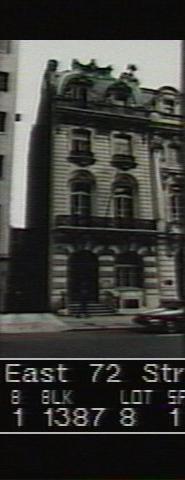
The city photographed every building for its tax records around 1940 and again in the 1980s. NYC Municipal Archives.
Written with AI from the source each entry cites, then fact-checked.
- 1898
The Jennings family buys the lot from the Huntington family for Oliver Gould Jennings's new house
In March 1898 the Jennings family purchased a plot on 72nd Street, just east of Fifth Avenue, from the Huntington family, at a reported price between $75,000 and $80,000. Oliver Gould Jennings's father had been an original Standard Oil stockholder. Several other buyers picked up land along Fifth Avenue's east side near 72nd Street in those same years.
“In March 1898, the Jennings family bought a plot on the north side of 72nd Street, east of Fifth Avenue, from the family of Collis P. Huntington…”
Source: Wikipedia
- 1899
Oliver Gould Jennings builds a Beaux-Arts mansion to match his neighbor's
Standard Oil heir Oliver Gould Jennings commissioned architects Flagg & Chambers to design his Beaux-Arts limestone mansion at 7 East 72nd Street, completed in November 1899. The architects deliberately matched its arched openings and ornament to the neighboring Sloane mansion next door, so the two houses read as one grand composition. Jennings and his wife Mary moved in that year.
Source: Daytonian in Manhattan
- 1914
Oliver Gould Jennings leaves his mansion as 72nd Street grows noisy
By 1914, rising traffic on East 72nd Street had made the block less appealing to Oliver Gould Jennings, who moved his family away after about fifteen years in the house. The property soon passed to W. Emlen Roosevelt's company and then, in 1917, to Sumner Gerard, whose family used it for charitable fundraising events. The Henry Ingersoll Riker family later owned the house as well.
Source: Wikipedia
- 1917
Sumner Gerard buys the mansion, valued at $325,000, as part payment for a Fifth Avenue site
Jennings sold the house in October 1917 to the businessman Sumner Gerard, brother of the former ambassador James W. Gerard. Gerard owned a site at Fifth Avenue and 96th Street, and the house was offered as part payment for it. The house was valued at $325,000 when it passed to him, and the Gerards lived there only a short time.
“…sold it in October 1917 to Sumner Gerard, a businessman whose brother James W. Gerard was a former U.S. ambassador…”
Source: Wikipedia
- 1921
Helen Gerard plans a big bridge party at the mansion during a Serbian child-welfare fund drive
Helen Gerard belonged to the Women's Committee of One Hundred of the Serbian Child Welfare Association and was a major player in its relief fund-raising. On January 2, 1921 the New-York Tribune noted that the most ambitious affair would be a bridge party at Mrs. Sumner Gerard's home at 7 East 72nd Street on Tuesday, January 11.
Source: Daytonian in Manhattan
- 1927
Henry Ingersoll Riker dies at home after a cold turns to pneumonia
Henry Ingersoll Riker, 55, lived in the mansion with his wife Mary and their children after the Gerards. A Harvard Law School graduate who never practiced, he spent a few years in Wall Street and then managed his property. In November 1927 he caught a cold that quickly advanced to pneumonia, and after a few days' illness he died in the mansion on November 14.
Source: Daytonian in Manhattan
- 1957
The Guggenheim Museum rents the mansion during its new building's construction
While its Frank Lloyd Wright-designed building rose on Fifth Avenue, the Guggenheim Museum rented the former Jennings mansion at 7 East 72nd Street from 1957 to 1959 for temporary exhibition space. The house had already passed through several owners since Jennings left in 1914, including the Gerard and Riker families. It later became home to the Lycée Français de New York.
Source: Daytonian in Manhattan
- 1960
The Lycee Francais leases the mansion, then buys it and joins it to the Sloane house next door
The Lycee Francais de New York rented the Jennings mansion in August 1960 as extra space for its main school on East 95th Street. Four years later the school bought it together with the former Sloane mansion next door, and walls were broken through to join the two buildings.
Source: Daytonian in Manhattan
- 1977
The city designates the Jennings House a landmark
New York's Landmarks Preservation Commission designated the former Jennings mansion an individual landmark in January 1977, protecting Flagg & Chambers' Beaux-Arts limestone facade. By then the house had long served as the Lycée Français de New York, which occupied the building from 1960 to 2002. It was later purchased by Qatar's Emir and combined with its neighbor into one of the city's largest private residences.
Source: Wikipedia
- 2002
Qatar's emir agrees to buy the Jennings and Sloane houses, reportedly beating Donald Trump
After the houses sat unsold for over two years, the ruler of Qatar, Hamad bin Khalifa Al Thani, agreed in August 2002 to buy 7 and 9 East 72nd Street for a combined $26 million, reportedly outbidding developer Donald Trump. The Qatari government began joining them into one house in 2004, a six-year project that created New York's largest single-family home.
“The purchaser of the buildings was Hamad bin Khalifa Al Thani, then the Emir of Qatar, who reportedly beat out the developer Donald Trump…”
Source: Wikipedia
Further reading
- Oliver Gould Jennings HouseWikipedia
- The 1899 Oliver Gould Jennings House -- No. 7 East 72nd StreetDaytonian in Manhattan
- The Sloane Mansion - 9 East 72nd StreetDaytonian in Manhattan
Nearby
- Joseph Pulitzer House11 East 73rd Street | 4 entries
- 907 Fifth Avenue907 5th Avenue | 10 entries
- Herbert N. Straus House9 East 71st Street | 15 entries
- Rhinelander Mansion867 Madison Avenue | 15 entries
- 927 Fifth Avenue927 5th Avenue | 7 entries
- Madison Avenue Presbyterian Church921 Madison Avenue | 8 entries