87 Perry Street
also 385 Bleecker Street | West Village | built 1818
Open on the map4 entries

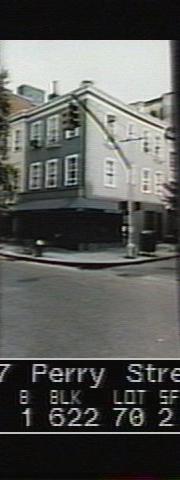
The city photographed every building for its tax records around 1940 and again in the 1980s. NYC Municipal Archives.
Written with AI from the source each entry cites, then fact-checked.
- 1817
Retired clothier Aaron Henry builds two frame houses at Perry and Bleecker, among the Village's earliest
Aaron Henry, a retired clothier, bought an irregular tract bounded by present-day West 11th, Perry and Bleecker Streets in 1815, then built nine houses on it, including this corner house and its neighbor in 1817-18. They were shallow two-story wooden buildings, and the tract passed to Samuel Torbert in 1820. Stores and a third floor were added in the late 19th century, and stucco now hides the frame.
- 1858
A fire starts in the dyeing room of the corner's buckram factory
By 1858 James Black was making buckram, a stiff fabric, on the ground floor; the family of a smith had lived upstairs a few years earlier. The New York Times reported that a fire broke out at 8:00 on the evening of March 10 in the dyeing room, caused by a defective flue. It was put out quickly and did little damage to the wooden building.
Source: Daytonian in Manhattan
- 1879
The Flannery brothers open a saloon in the ground-floor store
In 1879 the owner, John H. Timm, leased the corner store to Thomas, Joseph and John Flannery, who also ran saloons on Hudson, Third Avenue and Greenwich Street. Their bar stayed until 1897, when a May 11 auction sold off its ash counters, back bar mirrors and ice house. Later saloon tenants came and went quickly, with fixtures auctioned again in 1903.
Source: Daytonian in Manhattan
- 1918
A fishing tackle shop takes over the corner and advertises "No Bait"
After years of short-lived saloons, the Polimeni fishing tackle store occupied the ground floor by 1918. Its advertisements promised rods and lures but stated plainly that no bait was sold. In 1934 the building's wooden front was covered with stucco, and by then the Waverly Grocery had taken the space.
Source: Daytonian in Manhattan
Further reading
- The 1817 385 Bleecker StreetDaytonian in Manhattan
- Then & Now photos: 385 Bleecker Street (aka 87 Perry Street)Village Preservation: Greenwich Village Then & Now
Nearby
- 387 Bleecker Street1 entry
- 389 Bleecker Street1 entry
- 391 Bleecker Street1 entry
- El Rastro building (88 Perry Street)383 Bleecker Street | 3 entries
- 393 Bleecker Street3 entries
- 388 Bleecker Street1 entry