Excelsior Power Company Building
88 Fulton Street | also 29 Gold Street, 33 Gold Street, 82 Fulton Street | Financial District | built 1900
Open on the map10 entries

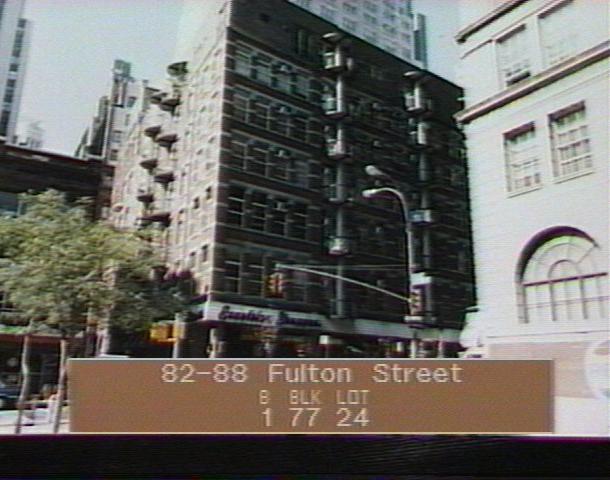
The city photographed every building for its tax records around 1940 and again in the 1980s. NYC Municipal Archives.
Written with AI from the source each entry cites, then fact-checked.
- 1882
American Heating and Power begins a Gold Street steam plant, but a pipe explosion and receivership follow
In 1882 the American Heating and Power Company had architect William C. Gunnell file plans for a four-story, $150,000 steam works on this Gold Street site. By June it had laid half a mile of pipe under nearby streets, but in early November a blast from its John Street main frightened pedestrians and coated buildings in lampblack. The firm was in receivership by May 1883; when Excelsior took over the site in 1887, the work had reached just part of the basement and the lower two stories.
- 1888
Leo Daft builds a ten-ton, 250-horsepower dynamo for the plant, billed as the world's largest
By the end of 1888 inventor Leo Daft was already building much larger dynamos for the Gold Street building than its first generators. One was a 250-horsepower, ten-ton machine, reported at the time to be the largest dynamo in the world.
- 1888
Martin B. Brown builds a power plant disguised as a Romanesque office block
Printer and city official Martin B. Brown hired architect William Milne Grinnell to design a seven-story red-brick building with round arches and terra cotta trim to house his Excelsior Steam Power Company, which converted steam into electricity for nearby businesses. It ranks among Manhattan's oldest surviving buildings put up specifically for commercial power generation.
Source: Daytonian in Manhattan
- 1888
The plant's dynamos begin supplying power to the block
The Excelsior plant's dynamos went into operation, delivering direct-current electricity to tenants in the surrounding Fulton and Gold Street neighborhood. The building is now recognized as Manhattan's oldest known structure built specifically for commercial power generation.
Source: Wikipedia
- 1891
A printing exhibition inside shows off a 40,000-an-hour press
Tenants of the building staged an exhibition demonstrating a printing press capable of turning out between 24,000 and 40,000 shop bills an hour, a display of the era's fascination with industrial speed.
Source: Daytonian in Manhattan
- 1895
Excelsior merges with the New York Heat, Light and Power Company
Excelsior joined forces in 1895 with the New York Heat, Light and Power Company, founded four years earlier and said to be the successor of the Daft Electric Light Company. The Gold Street building kept running as the powerhouse of the combined firm. Its customers included a newspaper, the Daily Press, as well as neighborhood factories, offices and the building's own printing and jewelry tenants.
- 1898
A fire on the fourth floor is one of several to hit the building
On June 1, 1898, a printing company on the fourth floor of 33 Gold Street caught fire, causing $3,000 in damage. It followed a July 29, 1894 fire on Fulton Street that damaged the rear of the building, and another blaze came on January 25, 1901. Daytonian in Manhattan notes that the sturdy building never suffered serious structural damage through any of them.
Source: Daytonian in Manhattan
- 1921
A deputy commissioner seizes opium and fake stamps from a jeweler here, who is later nabbed over forged fight tickets
In 1921 Special Deputy Commissioner Carleton Simon confiscated a large amount of opium and counterfeit revenue stamps from the jewelry firm of Sebastian Fagella in the building. Some months afterward Fagella was arrested once more, accused of producing forged tickets for the Dempsey-Carpentier boxing match.
Source: Daytonian in Manhattan
- 1978
Con Edison sells the old power building for apartments
Consolidated Edison, successor to the Excelsior company, sold the building in 1978, and it was converted the following year into a 197-unit residential complex.
Source: Wikipedia
- 2016
The city designates the old power plant a landmark after decades on the calendar
The Landmarks Preservation Commission first considered the building in 1977, but its owner opposed designation. After a late-2015 public hearing, at which most comments favored landmarking, the commission designated it in December 2016. It is the oldest surviving Manhattan building known to have been put up expressly as a commercial power plant.
Source: Wikipedia
Further reading
- Excelsior Power Company BuildingWikipedia
- The 1888 Excelsior Power Company -- 33 Gold StreetDaytonian in Manhattan
Nearby
- 130 William130 William Street | 8 entries
- Insurance Company of North America Building99 John Street | 8 entries
- Engine 6 firehouse (former Engine Co. 32)49 Beekman Street | 6 entries
- Meriden Britannia Co. Building45 Beekman Street | 7 entries
- 19 Dutch19 Dutch Street | 3 entries
- Peck Slip Retail Post Office116 John Street | 4 entries