The Octagon
888 Main Street | Roosevelt Island | built 1975
Open on the map12 entries

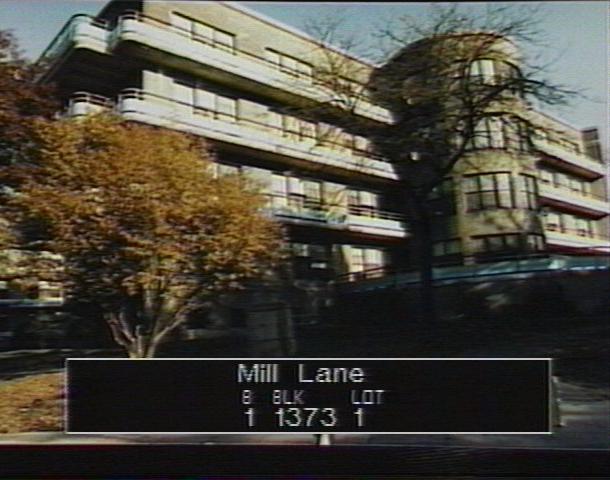
The city photographed every building for its tax records around 1940 and again in the 1980s. NYC Municipal Archives.
Written with AI from the source each entry cites, then fact-checked.
- 1834
Alexander Jackson Davis designs the domed rotunda entrance
Davis designs a five-story octagonal rotunda faced in blue-gray stone quarried on the island, built as the entrance to a new asylum. The rotunda later becomes the only piece of the hospital complex to survive into the 21st century.
Source: Wikipedia
- 1837
Construction halts over design disputes and resumes with Davis's grand plan cut down
Work on the asylum had barely started when the City Council ordered it stopped over disagreements about the design. When it resumed in 1837, Davis's great U-shaped scheme, with a pair of octagons, was reduced to one octagon joined to one east-west wing. A crenelated cupola was added, the details were switched to Greek Revival, and the building became the administrative center, main entrance and residence of the resident physician.
- 1841
The Octagon opens as the entrance to the city's insane asylum
The building becomes the main entrance to the New York City Lunatic Asylum, which is folded into the Metropolitan Hospital system in 1894. It continues serving as the hospital's principal entrance for more than a century, until Metropolitan Hospital closes in 1955.
Source: Wikipedia
- 1842
Charles Dickens tours the asylum, admires the Octagon and finds the wards listless
Charles Dickens toured the Blackwell's Island Lunatic Asylum during his 1842 trip to the United States. He called the building handsome and singled out the Octagon as an especially elegant feature. In American Notes, though, he wrote that everything inside had a 'lounging, listless, madhouse air' that he found very painful.
“…he was taken on a tour of the Blackwell's Island Lunatic Asylum where he much admired the architecture…”
- 1850
Hired orderlies and nurses replace penitentiary inmates as the asylum's attendants
In the asylum's early years patients were watched over by inmates from the island's penitentiary, under a small medical staff. The physicians deplored this arrangement, and a proper corps of orderlies and nurses did not arrive until 1850, when the city hired one. Treatment leaned on work and recreation: male patients gardened or built sea walls to reclaim land, women sewed and helped with housekeeping, a library was formed, and weekly dances were held.
- 1879
Architect Joseph M. Dunn caps the Octagon with a mansard dome
In 1879 Joseph M. Dunn was commissioned to alter the asylum. He raised the wings a story and capped the Octagon with a convex, dome-like mansard roof with neo-Grec detail, so that it would keep its visual prominence. He also built a new main entrance with a double staircase. The landmarks report notes that the added dome changed the silhouette and proportions of Davis's design.
“He raised the wings one story in height…”
- 1887
Nellie Bly goes undercover in the Blackwell's Island asylum
In 1887 reporter Nellie Bly had herself committed to the women's lunatic asylum on Blackwell's Island, the institution whose central tower was the Octagon, on assignment for Joseph Pulitzer's New York World. After ten days the paper got her released. Her articles, collected as Ten Days in a Mad-House, led to a grand jury inquiry and an $850,000 budget increase for the Department of Public Charities and Corrections.
Source: Wikipedia
- 1894
The asylum becomes Metropolitan Hospital as the city's mental patients move to Ward's Island
By 1894 the city had concluded that its own institutions could not properly handle the large number of poor mentally ill people. Ward's Island, also in the East River, was handed over to New York State, and the city's mental patients were sent to hospitals there. The old asylum was renamed Metropolitan Hospital, turning into a general hospital that concentrated on tuberculosis patients.
- 1955
Metropolitan Hospital closes and the Octagon is left abandoned
The hospital shuts its doors, leaving the octagonal building empty for decades despite its 1972 listing on the National Register of Historic Places. Two fires and prolonged decay leave the structure close to ruin before restoration finally saves it in later years.
Source: Wikipedia
- 1970
The asylum's two wings are demolished and the Octagon is saved
By the late 1960s the island's redevelopment project, run by the state Urban Development Corporation, put the old asylum at risk of demolition. On the recommendations of the Landmarks Preservation Commission and a report by historian Henry-Russell Hitchcock, it was decided to keep the central Octagon. The two wings were demolished by 1970, and architect Giorgio Cavaglieri directed temporary measures to protect the Octagon.
“Demolition of the two wings which projected at right angles to the south and west was completed in 1970…”
- 1976
The city designates the Octagon Tower a landmark
After a hearing on November 25, 1975, with three witnesses in favor and none opposed, the Landmarks Preservation Commission designated the Octagon Tower a landmark on March 23, 1976. Representatives of the Roosevelt Island Development Corporation expressed reservations but agreed. The commission called it the only surviving part of the Lunatic Asylum, among the earliest institutions of its type in the country.
“…it is the sole surviving portion of this institution, which was one of the first of its kind established in this country…”
- 2006
The restored Octagon reopens as the lobby of new apartment buildings
Alexander Jackson Davis designed the Octagon as the core of the New York City Lunatic Asylum, which closed in 1955; the tower was designated a city landmark on March 23, 1976. After restoration, it reopened in April 2006 as the entrance lobby for a pair of new apartment buildings with 500 units in total.
Source: Wikipedia
Further reading
- The Octagon (Roosevelt Island)Wikipedia
Nearby
- Brearley School610 East 83rd Street | 4 entries
- 10 Gracie Square6 entries
- Cherokee Apartments516 East 78th Street | 8 entries
- Noguchi Museum9-01 33rd Road | 6 entries
- The Chapin School100 East End Avenue | 9 entries
- Lycée Français de New York502 East 76th Street | 4 entries