9 Carroll Place
New Brighton | built 1845
Open on the map3 entries

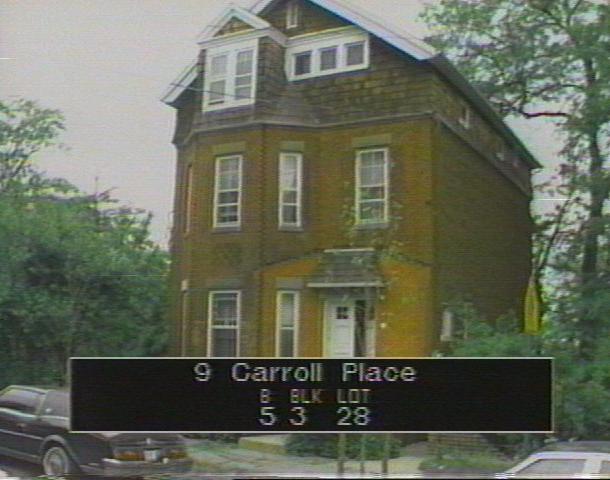
The city photographed every building for its tax records around 1940 and again in the 1980s. NYC Municipal Archives.
Written with AI from the source each entry cites, then fact-checked.
- 1845
Railroad president Samuel R. Brooks builds a carriage house for his mansion
Read more
Samuel R. Brooks, president of the New York and Harlem Railroad and an original officer of the New Brighton Association, built this brick carriage house and servants' quarters between 1836 and 1845. It served his Greek Revival mansion on Richmond Terrace, which he lived in for several years before leasing it out.
“…this building was constructed between 1836 and 1845 as a carriage house and servants' quarters for the now demolished Richmond Terrace mansion of Samuel R. Brooks…”
- 1886
Coal dealer James Crabtree gives the carriage house to his son Herbert to make a home
James Crabtree, whose coal and wood supply company stood on the waterfront nearby, bought the Brooks property in 1886, moved into the mansion and handed the carriage house to his son Herbert. Herbert had it converted into a house by about 1888: the front wall was rebuilt, a large angled bay was added, and a shingled, gabled third story went on top.
“James Crabtree established his residence in the mansion and turned the carriage house over to his son, Herbert, who had it altered for use as a dwelling.”
- 1910
Herbert Crabtree's extended family still fills the converted carriage house
Until at least 1910 Herbert Crabtree shared the house with his wife and four children, along with his sister-in-law and her daughter. By the 1920s the occupants were Dennis and Margaret Gonigal, a boatman and his wife, and their son Frank, who worked as a marine engineer. The building has since been divided into three cooperative apartments.
“Herbert Crabtree and his extended family, consisting of his wife and their four children, his sister-in-law, and her daughter, lived in this house until at least 1910.”
Nearby
- 17 Carroll Place3 entries
- Henry P. Robertson House (Pavilion on the Terrace)404 Richmond Terrace | 4 entries
- 2 Carroll Place4 entries
- 20 Carroll Place3 entries
- 26 Carroll Place2 entries
- 28 Carroll Place2 entries