Edward S. Harkness House
940 5th Avenue | also 1 East 75th Street | Upper East Side | built 1907
Open on the map10 entries

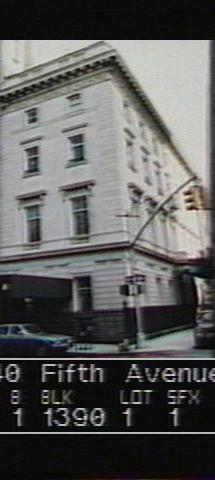
The city photographed every building for its tax records around 1940 and again in the 1980s. NYC Municipal Archives.
Written with AI from the source each entry cites, then fact-checked.
- 1907
James Gamble Rogers designs a restrained marble mansion for Edward Harkness
Edward S. Harkness buys the corner lot at Fifth Avenue and 75th Street in 1906, and in June 1907 plans are filed for a five-story residence by the architects Hale and Rogers, estimated at $250,000. Rogers designs a Tennessee marble Italian Renaissance palazzo facing 75th Street, behind an iron fence modeled on the Scaliger tombs of Verona. Inside are a Louis XVI reception room and a rosewood-paneled library, but the Harknesses, who dislike ostentation, include no ballroom.
Source: Daytonian in Manhattan
- 1909
The Harkness house is finished for $550,000 after a neighbor gives up the address No. 1
The mansion is completed in 1909 at a cost of $550,000. Edward Harkness wanted the prestigious address 1 East 75th Street, which then belonged to Stuart Duncan's house next door, and Duncan's number was changed to 3. Such renumberings were common on the Upper East Side, where low numbers facing Fifth Avenue were considered more desirable.
Source: Wikipedia
- 1916
Harkness gives the Met Museum an ancient Egyptian tomb
The Times reports on January 30, 1916 that the 4,500-year-old tomb of Perneb is now in the Metropolitan Museum of Art, presented by Edward S. Harkness. The next year he gives the museum a small blue faience hippopotamus dating to about 1950 BC. The figure, known as William, has become a well-known piece in the museum's Egyptian collection.
Source: Daytonian in Manhattan
- 1923
Edward Harkness helps finance Howard Carter's Tutankhamun excavation
After inheriting roughly $60 million in Standard Oil stock from his brother Charles in 1916, Edward Harkness and his wife Mary help finance Howard Carter's second excavation season at Tutankhamun's tomb, in the winter of 1923-24. The couple arrive in Egypt in December 1923 and visit the tomb the following day, according to the journal of the archaeologist Arthur Mace.
Source: Daytonian in Manhattan
- 1940
Edward Harkness dies in the house, and his funeral is held there
Edward Harkness, the oil heir and philanthropist, dies at the mansion in January 1940, and his funeral is hosted there shortly afterward. He leaves the mansion, along with the bulk of its furnishings, to his wife Mary, while the books, art and manuscripts are set aside for the New York Public Library and the Metropolitan Museum of Art after her death.
“Edward Harkness continued to live at the house until he died there on January 29, 1940; his funeral was hosted there shortly afterward.”
Source: Wikipedia
- 1940
Harkness's will sends his estate to charity after his widow's death
Edward Harkness's will directs that his estate go to charitable and educational institutions when his wife Mary dies. The couple, who had a reputation for avoiding publicity, had given away money for decades, including funding for Harvard and Yale residential colleges. Mary continues to live in the mansion.
Source: Daytonian in Manhattan
- 1950
Mary Harkness dies in the mansion and her art collection goes to the Met
Mary Harkness dies on June 7, 1950, in the palazzo of white marble where she had lived for 43 years. The Harkness fortune of $60 million goes to charities, and the Metropolitan Museum of Art receives her art collection, including works by Sir Thomas Lawrence, Constable and Hans Holbein the Younger.
Source: Daytonian in Manhattan
- 1950
The Commonwealth Fund inherits the mansion after Mary Harkness dies
Edward Harkness dies on January 30, 1940, and his will directs that his estate go to charitable and educational institutions on the death of his wife. Mary Harkness dies in the house on June 7, 1950, and the $60 million fortune is distributed to charities. The mansion goes to the Commonwealth Fund, founded in 1918 by Edward's mother, Anna Harkness, which still occupies it.
Source: Daytonian in Manhattan
- 1952
The Commonwealth Fund moves in and turns servants' rooms into offices
In 1952, two years after Mary Harkness's death, the house becomes the headquarters of the Commonwealth Fund, a philanthropic foundation set up in 1918 by Mrs. Stephen V. Harkness for the welfare of mankind. The Landmarks Preservation Commission later notes that the only architectural change has been converting the servants' rooms into offices.
- 1967
The city designates the Harkness House a landmark
After a public hearing on November 10, 1966, at which two witnesses speak in favor and none against, the Landmarks Preservation Commission designates the Harkness House a landmark. It calls the house one of the few remaining New York residences designed as an Italian Renaissance palazzo, with masonry and carved ornament by fine craftsmen.
Further reading
- Edward S. Harkness HouseWikipedia
- The Edward S. Harkness Mansion - 1 East 75th StreetDaytonian in Manhattan
Nearby
- McCready House4 East 75th Street | 5 entries
- 930 Fifth Avenue930 5th Avenue | 7 entries
- Clarence Whitman Mansion7 East 76th Street | 3 entries
- 927 Fifth Avenue927 5th Avenue | 7 entries
- Joseph Pulitzer House11 East 73rd Street | 4 entries
- Breuer Building (945 Madison Avenue)945 Madison Avenue | 13 entries