Joseph Pulitzer House
11 East 73rd Street | also 7 East 73rd Street | Upper East Side | built 1903
Open on the map4 entries

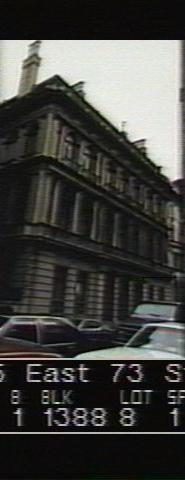
The city photographed every building for its tax records around 1940 and again in the 1980s. NYC Municipal Archives.
Written with AI from the source each entry cites, then fact-checked.
- 1903
Stanford White designs a soundproof palace for the blind Pulitzer
After an 1900 fire destroyed his previous home, newspaper publisher Joseph Pulitzer hired architect Stanford White to design a new mansion modeled on Venice's Palazzo Pesaro and Palazzo Rezzonico, completed in 1903 at a cost of $369,000. Because Pulitzer was nearly blind and highly sensitive to noise, White fitted his private rooms with triple-paned windows and heavily insulated walls, and built scale models so his client could review the design by touch.
Source: Daytonian in Manhattan
- 1904
A thick-walled annex is built to shield Pulitzer from street noise
In 1904, builders added a one-story extension at the far end of Pulitzer's side garden, set as far from the street as possible and built with massive walls and just one small window, after earlier soundproofing failed to quiet the noise-sensitive publisher. According to one magazine account, Pulitzer was so sensitive to sound that even the striking of a match could send him into what was described as spasms of suffering.
Source: Ephemeral New York
- 1911
Joseph Pulitzer dies after seven years in the mansion
Joseph Pulitzer died in 1911, after living in the mansion since 1904. The Pulitzer family retained ownership of the property until 1934. Two later plans to demolish the mansion for a modern apartment building, in 1930 and 1952, both fell through.
Source: Wikipedia
- 1937
The Pulitzer mansion is divided into apartments
In 1937, the long-vacant Pulitzer mansion was converted into seventeen apartments, preserving Stanford White's limestone facade while turning even its squash court and basement pool into living space. By the early 1950s, new owners had converted the building into cooperative apartments. The mansion's 50-foot ballroom and electro-pneumatic organ had been among its grandest original features.
Source: Daytonian in Manhattan
Further reading
- Joseph Pulitzer HouseWikipedia
- The 1903 Joseph Pulitzer Mansion -- No. 11 East 73rd StreetDaytonian in Manhattan
- A newspaper magnate builds a soundproof, Venetian-style mansion steps from Fifth AvenueEphemeral New York
Nearby
- 927 Fifth Avenue927 5th Avenue | 7 entries
- Oliver Gould Jennings House7 East 72nd Street | 10 entries
- 930 Fifth Avenue930 5th Avenue | 7 entries
- Madison Avenue Presbyterian Church921 Madison Avenue | 8 entries
- McCready House4 East 75th Street | 5 entries
- Breuer Building (945 Madison Avenue)945 Madison Avenue | 13 entries