960 Fifth Avenue
960 5th Avenue | also 3 East 77th Street, 1A East 77th Street, 962 5th Avenue | Upper East Side | built 1928
Open on the map9 entries

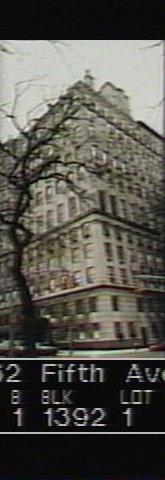
The city photographed every building for its tax records around 1940 and again in the 1980s. NYC Municipal Archives.
Written with AI from the source each entry cites, then fact-checked.
- 1899
Senator William A. Clark tells the Times he is building on Fifth and 77th mainly because a daughter lives in the city
Having arrived in New York in the 1890s, the Montana copper magnate William A. Clark settles for the northeast corner of Fifth Avenue and 77th Street, with 77 feet on the avenue and 250 on the side street. In 1899 he tells The New York Times that one of his daughters living in the city is the main reason he is building. His mansion here is the one later demolished for 960 Fifth.
Source: The New York Times
- 1911
A court agrees that Clark's mansion has no market value for tax purposes
Clark sues in 1911 to cut the assessed valuation of his Fifth Avenue house, then set at $3 million, although he had spent perhaps $7 million on it. The court accepts his argument that few if any buyers could afford such grandeur and finds that the house had no market value on its own. An editor of The Architect had already called the place the House of a Thousand Cartouches.
Source: The New York Times
- 1925
William A. Clark dies in his Fifth Avenue mansion, one of the 50 richest men in America
At 86, the former senator and copper tycoon William A. Clark dies in his bedroom in the mansion at Fifth Avenue and 77th Street. His widow Anna and daughter Huguette later move to 907 Fifth Avenue and sell the house. The apartment tower now known as 960 Fifth takes its site.
Source: Daytonian in Manhattan
- 1927
The Clark mansion opens to the public for charity before its auction and demolition
Ahead of the auction of its furnishings and its demolition, the Clark mansion admits visitors between February 20 and March 1, 1927, and the admission fees go to charity. Soon afterward the hulking house, only about two decades old, is torn down. An apartment building rises on the site.
Source: Daytonian in Manhattan
- 1927
Anthony Campagna buys the Clark site and has Warren & Wetmore and Rosario Candela design 960 Fifth
Anthony Campagna buys the Clark mansion for $3 million in 1927 and razes it. The new 15-story cooperative is designed by Warren & Wetmore with Rosario Candela as supervising architect, and the decorator Dorothy Draper consults. Apartments average 14 to 17 rooms with eight maids' rooms, and 60 smaller rental units are reached from 77th Street.
“The new building was designed by Warren & Wetmore, who were responsible for Grand Central Terminal and the supervisory architects was Rosario Candela…”
Source: Wikipedia
- 1928
Over 75 percent of 960 Fifth's apartments sell before the frame is enclosed, one for a record $450,000
Originally priced from $130,000 to $325,000, the cooperative apartments are snapped up while the steel is still going up. Dr. Preston Pope Satterwhite reportedly pays $450,000 for his 20-room apartment, considered the most expensive cooperative sale yet made. Douglas L. Elliman handles the sales for Campagna.
“…more than 75 percent of the apartments were sold before the frame of the building was enclosed…”
Source: Wikipedia
- 1985
Ann Getty hosts a classical concert in the dining room, with a loud dishwasher for accompaniment
By the 1980s the building's kitchen had been losing about $100,000 a year until management began renting out the dining room for parties. In 1985, Ann Getty hosts a classical concert there for guests including the media mogul William Paley and the Metropolitan Opera's Schuyler Chapin. The performance is apparently interrupted by a loud dishwasher.
Source: curbed.com
- 2014
Edgar Bronfman's penthouse sells for a then-record $70 million co-op price
After the former Seagram chairman Edgar Bronfman Sr. lived in his 16-room penthouse for 40 years until his death in 2013, the apartment is listed for $65 million. It is bought by Nassef Sawiris, chief executive of Orascom Construction Industries, for a reported $70 million, the most expensive co-op sale in New York at the time.
Source: Wikipedia
- 2017
An art dealer's 22-room third-floor co-op sells for $55 million; he had adopted Claus von Bulow's dog
The estate of the Asian-art dealer Robert H. Ellsworth sells his palatial third-floor apartment at 960 Fifth for $55 million, the priciest closed sale of May. Ellsworth, who called the home his honey pot, had lived there more than three decades. The Times notes that residents over the years included Edgar Bronfman and Claus von Bulow, whose dog Ellsworth adopted after von Bulow's arrest.
Source: The New York Times
Further reading
- 960 Fifth AvenueWikipedia
Nearby
- The Mark Hotel992 Madison Avenue | 5 entries
- Clarence Whitman Mansion7 East 76th Street | 3 entries
- James B. Duke House970 5th Avenue | 11 entries
- Payne Whitney House972 5th Avenue | 7 entries
- Stuyvesant Fish House1012 Madison Avenue | 9 entries
- Fletcher-Sinclair Mansion2 East 79th Street | 11 entries