Payne Whitney House
972 5th Avenue | Upper East Side | built 1906
Open on the map7 entries

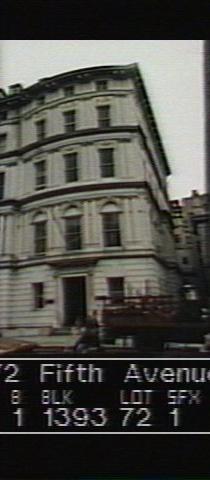
The city photographed every building for its tax records around 1940 and again in the 1980s. NYC Municipal Archives.
Written with AI from the source each entry cites, then fact-checked.
- 1902
Payne Whitney's wedding brings a Fifth Avenue mansion from his uncle
Payne Whitney and Helen Hay marry on February 6, 1902, in Washington, DC, where the gift of a Fifth Avenue mansion is announced with the donor's name kept secret. The Times soon reveals that Whitney's uncle, the Civil War colonel Oliver H. Payne, has bought a 70-by-100-foot plot between 78th and 79th Streets, which it values at $525,000. Stanford White, a guest at the wedding, is hired to design the house.
Source: Ephemeral New York
- 1905
Stanford White and the Whitneys buy European furnishings for the Venetian Room
Stanford White designed the Venetian Room, just off the rotunda, to evoke a hall of mirrors framed in gilded rococo. The French firm Allard et fils built it through its New York office, and White and the Whitney family bought its furnishings in Europe during the summer of 1905. By the 1930s Helen Hay Whitney was calling it the Venetian Room.
Source: villa-albertine.org
- 1909
Stanford White's mansion is finished three years after his murder
Stanford White of McKim, Mead & White designs a five-story, High Italian Renaissance mansion at 972 Fifth Avenue, with a rotunda inspired by the portico of Rome's Villa Giulia. White is murdered in June 1906, and the house is completed in 1909. It has 40 rooms and 11 bathrooms, some with marble baths.
Source: Wikipedia
- 1946
Parke-Bernet auctions off the mansion's artworks and furnishings for $101,386
After Helen Hay Whitney died in 1944, the ground floor was shut and its windows were boarded over. Parke-Bernet Galleries sold many of the artworks, furnishings and architectural details at auction on February 7 and 8, 1946. The first day took in $31,119 and the second $70,267, a total of $101,386, yet many original furnishings stayed and a caretaker was hired to look after them.
Source: Wikipedia
- 1952
France buys the mansion for its cultural services in New York
After Payne Whitney's death in 1927 and Helen Hay Whitney's in 1944, her son Jock Whitney sells the house in 1949, and by 1950 it is divided into suites and doctors' offices. In 1952 the property passes to the Republic of France, and the Cultural Services division of the French embassy uses it. The Albertine bookstore and reading room opens in the house in 2014.
Source: Wikipedia
- 1970
The Landmarks Preservation Commission designates the Payne Whitney House a landmark
The Landmarks Preservation Commission held its public hearing on the Payne Whitney House on June 23, 1970, and Manhattan Community Board 8 told it that the board favored designation. The commission designated the mansion a landmark on September 15, 1970. Its report called the house the town residence of Payne Whitney, standing on the last remaining blockfront of imposing town houses on Fifth Avenue.
- 1996
An art historian identifies the rotunda's Young Archer as a Michelangelo
The marble Young Archer in the rotunda was bought by Stanford White after it failed to sell at a 1902 London auction, and it stayed relatively unnoticed until 1990. In 1996 Kathleen Weil-Garris Brandt of New York University's Institute of Fine Arts, after visiting a French Cultural Services exhibition, identified it as a genuine Michelangelo. The statue went on loan to the Met in 2009, and a replica now stands in the rotunda.
Source: Wikipedia
Further reading
- Payne Whitney HouseWikipedia
- The Fifth Avenue wedding present gifted to these rich Gilded Age newlywedsEphemeral New York
Nearby
- Fletcher-Sinclair Mansion2 East 79th Street | 11 entries
- James B. Duke House970 5th Avenue | 11 entries
- 960 Fifth Avenue960 5th Avenue | 9 entries
- Stuyvesant Fish House1012 Madison Avenue | 9 entries
- The Mark Hotel992 Madison Avenue | 5 entries
- The Stanhope995 5th Avenue | 6 entries