97 Wooster Street
SoHo | built 1897
Open on the map5 entries

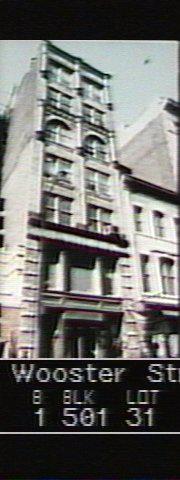
The city photographed every building for its tax records around 1940 and again in the 1980s. NYC Municipal Archives.
Written with AI from the source each entry cites, then fact-checked.
- 1867
The house on this lot becomes a branch YMCA for Black boys, independent of the city association
In 1867 No. 97 Wooster Street, then a brick house, was converted into a Young Men's Christian Association branch for "colored" boys only. The New York Times later described it as separate from the city's YMCA, though the two worked together. The club stayed at least until 1889, after which the old houses on the block were torn down for loft buildings.
Source: Daytonian in Manhattan
- 1897
George Pelham finishes a seven-story Romanesque Revival loft with carved faces and fern-capped columns
Louisa and Samuel Friedline, a real estate buyer and a builder, bought the 25-foot lot in April 1896 for a seven-story warehouse and hired George F. Pelham as architect. Completed in November 1897, it has a two-story cast-iron storefront framed in beige brick. Carved faces hold up engaged columns on the fifth floor, and the entablature above the second floor looks like an unrolled fluted column.
Source: Daytonian in Manhattan
- 1903
Firefighters rescue three trapped workers by hoisting a ladder from the neighboring firehouse roof
Late on May 11, 1903 a fire broke out on the fifth floor while manufacturer Benjamin Lustgarten and two employees worked on the seventh. Next door at No. 99 Wooster was the firehouse of Engine Company 13, and Lt. George J. Irving climbed to its roof, raised a scaling ladder with a rope, and climbed to the seventh floor. The Tribune reported that he handed the men down, with Lustgarten partly overcome by smoke.
Source: Daytonian in Manhattan
- 1968
Six artists who work in the building stage a group show in an empty studio lent by the landlord
By the late 1960s the loft building, once a muslin underwear factory, had artists working in it. The New York Times reported in April 1968 that May Stevens, Bob Pittenger, George Gillson, Rudolph Baranik, Tony Balzano and Sue Aitkin had put on a three-weekend group show the previous month. They used an empty studio lent by the landlord, part of the early loft art scene that became SoHo.
Source: Daytonian in Manhattan
- 1972
A.I.R. Gallery, the first women's cooperative gallery in the United States, opens with a show by all twenty founders
Twenty women artists, among them Nancy Spero, Howardena Pindell, Harmony Hammond and Agnes Denes, rented a 70-foot space here with peeling plaster and warped floors and readied it with their own carpentry and wiring skills. A.I.R. Gallery opened to the public on September 16, 1972 with a group exhibition featuring every member.
Source: thefeministinstitute.org
Further reading
- George Pelham's 1897 No. 97 Wooster StreetDaytonian in Manhattan
Nearby
- Gay Activists Alliance Firehouse (former Engine Company No. 13)99 Wooster Street | 6 entries
- Josiah Purdy House143 Spring Street | 5 entries
- 145 Spring Street1 entry
- 147 Spring Street2 entries
- 101 Wooster Street1 entry
- 149 Spring Street2 entries