Gay Activists Alliance Firehouse (former Engine Company No. 13)
99 Wooster Street | SoHo | built 1888
Open on the map6 entries

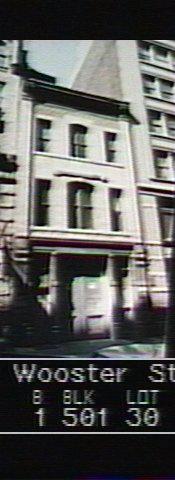
The city photographed every building for its tax records around 1940 and again in the 1980s. NYC Municipal Archives.
Written with AI from the source each entry cites, then fact-checked.
- 1865
The volunteers of Oceanus Engine Company 11 give way to Metropolitan Engine Company 13
Until the Civil War ended, 99 Wooster Street housed Oceanus Engine Company 11, with 45 volunteer firefighters. In 1865 the state reorganized the city's fire service as the Metropolitan Fire Department, which the city took over in 1870. The Wooster Street house became known as Metropolitan (Steam) Engine Company 13.
- 1881
Napoleon Le Brun & Son rebuild the firehouse in a job that runs from April 1881 to March 1882
Napoleon Le Brun & Son redesigned the building in a job that began in April 1881 and was completed in March 1882. The firm designed roughly 40 fire department buildings between 1865 and 1895. The facade mixes neo-Grec and Queen Anne elements, with a cast-iron ground story built around a single apparatus bay, red brick above, and a grid of terra-cotta rosettes below the cornice. It matches the former firehouse at 173 Franklin Street in Tribeca.
- 1903
Lieutenant George Irving ladders three trapped workers out of the factory next door
On May 11, 1903 a window blew out on the fifth floor of the factory at No. 97 Wooster Street, next to the firehouse. Lieutenant George J. Irving climbed to the firehouse roof and dropped a rope, which firefighters below used to send up a scaling ladder. He ran the ladder up floor by floor to three men trapped on the seventh floor, petticoat maker Benjamin Lustgarten and two employees, and handed them down. Lustgarten was partly overcome by smoke but revived.
Source: Daytonian in Manhattan
- 1971
The Gay Activists Alliance signs a lease and names the old firehouse the GAA Firehouse
The Gay Activists Alliance signed a lease on 99 Wooster Street on April 20, 1971, with Congresswoman Bella Abzug and Councilmember Carter Burden as references. Two days later members voted to call the center the GAA Firehouse and to return it to something near its original condition. Volunteers did much of the renovation, the cast-iron ground floor was painted fire-engine red, and the center opened in June during Gay Pride Week. The historian Charles Kaiser called it the first gay community center in Manhattan.
- 1971
Thursday meetings, Saturday dances and Firehouse Flicks fill the GAA Firehouse
The GAA held its general meetings at the firehouse on Thursdays, dances on Saturdays and a film series called Firehouse Flicks on Fridays, organized by arts committee chair Vito Russo, who later wrote The Celluloid Closet. The dances took place on the ground floor, whose high ceiling dated from the days of the fire trucks, and drew hundreds of people. They earned money for the group and attracted new members, though some feared they would pull attention from its political mission.
- 1974
Arson burns the upper floors of the GAA Firehouse, and the group is evicted
On October 8, 1974 a fire set in six places, according to the New York Times, destroyed the second- and third-floor offices, with an estimated 30 to 50 percent damage. GAA president Morty Manford called it part of a wave of harassment against gay people, while founder Arthur Bell suggested factional strife and the burden of the $1,500 monthly rent might have played a part. The group was evicted afterward, and by June 1975 the building had been renovated and was available to new tenants.
Further reading
- Engine Company No. 13 -- No. 99 Wooster StreetDaytonian in Manhattan
Nearby
- 97 Wooster Street5 entries
- 101 Wooster Street1 entry
- 149 Spring Street2 entries
- 145 Spring Street1 entry
- 147 Spring Street2 entries
- Josiah Purdy House143 Spring Street | 5 entries