The Frick Collection
1 East 70th Street | also 10 East 71st Street, 895 5th Avenue | Upper East Side | built 1914
Open on the map15 entries

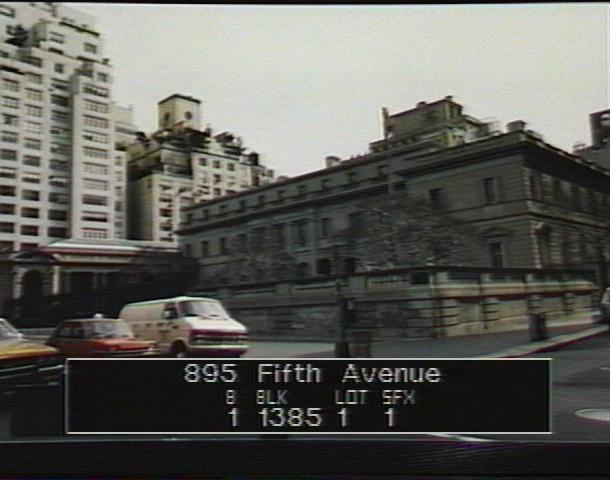
The city photographed every building for its tax records around 1940 and again in the 1980s. NYC Municipal Archives.
Written with AI from the source each entry cites, then fact-checked.
- 1912
Frick offers to move the Lenox Library to Central Park, then withdraws after protests
Frick gained ownership of the Lenox Library plot on May 21, 1912, and five days later it was announced that the library would be torn down. He offered to move the old building to the Arsenal site in Central Park, and the Municipal Art Commission approved the relocation that June. Protests from civic and social groups followed, and Frick withdrew the offer that same month. Workers began razing the library in July, clearing the lot for his mansion. This entry concerns the earlier building on the site.
Source: Wikipedia
- 1914
Henry Clay Frick moves into his new Fifth Avenue mansion
Henry Clay Frick bought the former Lenox Library site in 1906 for almost $2.5 million and commissioned Thomas Hastings of Carrere & Hastings to design a limestone mansion in the Beaux-Arts style. His family began moving in on November 16, 1914. The house and land were then worth about $3.1 million.
Source: Wikipedia
- 1915
Morgan's Fragonard panels leave the Metropolitan Museum for Frick's new galleries
On March 15, 1915, the New-York Tribune reported that the public had taken its last look at the Fragonard panels from J. P. Morgan's collection, which were to be carried that day from the Metropolitan Museum to Frick's residence. Frick admired the series so much that he had his architects design a Louis XVI-style room to hold it. According to Daytonian in Manhattan, he paid about $1.5 million for the fourteen panels.
Source: Daytonian in Manhattan
- 1915
Twenty-seven servants keep the Frick household running in 1915
The 1915 census recorded 27 servants living with the Fricks, among them butlers, footmen, maids, cooks and laundresses, and the third floor held their rooms. Early that year the family began entertaining, inviting steel executives, collectors and art-trade figures to the new house. They settled into a routine of two formal dinners a week in the dining room.
Source: Wikipedia
- 1917
French Marshal Joffre visits the Frick mansion during World War I
The mansion hosted French dignitaries including Marshal Joseph Joffre during a May 1917 wartime visit to New York. Two years later, Frick opened his lawn so wounded soldiers could view the city's 1919 Victory Day parade.
Source: Daytonian in Manhattan
- 1919
Frick puts up a covered stand outside his mansion for wounded soldiers to watch the victory parade
About 21,000 soldiers reached New York in March 1919 to a round of celebrations, and the city arranged places along Fifth Avenue for the wounded who could not march. The New-York Tribune reported that men well enough to move around would watch from a covered stand Frick had built in front of his Lenox Hill home. Those more severely wounded were to be seated on trucks parked at the crossings farther south.
Source: Daytonian in Manhattan
- 1919
Henry Clay Frick dies five years after moving in
Frick died of a heart attack on December 2, 1919, only five years after moving into the mansion. His funeral was held at the house the next day, and his widow Adelaide kept living there until her death in 1931.
Source: Wikipedia
- 1920
The Frick Art Reference Library is organized inside the mansion
Frick's trustees organized the Frick Art Reference Library at the house in 1920, soon after his death. At first its staff worked in the main house's basement. A dedicated library building next door opened in 1924.
Source: Wikipedia
- 1924
The Frick Art Reference Library opens in its own building, with a front door hung backward
The Frick Art Reference Library moved into a new building beside the mansion in June 1924. Thomas Hastings's design left the front stoop without a landing, so anyone waiting outside risked being struck when the door swung open, and the door had to be hung in reverse. That flaw and others prompted angry letters from Adelaide and Helen Frick, and in 1926 Helen vowed never to hire Hastings again.
“As built, the stoop outside the library's front entrance had no landing... the front door had to be installed in reverse.”
Source: Wikipedia
- 1931
Adelaide Frick dies, and the mansion's conversion into a museum begins
Adelaide Frick died on October 4, 1931, aged 71. During her last two years she was mostly ill, and in the seven months a year she lived in the house she saw only family and close friends. Her nephew Karl Overholt told a reporter that the place was closer to a museum than a home, since even the few second-floor rooms she used held pieces of the collection. Her death let the trustees go ahead with Henry Frick's plan, and John Russell Pope was hired to remake the house.
Source: Daytonian in Manhattan
- 1935
The Frick Collection opens as a museum in the former Frick mansion
After Adelaide Frick's death in 1931, the trustees hired architect John Russell Pope to convert the house into a museum, as Henry Frick's will provided. The Frick Collection had a soft opening on December 11, 1935, and opened officially to the public five days later. Its paintings include works by Rembrandt, Titian, Velazquez and Fragonard.
Source: Wikipedia
- 1941
A reinforced-concrete vault under the mansion doubles as an art store and a bomb shelter
In March 1941 museum officials filed plans for a concrete vault beneath the Frick house. It held the most valuable objects in the collection and also served as a bomb shelter, because World War II air raids on the city were a worry. The vault measures about 30 by 80 feet, with walls a foot thick and a roof three feet thick.
“The vault doubled as an art storage facility and a bomb shelter…”
Source: Wikipedia
- 1973
The Landmarks Commission designates the Frick Collection and its library as a landmark
On March 20, 1973, the Landmarks Preservation Commission designated the mansion at 1 East 70th Street, along with the Frick Art Reference Library at 10 East 71st Street. The commission noted that Frick's house was planned from the start to become a museum. At the 1970 hearing one witness spoke in favor and none opposed, and the Frick Collection itself supported designation.
- 2014
Preservationists fight a six-story annex that would replace the Russell Page garden
In 2014 the museum announced a six-story annex on 70th Street by Davis Brody Bond, which would have swept away the 1970s wing and Russell Page's garden. More than two thousand opponents formed United to Save the Frick, and the Historic Districts Council voted against the plan. The museum abandoned the design in 2015, hired Annabelle Selldorf in 2016, and won Landmarks Commission approval in June 2018 for a scheme that rebuilt the garden.
“Residents and preservationists opposed the proposed demolition of the 70th Street garden, and over two thousand opponents formed a group called United to Save the Frick.”
Source: Wikipedia
- 2025
The Frick reopens its Fifth Avenue house after a four-year renovation
The Frick Collection reopened its Fifth Avenue home on April 17, 2025, after work that ran from 2021 to 2025. The museum describes the project as its first comprehensive renovation and enhancement in nearly ninety years. In his will, Frick named the purpose of the institution as encouraging and developing the study of the fine arts.
Source: frick.org
Further reading
- Henry Clay Frick HouseWikipedia
- The Henry C. Frick Mansion -- No. 1 East 70th StreetDaytonian in Manhattan
Nearby
- Herbert N. Straus House9 East 71st Street | 15 entries
- 907 Fifth Avenue907 5th Avenue | 10 entries
- Rhinelander Mansion867 Madison Avenue | 15 entries
- St. James' Episcopal Church861 Madison Avenue | 7 entries
- Oliver Gould Jennings House7 East 72nd Street | 10 entries
- 720 Park Avenue9 entries