1 Patchin Place
also 1A Patchin Place | West Village | built 1848
Open on the map7 entries

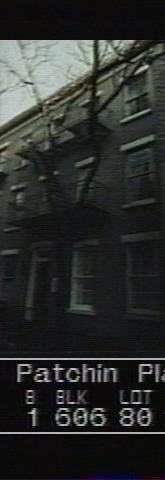
The city photographed every building for its tax records around 1940 and again in the 1980s. NYC Municipal Archives.
Written with AI from the source each entry cites, then fact-checked.
- 1848
Samuel Milligan builds ten workers' houses on a dead-end lane named for his son-in-law
Samuel Milligan started building ten modest houses about 1848 at a dead end off Amos Street, which later became West 10th Street. His surveyor and son-in-law, Aaron Darwin Patchin, gave the lane its name. The brick houses are three stories and three bays wide, with plain stone lintels. No. 1 began as a single-family home for the Laymans, where John worked as a mason and Thomas as a sash maker.
Source: Daytonian in Manhattan
- 1854
The father of painter Ralph Blakelock lives in the crowded house
By 1852 the house was packed with roomers, among them the family of policeman Ralph Blakelock, who stayed at least through 1854. His son Ralph Albert Blakelock was seven that year and later became a noted landscape painter. City directories listed the father as police, though the artist's biographers later called him a physician.
Source: Daytonian in Manhattan
- 1854
A tipped camphene lamp sets a mother ablaze at the family tea table
On the evening of November 23, 1854, the Smith family was at table when their 4-year-old child pulled the tablecloth and overturned a lamp burning camphene, a volatile turpentine-and-alcohol fuel. The spilled fluid caught Mrs. Smith's clothing, and newspapers reported she was badly burned before the flames were put out.
Source: Daytonian in Manhattan
- 1889
A printer living here is killed after a quarrel over thrown ashes on Bleecker Street
On May 18, 1889, printer James Grant Anderson was walking on Bleecker Street with a friend when dirt or ashes landed on two men ahead. William Warren accused Anderson, a fight followed, and Anderson was left unresponsive on the pavement. He was dead when an ambulance arrived, and Warren was arrested and charged with murder.
Source: Daytonian in Manhattan
- 1918
Journalist Louise Bryant leases rooms while John Reed faces sedition charges
In July 1918 Louise Bryant, known for reporting on the Bolsheviks, leased rooms here. Her husband John Reed was charged with sedition and treason, and his articles on the Bolsheviks appeared in The Independent and The Liberator during their stay. The couple moved to 147 West 4th Street that autumn.
Source: Daytonian in Manhattan
- 1918
Village Preservation says John Reed wrote Ten Days That Shook the World here
Village Preservation's biography of Reed says he reportedly wrote Ten Days That Shook the World, his book on the Bolshevik Revolution, while living at 1 Patchin Place. A photo caption on the same page names the house as his home and the place where he wrote it.
Source: Village Preservation
- 1971
The radio production company No Soap Radio sets up its office on the ground floor
After a 1965 renovation made a first-floor apartment, the space became the home base in 1971 of No Soap Radio, Ltd., a newly formed company producing commercial radio. A journalist who stopped by in November 1971 saw a shaggy rug, rocking chairs in chrome and velvet, a fireplace and a poster of a woman he took to be Clara Bow.
Source: Daytonian in Manhattan
Further reading
- The 1850 John Layman House -- 1 Patchin PlaceDaytonian in Manhattan
- Then & Now photos: 1 Patchin PlaceVillage Preservation: Greenwich Village Then & Now
Nearby
- 113 West 10th Street4 entries
- 4 Patchin Place3 entries
- 445 Avenue of the Americas1 entry
- 447 Avenue of the Americas1 entry
- Jefferson Market Library425 Avenue of the Americas | 11 entries
- 453 Avenue of the Americas3 entries