113 West 10th Street
West Village | built 1850
Open on the map4 entries

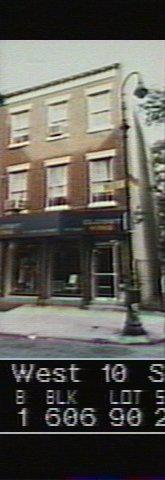
The city photographed every building for its tax records around 1940 and again in the 1980s. NYC Municipal Archives.
Written with AI from the source each entry cites, then fact-checked.
- 1850
Aaron Patchin finishes a corner house-and-shop at the entrance to Patchin Place
Land surveyor Aaron Darwin Patchin, who worked with his father-in-law Samuel Milligan, added four houses with shops at the mouth of Patchin Place in 1848. The corner building, completed in 1850, was first numbered 13 Amos Street and had a store at sidewalk level with two brick floors above. Its upper floors became home to Mary Bretell, a widow who earned her living making or selling bellhangings.
Source: Daytonian in Manhattan
- 1893
Grocer William Maack sends gas balloons over Greenwich Village from 113 West 10th Street
William P. Maack, who kept the grocery in the ground-floor store, became so taken with hot air balloons in the early 1890s that the New York World called him a balloon crank. After a first small balloon carrying a red lantern on July 4, a crowd gathered at Greenwich and Sixth avenues on July 7 to watch another launch. High winds pushed it into a telegraph wire where it burned, but Maack sent up a second large balloon within two hours.
Source: Daytonian in Manhattan
- 1896
Mrs. Patchin and Mrs. Dorsheimer buy 113 West 10th Street at the Milligan auction
The auction of Samuel Milligan's extensive real estate holdings took place in May 1896, but his family was reluctant to let go of Patchin Place. The New York Times reported on May 14 that Mrs. Patchin and Mrs. Dorsheimer secured 113 West Tenth Street, along with the Patchin Place land and buildings, for $81,000.
Source: Daytonian in Manhattan
- 1937
A law office at 113 West 10th Street turns up in gangland court testimony
By the 1930s the address held the law office of Jesse Jacobs, a meeting place for organized gangsters. In 1937 Peter Balitzer testified about a gathering there two years earlier, where names like Tommy Bull, Hungarian Helen and Gypsy Tom came up alongside Davie Betillo, Jimmy Fredericks and Abie Wahrman. He recalled a dispute over about 30 "joints" that bookies were said to be holding back from the list.
Source: Daytonian in Manhattan
Further reading
- The 1850 Mary Bretell House - 113 West 10th StreetDaytonian in Manhattan
- Then & Now photos: 113 West 10th StreetVillage Preservation: Greenwich Village Then & Now
Nearby
- 4 Patchin Place3 entries
- 1 Patchin Place7 entries
- Northeast corner of Greenwich Avenue and West 10th Street18 Greenwich Avenue | 3 entries
- Jefferson Market Library425 Avenue of the Americas | 11 entries
- 24 Greenwich Avenue1 entry
- First home of The Village Voice22 Greenwich Avenue | 2 entries