Jefferson Market Library
425 Avenue of the Americas | also 421 Avenue of the Americas | West Village | built 1877
Open on the map11 entries

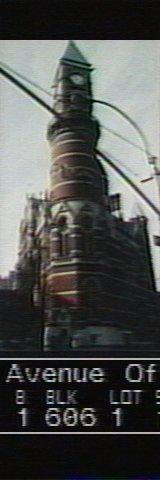
The city photographed every building for its tax records around 1940 and again in the 1980s. NYC Municipal Archives.
Written with AI from the source each entry cites, then fact-checked.
- 1877
Jefferson Market Courthouse is completed
Frederick Clarke Withers and Calvert Vaux designed this High Victorian Gothic courthouse, with its clock tower, for the Third Judicial District.
Source: Wikipedia
- 1885
A national poll ranks Jefferson Market among America's most beautiful buildings
A panel of American architects convened by American Architect and Building News votes Frederick Clarke Withers and Calvert Vaux's High Victorian Gothic courthouse the fifth most beautiful building in the United States. The ranking cements the polychrome brick-and-stone landmark's reputation less than a decade after its completion.
Source: Wikipedia
- 1896
Writer Stephen Crane comes to Jefferson Market court to defend a woman arrested for solicitation
In 1896 the writer Stephen Crane appeared in the Jefferson Market police court on behalf of a woman who had been picked up for solicitation. He had met her, as he put it, while studying human nature. Ephemeral New York lists him among the famous and infamous who stood before the magistrate alongside ordinary defendants.
Source: Ephemeral New York
- 1906
Harry K. Thaw is held without bail here after the killing of Stanford White
Harry K. Thaw, the jealous husband of Evelyn Nesbit, was brought before a judge at Jefferson Market after he shot Stanford White on the roof of Madison Square Garden. The judge ruled that Thaw be held without bail and sent him to the Tombs. Ephemeral New York counts Thaw among the notorious defendants who passed through the police court.
Source: Ephemeral New York
- 1907
The country's first night court opens inside Jefferson Market
To relieve overcrowding from arrests made in the nearby Tenderloin entertainment district, the courthouse begins holding sessions after dark, becoming the first night court in the United States. The court processes a steady stream of minor offenders through the building's police-court wing for decades afterward.
Source: Ephemeral New York
- 1909
Striking shirtwaist workers are brought to Jefferson Market
During the citywide shirtwaist strike, police bring arrested picketers from the garment district to Jefferson Market's police court, where labor organizers charge that the arrests are meant to intimidate strikers. The courthouse becomes a visible stage in the labor conflict then unfolding across Greenwich Village's factory blocks.
Source: Ephemeral New York
- 1917
John Sloan paints the courthouse and haunts its night court
John Sloan, who lived on Washington Place and worked in a high-floor studio on West Fourth Street, painted Jefferson Market, Sixth Avenue in 1917. He put the courthouse into several works, drawn to its spires and roofline set against the elevated trains below. Sloan also visited the night court regularly to watch the drunks, prostitutes and petty offenders brought before the judges, and he found it more stirring than most plays.
Source: Ephemeral New York
- 1927
Mae West is prosecuted at Jefferson Market and sentenced to 10 days
After police raided her play Sex and arrested West along with the cast, she was taken to the Jefferson Market Court House and prosecuted on morals charges. She received a 10-day sentence on April 19, 1927, for corrupting the morals of youth. Although she could have paid a fine and walked free, she chose jail, judging that it would bring publicity.
Source: Wikipedia
- 1958
Margot Gayle starts a neighborhood campaign to save the courthouse, beginning with its clock
Margot Gayle began a community effort in 1958 after hearing that the city might sell the courthouse. Her supporters included Jane Jacobs, Lewis Mumford and Edward Hopper, and they first set out to restart its stopped clocks, meeting in her apartment at 44 West Ninth Street. The clock was running again by 1961, with support from Borough President Edward Dudley and Mayor Robert Wagner.
“…the clock was back in working order by 1961 and Gayle shifted her focus to preserving the building itself.”
Source: Wikipedia
- 1967
Saved from demolition and reopened as a library
After the courts moved out, the building faced demolition. A neighborhood campaign saved it, and it reopened as a branch of the New York Public Library in 1967.
Source: Wikipedia
- 1996
Ol' Jeff, the courthouse fire bell, rings again after 135 years of silence
The fire bell in the tower, known as Ol' Jeff, had been silent for 135 years until 1996, when Margot Gayle, Cynthia Crane and Marilyn Dorato helped bring its voice back. Today it sounds the hours between 9 a.m. and 10 p.m. The New York Times wrote in 1997 that the bell had unexpectedly connected the neighborhood around the building.
“In 1996 "Ol' Jeff", the fire bell, silent in the Tower for 135 years, regained its voice with Margot Gayle's help…”
Source: Wikipedia
Further reading
- Jefferson Market LibraryWikipedia
- Then & Now photos: Jefferson Market CourthouseVillage Preservation: Greenwich Village Then & Now
- What remains of Jefferson Market’s police courtEphemeral New York
- Stained glass beauty at Jefferson Market LibraryEphemeral New York
Nearby
- 1 Patchin Place7 entries
- 113 West 10th Street4 entries
- 445 Avenue of the Americas1 entry
- 447 Avenue of the Americas1 entry
- 4 Patchin Place3 entries
- 432 Avenue of the Americas1 entry