One Sutton Place South
1 Sutton Place South | also 500 East 57th Street, 501 East 56th Street | Sutton Place | built 1926
Open on the map9 entries

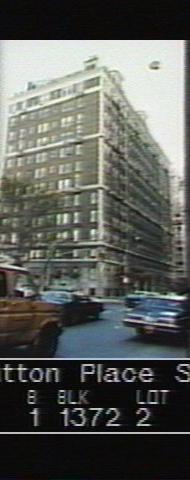
The city photographed every building for its tax records around 1940 and again in the 1980s. NYC Municipal Archives.
Written with AI from the source each entry cites, then fact-checked.
- 1926
Henry Phipps Jr. develops an elite cooperative overlooking the East River
Architects Cross & Cross and Rosario Candela designed this 14-story U-shaped building for developer Henry Phipps Jr., son of Andrew Carnegie's business partner. Completed in 1926 with just 32 apartments of 12 to 13 rooms each, it originally included a tennis court and a private yacht dock on its riverfront lawn.
Source: Daytonian in Manhattan
- 1927
Vincent and Mrs. Astor take winter quarters at 1 Sutton Place South
The New York Times reports on November 20, 1927 that Vincent Astor and his wife have settled into the building for the winter. The paper notes that this stretch of the East River bank now counts an Astor, a Morgan and a Vanderbilt among its social and artistic celebrities. The Astors' stay is meant to be brief, lasting only until their new house at 130 East 80th Street is finished.
Source: Daytonian in Manhattan
- 1927
Frederick and Amy Phipps Guest move into the penthouse
Frederick Guest, a cousin of Winston Churchill, and his wife Amy Phipps Guest occupied the building's duplex penthouse. Vincent Astor and his wife also took a unit that year for the winter season, part of a wave of society families drawn to the new building on Sutton Place.
Source: Daytonian in Manhattan
- 1938
Charlotte Morton, widow of Navy Secretary Paul Morton, dies in her apartment
Charlotte Goodridge Morton dies in her apartment on December 28, 1938, at the age of 80. Her husband Paul Morton, dead for 21 years, had been Secretary of the Navy under Theodore Roosevelt. Her brother-in-law Joy Sterling Morton founded the Morton Salt Company, and her father-in-law had served as Secretary of Agriculture under Grover Cleveland and founded Arbor Day.
Source: Daytonian in Manhattan
- 1945
Jennie Robinson Smith, a friend of Edith Wharton and Sarah Bernhardt, dies in her apartment
Jennie Porter Steele Robinson Smith dies in her apartment on April 7, 1945, aged 87. She grew up in France and counted Alexandre Dumas, Gustav Mahler, Edith Wharton and Sarah Bernhardt among her friends. Her unmarried daughter Gertrude Robinson Smith, a founder of the Berkshire Symphonic Festival that later became Tanglewood, remains in the apartment.
Source: Daytonian in Manhattan
- 1951
Yachtsman Walbridge Smith Taft, a nephew of President Taft, dies in his apartment
Walbridge Smith Taft, an attorney and yachtsman who was a nephew of former President William Howard Taft, dies in his apartment on January 2, 1951, at the age of 66. He had been appointed chairman of the Salvation Army Association in 1940. A heart attack three years earlier had left him never fully recovered.
Source: Daytonian in Manhattan
- 1963
Winston and C. Z. Guest sell the penthouse to philanthropist Janet Annenberg Hooker
Winston Guest and his wife, the garden columnist C. Z. Guest, sell their 17-room penthouse in 1963. Winston had called it the most magnificent apartment in New York City. The buyer is Janet Annenberg Hooker, a philanthropist and the sister of communications mogul Walter Annenberg. The Guests had kept the antique pine boiserie that Amy Guest imported, along with the paneled library and the Queen Anne style dining room.
Source: Daytonian in Manhattan
- 2006
Designer Carolyne Roehm's duplex is profiled in the New York Times
On October 15, 2006, the New York Times journalist Dan Shaw describes the duplex of the designer Carolyne Roehm. Portraits of aristocrats by Vigee Le Brun, Sir Joshua Reynolds and Franz Xaver Winterhalter hang among furniture that is largely 18th-century, gathered from England, France, Italy, Russia and Sweden. A 19th-century neo-Classical piano is also there, which Roehm says is the make Chopin preferred to play.
Source: Daytonian in Manhattan
- 2011
The co-op and city settle a two-decade fight over the FDR Drive backyard
Residents' rear garden sits atop the FDR Drive on land the city took by condemnation in 1939 and leased back to the building; that lease expired in 1990. The dispute over the land came to a head in 2003 and was settled on November 1, 2011, when the co-op ceded its claim to a strip of the disputed land and it and the city each contributed $1 million to turn that strip into a public park.
Source: Wikipedia
Further reading
- One Sutton Place SouthWikipedia
- The 1926 1 Sutton Place SouthDaytonian in Manhattan
Nearby
- 1 Sutton Place4 entries
- 19 Sutton Place1 entry
- 444 East 58th Street4 entries
- Sutton 58426 East 58th Street | 10 entries
- The Sovereign425 East 58th Street | 1 entry
- Church of St. John the Evangelist1011 1st Avenue | 3 entries