Marble Collegiate Church
1 West 29th Street | also 270 5th Avenue | NoMad | built 1854
Open on the map11 entries

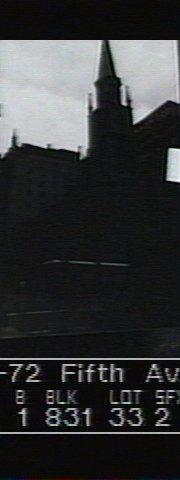
The city photographed every building for its tax records around 1940 and again in the 1980s. NYC Municipal Archives.
Written with AI from the source each entry cites, then fact-checked.
- 1854
A Dutch Reformed congregation dating to 1628 finishes its marble church on Fifth Avenue
The congregation traces its founding to 1628 as the Collegiate Reformed Protestant Dutch Church, one of the oldest continuous Protestant congregations in North America. Its Fifth Avenue church, designed by Samuel A. Warner in the Romanesque Revival style, was built in 1851–54 and faced with Tuckahoe marble. In 1906 it took the name Marble Collegiate after that stone. It became a city landmark in 1967.
Source: Wikipedia
- 1854
An iron fence goes up around the church to keep grazing cows out
When the church opens on a still-rural stretch of Fifth Avenue in 1854, dairy cows and other grazing animals wander the area freely. Trustees put up an iron fence around the churchyard to keep animals from disturbing worshippers. Sections of that original fence survive today, among the oldest ironwork of its kind still standing in New York City.
Source: Ephemeral New York
- 1871
The church ends its shared-minister system and calls its first permanent minister
For its first 18 years the congregation relied on four ministers rotating in service, a practice imported from Holland and known as the collegiate system. In 1871 that system ended and the church called its first permanent minister. The city was expanding northward, and the church sat in a prosperous, fashionable residential neighborhood.
Source: nycago.org
- 1891
The old Erben organ is enlarged and electrified, with the choir moved to the chancel
During repairs and improvements in 1891, J.H. and C.S. Odell enlarged and electrified the church's original Henry Erben organ, built in 1836 and moved here from the North Church. The work added two divisions in the chancel and two freestanding cases, and the console and choir moved from the gallery down to the chancel, where they remained until the 1980s.
Source: nycago.org
- 1900
The first narrative stained-glass window, from Tiffany Studios, is dedicated
On December 9, 1900, Marble Collegiate dedicated the first of its narrative windows. Designed by Tiffany Studios, Joshua Leading the Israelites is a memorial to the donor's son. Senior minister David J. Burrell envisioned ten such windows. A second Tiffany window, Moses and the Burning Bush, followed in 1901, and 97 years passed before another was unveiled.
Source: marblechurch.org
- 1906
The church is renamed Marble Collegiate for its Tuckahoe marble facade
Originally known as the Fifth Avenue Church, the congregation renames its home Marble Collegiate Church in 1906, a nod to the Tuckahoe marble cladding architect Samuel A. Warner used when the Romanesque Revival building rose in 1851-1854. The Dutch Reformed congregation itself dates to 1628, among the longest continuously active Protestant congregations in North America.
Source: Wikipedia
- 1932
Norman Vincent Peale begins 52 years as senior minister
Norman Vincent Peale became senior minister in 1932 and served until 1984. The author of The Power of Positive Thinking made the church nationally known, and it came to be called America's Hometown Church. Celebrities married here too: Lucille Ball wed Gary Morton in the church on November 19, 1961.
Source: Wikipedia
- 1961
Lucille Ball marries Gary Morton at the church
Actress and comedian Lucille Ball marries her second husband, Gary Morton, at Marble Collegiate Church on November 19, 1961. The widely publicized wedding takes place during Norman Vincent Peale's long tenure as senior minister; Peale, author of The Power of Positive Thinking, leads the congregation from 1932 to 1984.
Source: Wikipedia
- 1967
The Landmarks Commission designates Marble Collegiate Church
On January 11, 1967, the Landmarks Preservation Commission made the church a city landmark, calling it a distinguished example of early Romanesque Revival church architecture that uses Gothic forms in its details. The report described the congregation as the oldest Protestant church in America with an unbroken ministry since 1628, and noted that a bell from the North Church, cast in Amsterdam in 1768, is preserved in the churchyard.
- 1985
Simon Preston dedicates a new 83-rank Austin organ in the gallery
By 1983 the church's organ needed urgent attention, so it commissioned an entirely new Austin instrument, Opus 2689, with 83 ranks in seven divisions. The choir and console returned to the original rear gallery. Organist Simon Preston dedicated it on January 23, 1985, and William Whitehead and Jack Ossewaarde with Kevin Walters followed in the inaugural series. It was removed around 2010 during ceiling repairs.
Source: nycago.org
- 2002
A stained-glass Stilling of the Storm is begun in the shadow of 9/11
Work began in 2002 on the Stilling of the Storm window, one of the church's narrative stained-glass windows, while memories of the September 11 attacks were still raw. The window shows the moment just before calm returns, as Jesus tells the men to place themselves in God's hands. The church describes it as an allegory of how people respond to crisis.
Source: marblechurch.org
Further reading
- Marble Collegiate ChurchWikipedia
- This Fifth Avenue church had an iron fence built around it in 1854—here’s whyEphemeral New York
Nearby
- The Wilbraham284 5th Avenue | 4 entries
- 277 Fifth Avenue277A 5th Avenue | 5 entries
- Church of the Transfiguration (Little Church Around the Corner)1 East 29th Street | 12 entries
- Gilsey House1200 Broadway | 8 entries
- Hotel Wolcott4 West 31st Street | 11 entries
- The NoMad (Johnston Building)1170 Broadway | 7 entries