Gilsey House
1200 Broadway | also 25 West 29th Street, 17 West 29th Street | NoMad | built 1871
Open on the map8 entries

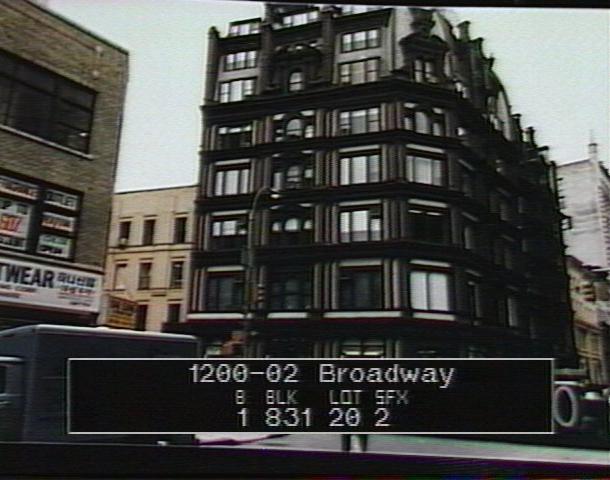
The city photographed every building for its tax records around 1940 and again in the 1980s. NYC Municipal Archives.
Written with AI from the source each entry cites, then fact-checked.
- 1868
Peter Gilsey takes the last Midtown farm, with a cricket club's grounds, as a hotel site
Peter Gilsey, a Danish immigrant merchant, saw that the north-moving theater district would need a first-class hotel. In 1868 he secured the last farm in Midtown from Caspar Samlar, a parcel that included the grounds of the Saint George Cricket Club. He wanted a hotel to rival the downtown houses that served the carriage trade, and knew that attracting wealthy guests would take heavy spending.
Source: Daytonian in Manhattan
- 1869
Danish-born alderman Peter Gilsey hires cast-iron maker Daniel Badger again, this time for a hotel
Gilsey was born in Hobro, Denmark, in 1811, emigrated in 1837 and made his money in tobacco before investing in Broadway real estate. In 1854 he built a Venetian-style palazzo at Broadway and Courtlandt Street with a facade cast by Daniel Badger's Architectural Iron Works. Fifteen years later he hired Badger again for the hotel. Badger's East 14th Street foundry shipped cast-iron fronts across the United States and as far as Egypt and Brazil.
“Fifteen years later, Gilsey again hired Badger to cast the facade of his new hotel, the Gilsey House.”
- 1869
Architect Stephen Decatur Hatch turns a setback covenant into two chamfered corners
Gilsey leased the land for 21 years at $10,000 a year. It combined a corner lot with three smaller lots on West 29th Street, which an 1848 covenant required to sit eight feet back. That left a sudden corner near the middle of a long facade, so Hatch cut it at an angle, and did the same at Broadway, making two single-bay chamfers with entrances and paired columns. The commission calls the result mature American Second Empire.
- 1872
The Gilsey House opens in 1872 and draws Samuel Clemens, Diamond Jim Brady and Oscar Wilde
The Gilsey House opened in 1872 with rosewood and walnut rooms, carved marble mantels and gilt bronze chandeliers, and quickly proved a hit. Its bar had a floor inlaid with silver dollars and became known around the world. Guests included Samuel Clemens, Diamond Jim Brady and Oscar Wilde.
Source: Daytonian in Manhattan
- 1872
Gilsey House opens as Broadway between 28th and 31st Streets fills with theaters and the Tenderloin takes shape
The commission's report places the hotel at the start of a glittering entertainment district: at one time six theaters stood in the three blocks on Broadway from West 28th to 31st, among them Daly's, Weber & Field's and Wallack's. Music publishers on West 28th Street gave it the name Tin Pan Alley. On the side streets stood brothels and gambling clubs, and Inspector Alexander "Clubber" Williams, taking over the West 30th Street precinct, joked that after chuck steak he would get some tenderloin.
“…the three blocks along Broadway between West 28th and 31st Streets boasted six theaters…”
- 1904
The Gilsey House proprietor orders every guest out of the hotel with almost no notice
A lease fight between the Gilsey family and the hotel's operator came to a head in 1904. On December 12, 1904, the proprietor suddenly told every guest to leave, giving almost no warning. Operations resumed, but the dispute and the hotel's other problems dragged on until it closed in 1911.
Source: Daytonian in Manhattan
- 1911
The Gilsey House closes as a hotel and its projecting cast-iron columns are removed
The hotel closed in 1911. Soon afterward the cast-iron columns that projected past the property line were removed and the building became a shabby loft building. By the 1970s water leaked in, rust attacked the structure and the floors sagged.
Source: Daytonian in Manhattan
- 1980
Richard Berry and F. Anthony Zunino convert the Gilsey House into co-op apartments
Richard Berry and F. Anthony Zunino bought the building in 1980 and converted it to cooperative apartments. A cosmetic restoration installed fiberglass copies of the columns and other details. In 1991 the co-op board backed a true restoration, though picture windows replaced some arched nineteenth-century windows and the projecting columns were not replaced.
Source: Daytonian in Manhattan
Further reading
- Gilsey HouseWikipedia
Nearby
- Marble Collegiate Church1 West 29th Street | 11 entries
- Grand Hotel1230 Broadway | 9 entries
- The NoMad (Johnston Building)1170 Broadway | 7 entries
- The Wilbraham284 5th Avenue | 4 entries
- Tin Pan Alley (51 West 28th Street)51 West 28th Street | 2 entries
- Hotel Wolcott4 West 31st Street | 11 entries