Castle Clinton
10 Battery Park | The Battery | built 1951
Open on the map5 entries

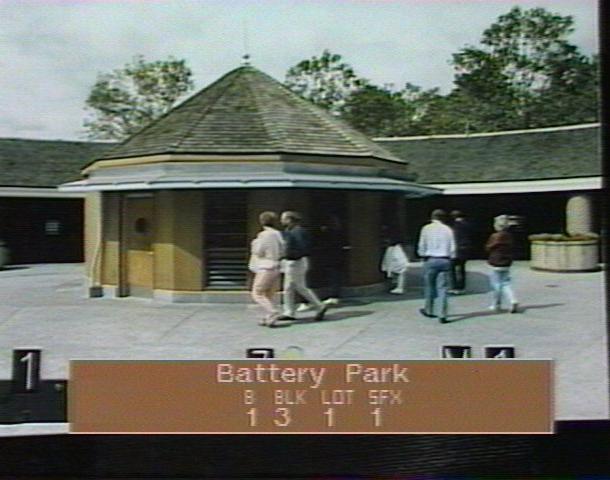
The city photographed every building for its tax records around 1940 and again in the 1980s. NYC Municipal Archives.
Written with AI from the source each entry cites, then fact-checked.
- 1811
John McComb Jr. and Jonathan Williams build a round sandstone fort off Manhattan's tip
Built from 1808 to 1811 on an artificial island, the harbor fort was designed by architect John McComb Jr., with Jonathan Williams as consulting engineer. It carried 28 thirty-two-pounder cannons and was garrisoned in 1812, but it was never used in warfare. The Army gave it up in 1821 and Congress ceded it to the city in 1822.
Source: Wikipedia
- 1850
Jenny Lind makes her American debut at Castle Garden
The city leased the old fort in 1824 and turned it into Castle Garden, an entertainment venue that later held 6,000 seats. Presidents Jackson and Polk were among its visitors, and Samuel Morse demonstrated a telegraph machine there in 1835. In September 1850 the Swedish soprano Jenny Lind gave her first American concerts on its stage, with the best tickets costing up to $225.
Source: Wikipedia
- 1855
The state opens the Emigrant Landing Depot, the first American immigration station
New York State's emigration commissioners took over the Castle Garden lease in May 1855, and the Emigrant Landing Depot opened inside the fort on August 1. Sources cite 7.5 to 8 million immigrants processed there before it closed on April 18, 1890. A fire on July 30, 1876 destroyed the interior, and a $30,000 rebuilding project followed.
Source: Wikipedia
- 1896
Castle Garden reopens as the New York Aquarium
With immigrant processing moved away, the building opened as the New York Aquarium on December 10, 1896, with room for 10,000 fish and other creatures. By the 1920s it drew two million visitors a year. Its director, Charles Haskins Townsend, complained that equipment under the fort flooded at high tide and that the coal bunkers needed refilling by hand every four days.
Source: Wikipedia
- 1941
Robert Moses's plan to demolish the aquarium building leads to a fight that saves it as a national monument
In February 1941 Robert Moses announced that he would demolish the building when the park was rebuilt for the Brooklyn-Battery Tunnel. A long preservation fight followed, and President Truman signed the bill designating Castle Clinton a national monument on August 12, 1946. After a restoration costing about $750,000, it reopened with a performance of Beethoven's Ninth Symphony on May 25, 1975.
Source: Wikipedia
Nearby
- Castle Clinton10 Battery Place | 13 entries
- The Battery North Kiosk10 Battery Park | 1 entry
- Pier A22 Battery Place | 12 entries
- The Battery South Kiosk10 Battery Park | 1 entry
- SeaGlass Carousel10 Battery Park | 1 entry
- Battery Park Control House10 Battery Park | 5 entries