Battery Park Control House
10 Battery Park | The Battery | built 1951
Open on the map5 entries

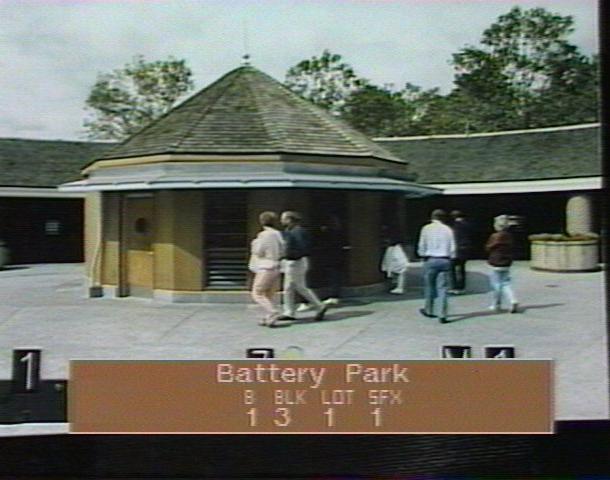
The city photographed every building for its tax records around 1940 and again in the 1980s. NYC Municipal Archives.
Written with AI from the source each entry cites, then fact-checked.
- 1625
Fort Amsterdam's bastions and a Dutch windmill once stood near this spot
The Landmarks Preservation Commission notes that the control house stands near Manhattan's original shoreline. The western bastions of Fort Amsterdam were first laid out close by in 1625-26, and the first windmill in New Netherland was raised nearby before 1628.
- 1905
The IRT's Bowling Green station opens with this control house as its southern entrance
Bowling Green station opened on July 10, 1905, as the end of the original subway line's extension to South Ferry. Its single island platform was served by a head house in Battery Park at the south end and a smaller entrance beside Bowling Green park. Subway service to Brooklyn did not yet exist, so Lexington Avenue trains all stopped at South Ferry.
Source: Wikipedia
- 1905
Heins & LaFarge build a yellow-brick Beaux-Arts entrance for the first subway
Begun in 1904 and finished in 1905, the control house was designed by the firm Heins & LaFarge. The Landmarks Preservation Commission describes yellow brick with limestone quoins and banding on a dark granite base. In 1973 the south gable's bull's-eye was still filled with its original terra-cotta sunburst, and a limestone porch with a pediment marks the north entrance.
- 1973
The Landmarks Preservation Commission designates the control house a city landmark
After a public hearing on September 25, 1973, at which a Transit Authority representative spoke in favor and no one opposed, the commission designated the building a landmark. Its report cites the control house as one of the original stations of the city's first subway and one of the last surviving monumental subway entrances. It also notes that restoration was planned along with the enlarged Bowling Green station then under construction.
- 1978
The southern entrance closes for six months of rehabilitation during the station's rebuilding
In 1972 the MTA announced that Bowling Green station would be renovated and expanded to double its capacity, and the work ran years past its original 1974 target. The head house at the south end shut for six months starting in April 1978 while it was rehabilitated. The overall station renovation was completed that year at a cost of $16.8 million.
Source: Wikipedia
Nearby
- Alexander Hamilton U.S. Custom House1 Bowling Grn | 12 entries
- 1 Broadway14 entries
- Bowling Green Offices Building11 Broadway | 10 entries
- 17 State Street8 entries
- 2 Broadway9 entries
- 6 Stone Street5 entries