Castle Clinton
10 Battery Place | also 10 Battery Park | The Battery | built 1951
Open on the map13 entries

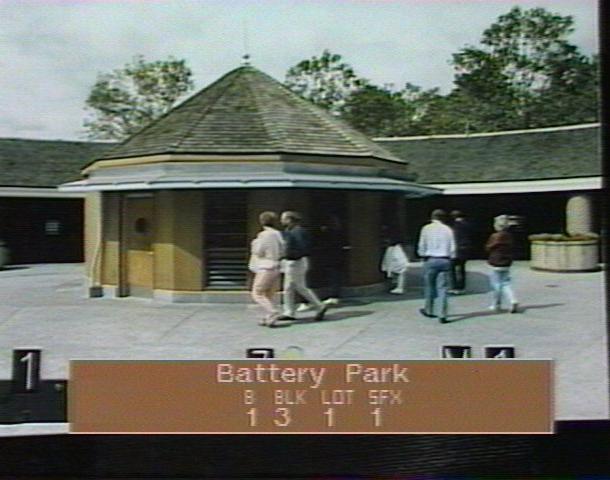
The city photographed every building for its tax records around 1940 and again in the 1980s. NYC Municipal Archives.
Written with AI from the source each entry cites, then fact-checked.
- 1811
The West Battery is completed on an artificial island off the tip of Manhattan
Designed by John McComb Jr. with Jonathan Williams as consulting engineer, the round sandstone fort was built from 1808 to 1811 on an artificial island just offshore, armed with 28 cannons. It was garrisoned during the War of 1812 but never saw combat. After the war it was renamed Fort Clinton for DeWitt Clinton, the city's mayor, and the Army handed it over to the city in 1822.
Source: Wikipedia
- 1812
General Joseph Bloomfield makes the Southwest Battery his headquarters for New York's harbor forts
On March 27, 1812, General Joseph Bloomfield took command of all the fortifications of New York City and its harbor, and he set up his headquarters at the Southwest Battery, as the fort was then called. It was one of four forts defending the harbor, with Castle Williams, Fort Wood and Fort Gibson. Its 28 cannons could throw a 32-pound ball 1.5 miles. The British navy stayed away, and the battery never fired on an enemy.
“On March 27, 1812, General Joseph Bloomfield was appointed to the command of all the fortifications in New York City and harbor.”
Source: National Park Service
- 1824
Castle Garden hosts a reception for the Marquis de Lafayette
About 6,000 people crowd into Castle Garden to honor the Marquis de Lafayette during his farewell tour of the United States. The fort, decommissioned from active defense only a few years earlier, has already begun its transformation into a public entertainment venue. The event helps establish Castle Garden's reputation as one of the city's largest gathering spaces.
Source: Wikipedia
- 1850
Jenny Lind makes her American debut at Castle Garden
From 1824 the old fort served as Castle Garden, a beer garden, exhibition hall and theater that grew to about 6,000 seats. The Marquis de Lafayette was received there in 1824, and on September 11, 1850, the Swedish soprano Jenny Lind gave her first American concert there. Tickets for her two September concerts sold for as much as $225.
Source: Wikipedia
- 1855
Castle Garden becomes the nation's first immigrant landing depot
The Emigrant Landing Depot opened here on August 1, 1855, and began processing new arrivals two days later. Before it closed on April 18, 1890, about 7.5 million people entered the country through Castle Garden, decades before Ellis Island. From 1896 to 1941 the building housed the New York Aquarium, and since 1986 it has sold tickets for the Statue of Liberty ferries.
Source: Wikipedia
- 1876
A fire guts the interior of Castle Garden, but the walls survive
A fire on July 30, 1876, destroyed the whole interior of the immigrant depot, leaving the exterior and the outbuildings to the north intact. Some city officials suggested closing the depot and returning the fort to public enjoyment, but New York State awarded a rebuilding contract that September. The $30,000 job added windows in the gun openings and two new doorways, and Castle Garden reopened on November 27, 1876.
Source: Wikipedia
- 1890
Castle Garden closes as the nation's immigrant depot after more than 8 million arrivals
Castle Garden stopped receiving immigrants on April 18, 1890, as the federal government took over immigration and Ellis Island opened. During the 34 years since 1855, the National Park Service says, more than 8 million people came through, about two of every three immigrants to the United States. The old fort was later remodeled once more and reopened as the New York City Aquarium.
“…over 8 million people entered the United States through Castle Garden. Two out of every three immigrants…”
Source: National Park Service
- 1896
The New York Aquarium opens inside Castle Garden
The city converts the old fort into the New York Aquarium, which opens on December 10, 1896, and draws crowds averaging more than 10,000 visitors a day. The aquarium occupies the circular stone fort for the next 45 years, becoming one of the city's most popular attractions. The exhibit closes for good in late 1941, and its fish and turtles are relocated elsewhere.
Source: Wikipedia
- 1941
Robert Moses announces plans to demolish Castle Garden for the Brooklyn-Battery Tunnel project
In February 1941 Robert Moses, head of the Triborough Bridge and Tunnel Authority, said the fort would come down when Battery Park was rebuilt during construction of the Brooklyn-Battery Tunnel. He cited poor light and ventilation and the cost of repairs, and later said the old fort never fired a shot. Former mayor George McAneny pressed for its preservation for nine years. The aquarium closed that year, with some fish moved to other aquariums and others released into the Atlantic.
Source: Wikipedia
- 1950
Castle Clinton is dedicated as a national monument
President Truman signs legislation in 1946 authorizing federal control of the fort, and New York City formally transfers ownership in mid-1950. The National Park Service dedicates Castle Clinton National Monument that October, protecting a site that had faced repeated proposals for demolition. A quarter-century of restoration follows before the fort reopens to the public in 1975.
Source: Wikipedia
- 1965
The Landmarks Preservation Commission designates Castle Clinton a city landmark
The Landmarks Preservation Commission held a public hearing on Castle Clinton on October 19, 1965, where three witnesses spoke for designation and nobody against, and it designated the fort on November 23. Its report praised the eight-foot-thick walls at the gun ports and a doorway probably based on a design by the French military engineer Vauban. It called the fort an outstanding example of early 19th-century military architecture in the country.
- 1975
Castle Clinton reopens after restoration with a symphony performance
The American Symphony Orchestra performs Beethoven's Ninth Symphony to mark Castle Clinton's reopening, following a long restoration of the fort to its early 19th-century appearance. The building later becomes the ticket office and visitor center for ferries to the Statue of Liberty and Ellis Island, a role it takes on in 1986. Its circular sandstone walls have anchored the tip of Manhattan since 1811.
Source: Wikipedia
- 1986
Castle Clinton reopens as the ticket office for the Statue of Liberty ferries
The National Park Service closed the fort for renovation in December 1985 and welcomed visitors back over the July 4 weekend of 1986. It now served the Statue of Liberty National Monument, as a visitor center and ticket office. The $1.5 million plan called for ticket booths and a waiting area for ferry passengers, and a ferry pier was installed behind the walls. Tickets for Ellis Island followed in 1990, once the main building there had been turned into a museum.
“The fort reopened the weekend of July 4, 1986, as a visitor center and ticket office for the Statue of Liberty National Monument.”
Source: Wikipedia
Further reading
- Castle ClintonWikipedia
Nearby
- Castle Clinton10 Battery Park | 5 entries
- The Battery North Kiosk10 Battery Park | 1 entry
- Pier A22 Battery Place | 12 entries
- Battery Park Control House10 Battery Park | 5 entries
- SeaGlass Carousel10 Battery Park | 1 entry
- The Battery South Kiosk10 Battery Park | 1 entry