Hiram and Linus Little House
102 Greenwich Avenue | West Village | built 1829
Open on the map5 entries

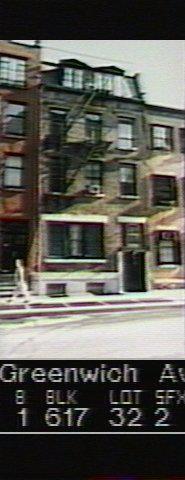
The city photographed every building for its tax records around 1940 and again in the 1980s. NYC Municipal Archives.
Written with AI from the source each entry cites, then fact-checked.
- 1829
Mason Linus Little and Hiram Little build a pair of late Federal houses at 102 and 104
Linus Little, a mason, and Hiram Little built Nos. 102 and 104 Greenwich Avenue in 1829 on land bought in 1828 from Jacob B. Taylor. Both houses began at two and a half stories, which shows today as a change from Flemish-bond to running-bond brick at the third story. By the end of the 19th century both had been raised to three stories, and No. 102 later gained a wide dormer under two low pediments.
- 1889
Lodger Paul Grolph, a self-styled inventor, is arrested for selling a stolen gold watch
In 1889 the lodger Paul V. Grolph, who called himself a journalist, inventor and clerk, was arrested on November 11 after police returned to 102 Greenwich Avenue. He was accused of stealing a gold watch and selling it to a club of men. Daytonian in Manhattan says he had earlier been fired from the Custom House for taking money from importers on a promise to cut their duties. His wife had him arrested the month before for abandonment.
Source: Daytonian in Manhattan
- 1895
A stage hand living here is told he has lost his sight when a shell explodes at the Fourteenth Street Theatre
Louis Weigand, a 28-year-old German stage hand, lived at 102 Greenwich Avenue. During the play Captain Paul at the Fourteenth Street Theatre on May 6, 1895, real shells were dropped on a line from the roof to explode on a lead plate. One went off early as he cleared the line and burst in his face. Two days later the New York Times reported that doctors said he would never recover his eyesight.
Source: Daytonian in Manhattan
- 1920
A new owner converts the old tenement into studio apartments and lowers the entrance to the street
When Mrs. J. Alverez bought the house in April 1920, the New-York Tribune said she would alter it into studio apartments. The stoop came off and the entrance dropped to street level, while a single big window took the place of the two parlor windows and the dormers on the fourth floor were merged into one studio window. A June 1921 advertisement offered bachelor apartments at $7 to $10 a week per room.
Source: Daytonian in Manhattan
- 1971
A gas explosion in the basement injures seven firefighters and a resident
On January 10, 1971, a tenant called the Fire Department about a smell of gas, and a captain, a lieutenant and five firemen went into the basement a little after 10:30 p.m. A blast then shook the basement. Seven firefighters and one resident, Lawrence Sims, were hurt and taken to St. Vincent's Hospital, and the fire that followed stayed in the basement and took an hour to control.
Source: Daytonian in Manhattan
Further reading
- The 1828 Hiram and Linus Little House - 102 Greenwich AvenueDaytonian in Manhattan
- Then & Now photos: 102 Greenwich AvenueVillage Preservation: Greenwich Village Then & Now
Nearby
- 100 Greenwich Avenue3 entries
- 104 Greenwich Avenue1 entry
- 98 Greenwich Avenue2 entries
- 108 Greenwich Avenue2 entries
- 96 Greenwich Avenue1 entry
- 106 Greenwich Avenue5 entries