106 Greenwich Avenue
West Village | built 1900
Open on the map5 entries

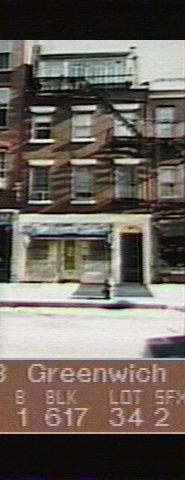
The city photographed every building for its tax records around 1940 and again in the 1980s. NYC Municipal Archives.
Written with AI from the source each entry cites, then fact-checked.
- 1831
Dr. James Cameron builds a brick-fronted house with a store at 106 Greenwich Avenue
Physician and surgeon James Cameron, who lived at 76 Hudson Street, had this three-story house put up in 1830-31. It was the first of several he built on the lots between here and the West 13th Street corner, land he had bought from Harris in 1828. The Landmarks Preservation Commission describes a plain vernacular design with a store at street level; the brick front has since been covered in stucco, but the old muntined windows remain.
“…erected in 1830-31 for James Cameron, physician and surgeon, who lived at 76 Hudson Street. This was the first house he erected on lots…”
- 1841
William Laird, who keeps a porterhouse here, is beaten with a club in the Five Points
By 1840 William Laird ran a porterhouse, a tavern that sold malt liquors such as porter, in the ground-floor store and lived upstairs with his family. The Tribune described him as an old man crippled by a stroke. On December 1, 1841 he was in the Five Points when John O'Connor, convinced Laird had thrown a brickbat through his window, struck him on the head with a club; a police officer found Laird lying in a snowbank and stopped the beating. O'Connor got a month in jail plus a $25 penalty.
Source: Daytonian in Manhattan
- 1907
A fish market replaces the butcher shop that filled the store for over half a century
From before 1845 the ground floor held a succession of butchers, among them Peter B. Marks, Eli Thompkins, John Rudman and Henry Schlegel, followed by Louis Koelsch, who leased it in 1882, and Thomas J. Fallon by 1896. In 1907 the Hartemann fish market took the space. Its proprietor, Harry Hartemann, was summoned by the Department of Labor in 1912 on a charge of employing children younger than 14.
Source: Daytonian in Manhattan
- 1964
The Rastro antiques shop fills the ground floor, followed by Victoria Galleries
In the 1960s the store was home to The Rastro, an antiques dealer that Interior Design in 1964 described as stocked with wrought iron, old brass, faience, oak furniture, carved wood figures and lighting fixtures. By 1970 it had become Victoria Galleries, another antiques and collectibles shop, which the 1982 New York Art Guide called a small house often good for jewelry and orientalia. The upper floors had been converted to rooms without kitchens in 1928.
Source: Daytonian in Manhattan
- 2012
After a 2011 renovation, the menswear store Odin moves into the ground floor
A renovation completed in 2011 divided each upper floor into four apartments. The men's clothing store Odin then took the ground-floor space, which Alexis Mainland of The New York Times described on January 11, 2012 as a glamorous new location. The upper floors' six-over-six windows still survive.
Source: Daytonian in Manhattan
Further reading
- The 1831 William Laird Porterhouse - 106 Greenwich Ave Daytonian in Manhattan
- Then & Now photos: 106 Greenwich AvenueVillage Preservation: Greenwich Village Then & Now
Nearby
- 108 Greenwich Avenue2 entries
- 104 Greenwich Avenue1 entry
- Panhard & Levassor Building230 West 13th Street | 5 entries
- Hiram and Linus Little House102 Greenwich Avenue | 5 entries
- 228 West 13th Street4 entries
- 100 Greenwich Avenue3 entries