Smith, Gray & Company Building
103 Broadway | also 96 South 6th Street | Williamsburg | built 1870
Open on the map8 entries

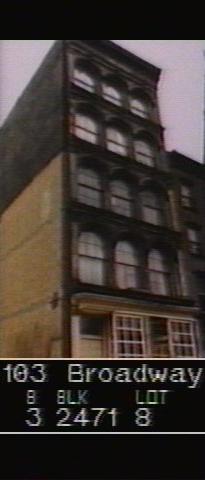
The city photographed every building for its tax records around 1940 and again in the 1980s. NYC Municipal Archives.
Written with AI from the source each entry cites, then fact-checked.
- 1870
Edward Smith builds a five-story cast-iron store at 95 Broadway, later renumbered 103
Edward Smith bought the Williamsburg lot from James M. Waterbury in January 1870 and put up a five-story store and loft building, 25 feet wide, with a cast-iron front. The ironwork was made by George R. Jackson & Sons, the design is attributed to William H. Gaylor, and the builders were probably Thomas and William Lamb. The building was finished by February 1871, when the Eagle reported a burglary there. Broadway was renumbered in 1888, making it No. 103.
“…constructed following the purchase of the property by Edward Smith from James M. Waterbury in January 1870…”
- 1870
Tailor Edward Smith's boys'-clothing firm builds its first new structure in Williamsburg
Edward Smith, born in Connecticut in 1811, started as a tailor on Chatham Street in Manhattan in 1833. With his brother-in-law Allen Gray, a patternmaker, he pioneered ready-made clothes for boys, until the Civil War forced him to close in 1861. He restarted in Williamsburg in 1864, and this 1870 building was the firm's first new structure there.
- 1873
Smith, Gray & Co. outgrows its new Broadway store within three years
The clothing business grew so quickly that it soon needed more room than the new 103 Broadway building offered. Within three years the firm was renting neighboring buildings, among them the King's County Fire Insurance Co. building, of which it took half. In 1884 it built a larger headquarters at 126 Broadway, and by the mid-1880s it had stopped using this building.
“The business grew so rapidly, however, that it outgrew this structure within three years and had to rent adjacent buildings…”
- 1887
Tenant Edmiston & Waddell, a farm-machinery firm headquartered here, defaults owing about $300,000
After Smith, Gray & Co. moved on, the Edmiston & Waddell Co. became the main tenant. It had been incorporated in 1884 to deal in agricultural implements, machinery and hardware. It also sold carriages and used the building as its national headquarters. In 1887 it defaulted on its creditors, owing about $300,000. A music store also occupied the ground story.
“This firm also dealt in carriages and used this building as its national headquarters until 1887, when it defaulted on its creditors, owing some $300,000.”
- 1895
Sugar refiner Claus Doscher buys the building for $25,500
In September 1895 Warren E. Smith sold the property to Claus Doscher, a German-born sugar refiner from Brooklyn who led the North Side Bank. Doscher had worked as a grocer after arriving in New York at 18, and later headed the Brooklyn Sugar Refinery. In 1897 he founded a sugar refinery in Long Island City. He also invested in Brooklyn real estate.
“Warren E. Smith sold the property in September 1895 for $25,500 to Claus Doscher…”
- 1912
A basement explosion starts a fire in the building
A basement explosion caused a fire at 103 Broadway in 1912. One of the tenants then was John S. Williams, a ship chandler with an address at the rear of the building. The property was at the time held by the daughter of Claus Doscher, Gesine Engel, who owned it until 1920.
- 1938
Chemicals dealer Joseph I. Blanck buys the building and his family keeps it for forty years
The building changed hands several times in the early 1920s, and in 1936 the Dime Savings Bank of Williamsburgh took it over. Joseph I. Blanck, a chemicals dealer, bought it in 1938, and he and his heirs used the building and owned it until 1978. Richard P. Netzband, who lived in the building, then bought it, and in 1983 the buyers were Samuel M. and Mary O. Stone.
“Joseph I. Blanck, chemicals dealer, acquired the property in 1938 and he and his heirs used and retained it until 1978.”
- 2005
The Landmarks Commission designates the Smith, Gray & Co. Building after a hearing with five speakers in favor
The Landmarks Preservation Commission designated the building on June 7, 2005, following a January 18 hearing. Five people spoke in favor, including representatives of the Victorian Society in America's Metropolitan Chapter, the Municipal Art Society, the Historic Districts Council and the New York Landmarks Conservancy. No one spoke against it. The commission called it an early and largely intact cast-iron-fronted store and loft in Brooklyn.
Further reading
- Smith & Gray Company BuildingWikipedia
Nearby
- Kings County Savings Bank135 Broadway | 7 entries
- Meadowsweet149 Broadway | 3 entries
- Long Island Business College143 South 8th Street | 11 entries
- Williamsburgh Savings Bank (The Weylin)175 Broadway | 9 entries
- Peter Luger Steak House848 Driggs Avenue | 5 entries
- Forman Building195 Broadway | 7 entries