103 Franklin Street
Tribeca | built 1834
Open on the map5 entries

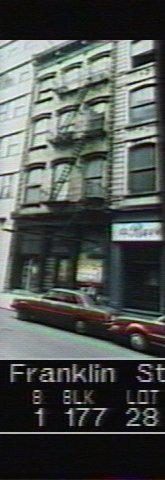
The city photographed every building for its tax records around 1940 and again in the 1980s. NYC Municipal Archives.
Written with AI from the source each entry cites, then fact-checked.
- 1835
Builder James Russell sells the new house at 103 Franklin Street to John Jacob Astor's nephew
James Russell bought the 25-foot lot in 1833 and put up a three-story brick house, most likely building it himself. Early in 1835 he sold it to George Ehninger, a merchant born in 1792 whose mother, Catharine Astor, was a sister of John Jacob Astor. Ehninger probably never lived there and treated it as an income property; by 1851 an advertisement was offering rooms with board in the house.
Source: Daytonian in Manhattan
- 1865
A lace maker upstairs chases a thief with a valise of silk, and the burglar walks free
On the night of August 12, 1865, Paul Greensmith, who made lace for a silk-net shop at 103 Franklin Street and lived upstairs, saw a man leaving with a black leather valise. He and a private watchman chased Henry Burks through the streets while four patrolmen on nearby beats ignored their shouts. The bag held $600 in silk and other goods, but witnesses placed Burks elsewhere and he was acquitted.
Source: Daytonian in Manhattan
- 1866
Alfred A. Dunham turns the old house into a four-story Italianate loft building
S. Heilpern hired the architect Alfred A. Dunham in 1866 to raise the building to four stories and deepen it from 52 to 90 feet, turning the house into a store and loft building. The cast-iron storefront with fluted columns, the iron window hoods, the brick quoins and the cornice all date from this work. A foundry mark reading "L.R. Case" survives at the western bay.
- 1897
A rubber broker who cheated a tenant firm in 1885 defrauds it again in 1897
Robert Solteau's rubber firm, based at 103 Franklin Street, sued the broker Henry A. Smith in 1885 over a claimed ten-ton sale of Borneo rubber to a Rhode Island company that had never ordered it, and Smith was found guilty of fraud. After his release he returned to the same firm and, by April 29, 1897, was pleading not guilty to grand larceny for obtaining $20,000 worth of rubber, which he sold to a Boston company before fleeing to Canada.
Source: Daytonian in Manhattan
- 1905
Linen importer Frederick Pinkus is arrested for smuggling and trying to bribe a customs inspector
Frederick S. Pinkus, a partner in the linen importers O. Jaffe & Pinkus, moved the firm to 103 Franklin Street in 1902. Returning from Europe in June 1904 with $2,100 worth of jewelry, clothing and glassware, he tried to bribe a customs inspector rather than pay duty. A United States marshal came to his East 56th Street home with a warrant on January 12, 1905, and by April 1906 the affair had cost him $9,704.46 in fines, duty and the value of the goods.
Source: Daytonian in Manhattan
Further reading
- Alfred Dunham's No. 103 Franklin StreetDaytonian in Manhattan
Nearby
- 105 Franklin Street4 entries
- New York Academy of Art111 Franklin Street | 12 entries
- Minot, Hooper & Co. Building51 Leonard Street | 5 entries
- 104 Franklin Street5 entries
- 102 Franklin Street2 entries
- Former Episcopal Residence106 Franklin Street | 4 entries