New York Academy of Art
111 Franklin Street | also 107 Franklin Street | Tribeca | built 1868
Open on the map12 entries

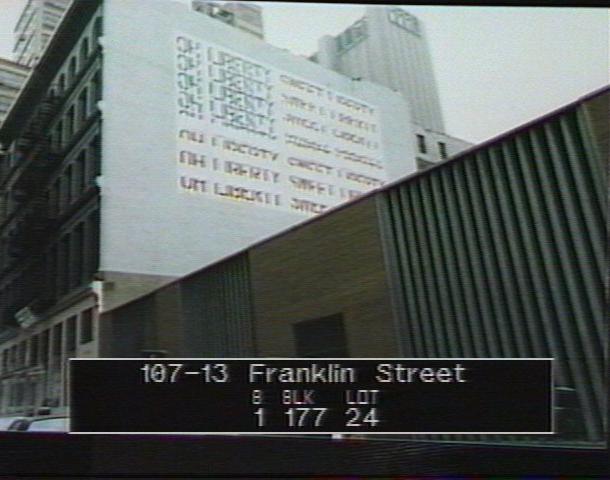
The city photographed every building for its tax records around 1940 and again in the 1980s. NYC Municipal Archives.
Written with AI from the source each entry cites, then fact-checked.
- 1808
The Northwest Dutch Reformed Church is dedicated on the Franklin Street lot
Before the present building, the lot at 107-113 Franklin Street held a church. The Northwest Dutch Reformed Church, also called the Franklin Street Church, was dedicated in 1808 on this site. The Landmarks Preservation Commission's Tribeca East report notes that the Appleton building later replaced it.
- 1868
D. Appleton & Company commissions a five-story store and loft building on Franklin Street
In 1868 the book publishers Daniel Appleton & Co. had architect Benjamin W. Warner design a five-story masonry building with cast-iron elements, with J. W. Mersereau as builder. The building is about 76 feet wide and 95 feet deep, and it replaced structures used for hazardous purposes. Its Italianate facade has segmental and round-arched windows, with neo-Grec incised detail.
“The structure, commissioned by Daniel Appleton & Co., book publishers, was built in 1868 according to the plans of Benjamin…”
- 1870
Dry goods merchants occupy the Franklin Street building for decades
Through the 1870s the building was home to Hunt, Catlin & Valentine, dry goods merchants whose business began as Catlin Farrish & Co. in 1835. In the 1890s tenants included Louis Kessel, a dealer in cloths and cassimeres, and R. Blankenburg & Co., dealers in linens. According to the Landmarks Preservation Commission, dry goods firms kept occupying the building into the 1940s.
- 1939
The ground floor of the Franklin Street building is altered
Read more
The Landmarks Preservation Commission's Tribeca East report records that the first story of 107-113 Franklin Street was altered in 1939. It says cast-iron storefront framing may survive behind the alterations, and that the top edge of the original storefront cornice and its supporting brackets can still be seen. The report also notes the historic wood sash, a fire escape at the center bays and a metal cornice on the facade.
- 1990
The New York Academy of Art moves in, helped by Andy Warhol's bequest
The school began operating out of the Franklin Street building in 1990. Andy Warhol, who died in 1987, left the academy a bequest that let it buy its Tribeca headquarters. Co-founder Stuart Pivar has said the idea of such a school came from a suggestion by his friend Warhol, and by 2004 the Warhol Foundation's gifts to the academy totaled over $1 million.
Source: Wikipedia
- 1994
The academy holds its first Tribeca Ball to raise money for the school and its building
In 1994 the academy organized the first Tribeca Ball, a fundraiser meant to pay for the upkeep of the Franklin Street building and the school's growth. Vogue reports that the ball has always been held in the building. It begins with a cocktail hour in which students welcome patrons into their studios to see and perhaps buy work, and continues with dinner in the first-floor Cast Hall, where the Metropolitan Museum of Art has lent the academy a permanent collection of nineteenth-century plaster casts.
Source: vogue.com
- 1994
A consultant's review finds the academy lacking the basics of a school
A consultant brought in during 1994 to evaluate the New York Academy of Art found that it was missing the basic features of an educational institution. A 2014 New York Times profile recalled that for most of its history the graduate school had been disorganized and divided by internal disputes, that it had been in litigation with one of its founders, and that two of its financial officers had been accused of embezzlement over the years.
Source: The New York Times
- 2001
A fire damages half of the academy's interior
A 2001 fire damaged about half of the interior space of the five-story, 42,000-square-foot building. The school had it renovated by the firm TRA Studio, which kept improving the building from 2010 onward and restored the facade in cooperation with the Landmarks Preservation Commission.
Source: Wikipedia
- 2004
Police arrest the academy's finance chief, who turns out to be using an alias
In April 2004 police arrested a man known at the academy as Robert J. Angona, accusing him of using a company credit card to take more than $50,000. Two years earlier he had answered a want ad for a bookkeeper, told some staff that his business was destroyed in the World Trade Center collapse, and risen to chief financial officer. Police said the name was one of five or six aliases of a man wanted by the federal government. The case revived the school's long feud with founder Stuart Pivar.
Source: The New York Times
- 2009
David Kratz, a former student, becomes the academy's president
David Kratz, a painter who had studied at the academy, took over as its president in 2009. By 2014 the New York Times reported that the school was digging its reputation out of the ditch, with a two-year program that accepted about 50 new applicants a year, trustees drawn from fashion, jewelry and art, and lecturers and critics including Philip Pearlstein, Eric Fischl and John Currin.
Source: The New York Times
- 2016
About 900 guests fill six floors of the building for a Tribeca Ball with stilt-balancing merpeople
On a Monday night in April 2016 about 900 people made their way up six floors of the academy for its annual Tribeca Ball, which doubles as an open studio for roughly a hundred graduate students. Tickets cost $300. The aquatic theme brought stilt-balancing merpeople and waitresses carrying oyster buckets, and the dinner honored restaurateur Michael Chow and his wife Eva. Performance artist Marina Abramovic told ARTnews she disliked turning performers into party entertainment.
Source: artnews.com
- 2020
The Tribeca Ball moves online as students work from home
In April 2020, with students working from home during quarantine, the academy turned its annual Tribeca Ball, normally a night when patrons tour the working studios, into an online event. It offered virtual studio tours, with new work posted every week, which the school billed as a digital showcase of up-and-coming artists and works to collect. Juxtapoz Magazine profiled several students in their makeshift studios, including MFA 2020 student Lydia Baker, who shared a converted living room with roommates.
Source: juxtapoz.com
Further reading
- New York Academy of ArtWikipedia
Nearby
- 105 Franklin Street4 entries
- 103 Franklin Street5 entries
- Minot, Hooper & Co. Building51 Leonard Street | 5 entries
- 116 Franklin Street5 entries
- Franklin Furnace building112 Franklin Street | 6 entries
- Former Episcopal Residence106 Franklin Street | 4 entries