108 West 14th Street
West Village | built 1910
Open on the map5 entries

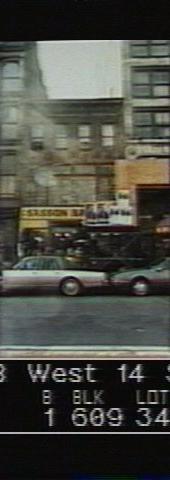
The city photographed every building for its tax records around 1940 and again in the 1980s. NYC Municipal Archives.
Written with AI from the source each entry cites, then fact-checked.
- 1876
Boarder and lawyer Juan Del Valle is sued for breach of promise
Juan Del Valle, a Spanish-born attorney who had served as district attorney in Havana, lived here in 1876 after moving to New York with four children. On November 16 Eugenie Henriques sued him for breach of promise. The New York Herald called it a remarkable story, and a throng gathered outside the courtroom, drawn by the wealth of those involved.
Source: Daytonian in Manhattan
- 1876
George C. Flint & Co. leases the house as an annex and adds a rear extension and storefront
After building a five-story cast-iron store next door, the Flint furniture firm found it needed more floor space. By December 1876 it had leased the three-story house at No. 108, then a boarding house, and hired architect Richard C. Jones to add a rear extension, install a storefront and change the pitch of the roof for $3,000. Flint advertised itself as a maker of good furniture at low prices.
Source: Daytonian in Manhattan
- 1896
A cellar fire forces carpet layers to flee along the cornice
By 1896 No. 108 served as the receiving department and workshop for the Cowperthwait furniture store. At 8 a.m. on October 23 a fire started in the cellar and spread. A carpet sewer, Lizzie Welch, ran out, but carpet layers Albert Hanks and George Weidner stayed to save carpets, were nearly overcome by smoke, and escaped from a second-floor window along the cornice to the next building.
Source: Daytonian in Manhattan
- 1911
The 'Sweet Bread King' Charles Wissmann opens a Flat Iron Restaurant branch here
After Cowperthwait & Co. left 14th Street, the building was given a new two-story cast-iron storefront and sold to Charles Wissmann in 1911. He ran his Flat Iron Restaurant Co. from offices upstairs and opened a branch of his Flatiron Building restaurant on the ground floor, where veal goulash and sauerbraten cost 50 cents and a squab casserole 85 cents. He was known in the trade as the Sweet Bread King.
Source: Daytonian in Manhattan
- 1925
The Spanish social club Casa de Galicia forms here
With the neighborhood still strongly Spanish, the Casa de Galicia was founded in the building in 1925. It hosted social events and cultural meetings until 1927, when it bought a building a block away at 109-111 East 15th Street.
Source: Daytonian in Manhattan
Further reading
- The Surviving Relic at 108 West 14th StreetDaytonian in Manhattan
- The 1876 Geo. C. Flint Building -- Nos. 104-106 West 14th StreetDaytonian in Manhattan
Nearby
- Evangeline Residence for Girls120 West 14th Street | 9 entries
- Daniel Stinson House122 West 13th Street | 3 entries
- James W. Hale House132 West 13th Street | 5 entries
- Henry Jarvis Raymond House134 West 13th Street | 5 entries
- Charles B. Macy House117 West 12th Street | 5 entries
- R. H. Macy & Co. Store, 14th Street Annex56 West 14th Street | 9 entries