R. H. Macy & Co. Store, 14th Street Annex
56 West 14th Street | Greenwich Village | built 1897
Open on the map9 entries

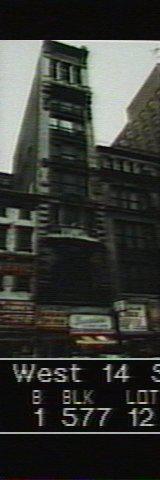
The city photographed every building for its tax records around 1940 and again in the 1980s. NYC Municipal Archives.
Written with AI from the source each entry cites, then fact-checked.
- 1871
Albert Levi builds a four-story brick jewelry store on the lot, before Macy's annex
An earlier building on the site went up in 1871, when Albert Levi began a brick store of four stories at 56 West 14th Street, a short way east of Sixth Avenue. It was finished only two months after the plans were filed. By September he had moved his watch, jewelry and silverware business over from 321 Canal Street, trading as Albert Levi & Bro. Rothschild's, a millinery shop, held the premises by 1893.
Source: Daytonian in Manhattan
- 1897
Schickel & Ditmars plan a nine-story, 25-foot-wide limestone annex for Macy's on 14th Street
In April 1897 the firm of Schickel & Ditmars filed for a nine-story building, only 25 feet wide, on the lot that Nathan Straus had taken over the year before. Macy's would use it as an annex to its Sixth Avenue store. The Beaux-Arts limestone front has a three-story rusticated base and a big arched second-floor window. The final cost came to $94,470, and the Buildings Department recorded completion in January 1898.
- 1897
Contractor Thomas J. Brady, a Tammany politician, builds the annex under a $100-a-day deadline
The general contractor was Thomas J. Brady, who began as a bricklayer's assistant in 1870 and rose through Tammany Hall politics to become the first Superintendent of the new city Department of Buildings in 1892. From 1898 he served as Commissioner of Buildings for Manhattan and the Bronx. His contract with the architects set a fine of $100 for each day the work ran past September 1, 1897. He met the deadline.
- 1903
Macy's Straus family sells the annex to the "Coffee King" Hermann Sielcken, apparently to negotiate through a middleman
In January 1903 Nathan and Lina Straus conveyed the annex, along with its neighbor on 13th Street, to Hermann Sielcken for over a million dollars. Sielcken was a German-born coffee trader and former clerk at L. Straus & Sons who had become a multimillionaire. The Landmarks Commission says the sale was apparently made solely so the Strauses could deal with rival Henry Siegel through a third party.
“Hermann Sielcken, apparently for the sole purpose of dealing with Siegel through a third party.”
- 1904
Henry Siegel leases the former Macy's annex for his 14th Street Store
Siegel, owner of the Siegel-Cooper department store on Sixth Avenue at 18th Street, wanted the old Macy's site as soon as the firm left for Herald Square. His lease on the 14th and 13th Street annexes began in March 1904 at $70,000 a year for 21 years. His new 14th Street Store, built beside the annex, opened in May 1904. Though first drawn to match the annex's height, it had a section only five stories tall next to it.
- 1914
Henry Siegel is convicted of fraud and jailed, and his 14th Street Store closes
Siegel's Siegel-Cooper business was ruined by scandal when it came out that he had taken as much as ten million dollars improperly and had faked figures to win credit. A court found him guilty of fraud in 1914 and he went to jail. His 14th Street Store, which included the former Macy's annex, was shut, and its stock was auctioned off in October 1915.
“He was convicted of fraud and jailed in 1914; the 14th Street Store was closed, and its contents were auctioned in October 1915.”
- 1920
Wine and grocery importer Acker, Merrall & Condit takes over the annex as its wholesale base
Acker, Merrall & Condit, a firm descended from a business founded in 1820, leased the annex and its 13th Street neighbor from 1920 to 1931 for the wholesale side of its trade in fine wines, ales, groceries and cigars. Part of the space was sublet in 1923-26 to the National Cloak & Suit Co. and in 1927-29 to Sears, Roebuck & Co. Kanter's department store rented the 14th Street storefront.
- 1939
The Noma Electric Corporation, a Christmas-light maker, moves into the annex
In October 1939 the Babsol Realty Corp. bought the annex and leased it to Noma Electric, a firm that had begun in 1925 as a trade group started by Albert Sadacca, whose family had sold Christmas lights since 1917. Its later incarnation, Noma Lites, incorporated in 1953, billed itself as the world's largest maker of Christmas lighting decorations. The company stayed until its bankruptcy in 1965, and its plastics-molding affiliate TICO Plastics worked in the building until 1971.
- 2011
The Landmarks Preservation Commission designates the Macy's annex an individual landmark
On December 20, 2011, the city designated the building a landmark, calling it the last stage in the expansion of the Macy's complex at Sixth Avenue and 14th Street. At the July 12, 2011 hearing, four speakers backed designation, among them representatives of Manhattan Community Board 2, the Greenwich Village Society for Historic Preservation and the Historic Districts Council.
Further reading
- The R. H. Macy & Co. Annex - 56 West 14th StreetDaytonian in Manhattan
Nearby
- Arnhold Hall55 West 13th Street | 5 entries
- 52 West 13th Street2 entries
- Jacob Day Residence50 West 13th Street | 10 entries
- E. H. Purdy & Co. Building42 West 13th Street | 5 entries
- 496 Avenue of the Americas4 entries
- Quad Cinema34 West 13th Street | 3 entries