11 Bank Street
West Village | built 1845
Open on the map5 entries

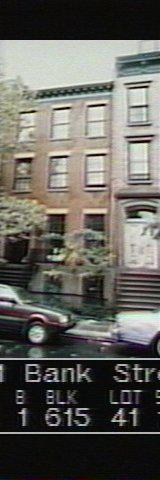
The city photographed every building for its tax records around 1940 and again in the 1980s. NYC Municipal Archives.
Written with AI from the source each entry cites, then fact-checked.
- 1845
Louis Peugnet, a veteran of Napoleon's army, makes the new house at 11 Bank Street his home
The Peugnet brothers, Louis and Hyacinthe, were French officers who fought for Napoleon at Waterloo and were tied to a plot to rescue him from Elba, and who had emigrated to Canada in 1822. They later ran a boys' academy on the block, and after 1845 Louis lived at No. 11, the first house built on their large lot, which stretched through to West 12th Street.
“The Peugnets, who had been officers in Napoleon's army at Waterloo, were involved in a plot to rescue Napoleon from Elba…”
- 1924
John Dos Passos lives at 11 Bank Street while writing Manhattan Transfer
The novelist John Dos Passos lived at No. 11 from 1924 to 1925 while writing Manhattan Transfer, among his first books to be widely praised. He then moved to an apartment in Brooklyn Heights, in the same building as the poet Hart Crane. His best-known work is the U.S.A. trilogy, which opens with The 42nd Parallel (1930).
Source: Village Preservation
- 1956
A physicist and a painter buy the 19-room boardinghouse at 11 Bank Street
In 1956 the physicist Harvey Slatin, a veteran of the Manhattan Project, and his wife, the painter Yeffe Kimball, bought the house, then a 19-room boardinghouse run for years by a Mrs. Maccario. They emptied it of boarders and began restoring it as a family home. Slatin lived there for decades, and Kimball died in 1978.
Source: Ephemeral New York
- 1957
A carpenter hammering through a ceiling finds a can of a stranger's ashes
During the restoration a carpenter breaking through a top-floor ceiling knocked loose a metal can labeled as the cremated remains of Elizabeth Bullock, who died in 1931 in a car accident on Hudson Street. She had never lived in the house as far as the couple knew, and no relatives could be found. The New York Times reported the story in 1957, noting the couple kept the can on their grand piano. Footsteps and hammering had been heard beforehand.
Source: Ephemeral New York
- 1980
The ghost of 11 Bank Street makes the Washington Post, and the ashes finally leave the piano
When Joyce Wadler visited in 1980, Bullock's ashes were still in their can on the piano, and the couple described a benign ghost whose perfume drifted through parties. A medium consulted after the 1957 article had channeled her, and she asked for a proper Christian burial. Following the Post story, a California priest offered one, and the Slatins accepted, sending the ashes to a Catholic cemetery on the Pacific Coast.
Source: Ephemeral New York
Further reading
- Then & Now photos: 11 Bank StreetVillage Preservation: Greenwich Village Then & Now
- Eerie footsteps, a woman’s remains, and a mysterious ghost story in a Bank Street row houseEphemeral New York
Nearby
- 13 Bank Street1 entry
- Louis Peugnet House9 Bank Street | 4 entries
- 15 Bank Street2 entries
- 17 Bank Street1 entry
- 19 Bank Street1 entry
- 87-95 Greenwich Avenue (One Bank Street)89 Greenwich Avenue | 2 entries