Madison Avenue Presbyterian Church
921 Madison Avenue | Upper East Side | built 1916
Open on the map8 entries

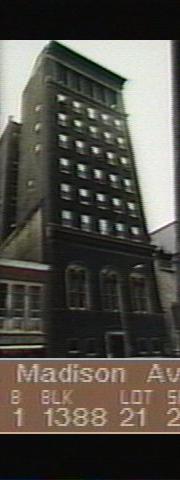
The city photographed every building for its tax records around 1940 and again in the 1980s. NYC Municipal Archives.
Written with AI from the source each entry cites, then fact-checked.
- 1858
The Phillips Church opens at Madison Avenue and 73rd Street on land given by James Lenox
In 1858 the downtown Fifteenth Street Presbyterian Church started a similar outreach ministry at Madison Avenue and 73rd Street. Called the Phillips Church, it occupied a plot donated by James Lenox, a prominent New Yorker and committed Presbyterian. In 1898 it merged with Madison Avenue Presbyterian, and its sanctuary was later demolished to make way for the present church.
Source: mapc.com
- 1901
The merged congregation moves into a new sanctuary on 73rd Street
After the 1898 merger, Madison Avenue Presbyterian sold its property at Madison Avenue and 55th Street and used the proceeds to build a new sanctuary on the 73rd Street site. The three-story church house behind the old Phillips sanctuary was kept and built into the new structure, and the original name still appears over the 73rd Street door. The combined congregation began its ministry here when the sanctuary was finished in 1901.
Source: mapc.com
- 1917
An eleven-story Church House with gyms, bowling alleys and a pool is dedicated
Edward S. Harkness had bought a carriage house next to the sanctuary in 1910 and given it to the church. By 1917 the congregation replaced it with an eleven-story Church House for classes, meetings, clubs and offices. It also held two gyms, two bowling alleys, housing for outreach staff, a covered roof garden with a projector, and a swimming pool.
Source: mapc.com
- 1923
Casavant nearly doubles the church organ as its Opus 1000
Soon after the church was finished, Hook & Hastings of Boston had built a three-manual organ of 34 stops. In 1923 Casavant Frères of Ste. Hyacinthe, Quebec, nearly doubled its size as their Opus 1000, following the specifications of organist Seth Bingham. The rebuilt instrument had a four-manual console and orchestral colors including a harp and a celesta stop. A planned Echo organ for the church tower was never completed.
Source: mapc.com
- 1936
Fred Trump and Mary Anne MacLeod marry here, with George Buttrick officiating
The real-estate developer Fred Trump married Mary Anne MacLeod, a Scottish immigrant raised in the Presbyterian faith, at the church on January 11, 1936. George Arthur Buttrick, the church's minister, performed the ceremony. A reception for 25 guests followed at the Carlyle Hotel, and the couple honeymooned in Atlantic City. Their son Donald was born in 1946.
Source: Wikipedia
- 1939
Under George Buttrick the church becomes New York's largest Presbyterian congregation
George Arthur Buttrick was called as pastor in 1927. By 1939 the congregation had 2,857 members, making it the largest Presbyterian congregation in New York City. The church's own history notes that, looking back at the end of the twentieth century, Buttrick was ranked as the third most influential preacher of the century, behind only Billy Graham and Martin Luther King Jr.
Source: mapc.com
- 1958
Novelist Frederick Buechner is ordained in the church where he first heard Buttrick preach
Frederick Buechner, a published novelist, was ordained at Madison Avenue Presbyterian on June 1, 1958, as an evangelist, meaning a minister without a pastoral charge. About four years earlier he had come to hear George Buttrick preach and was moved to astonished tears, which led him to seminary. Buttrick himself joked that trading a good novelist for a mediocre preacher would be a pity.
Source: Wikipedia
- 1997
Falling ceiling plaster prompts a $12 million Fund for Renewal campaign
By the early 1990s the church's facilities were showing their age. Plaster coming down from the sanctuary ceiling prompted the Fund for Renewal, a $12 million campaign launched in 1997. The money paid to renovate and modernize the sanctuary and parish hall and to replace the Church House elevators. A columbarium was later added next to the sanctuary.
Source: mapc.com
Further reading
- Madison Avenue Presbyterian ChurchWikipedia
Nearby
- 778 Park Avenue6 entries
- Breuer Building (945 Madison Avenue)945 Madison Avenue | 13 entries
- Joseph Pulitzer House11 East 73rd Street | 4 entries
- Oliver Gould Jennings House7 East 72nd Street | 10 entries
- McCready House4 East 75th Street | 5 entries
- 927 Fifth Avenue927 5th Avenue | 7 entries