Salmon Tower Building
11 West 42nd Street | also 20 West 43rd Street | Midtown | built 1926
Open on the map10 entries

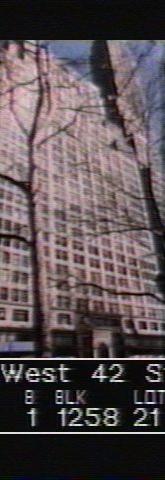
The city photographed every building for its tax records around 1940 and again in the 1980s. NYC Municipal Archives.
Written with AI from the source each entry cites, then fact-checked.
- 1833
Lowes Lane, an old pre-grid road through the site, is closed
Before Midtown's street grid, Lowes Lane ran from the Eastern Post Road at Third Avenue and 41st Street to the Bloomingdale Road at Broadway and 44th Street. Its path cut through the ground where the Salmon Tower now stands. As the city spread northward, the road was closed in 1833.
Source: Forgotten New York
- 1928
York & Sawyer design the entrance gateways, with Guastavino tile in the lobby
Walter J. Salmon commissioned Albert J. Wilcox as architect, while the firm York & Sawyer designed the entrance. The gateway on West 42nd Street is matched by an identical one at 20 West 43rd Street, and the lobby ceiling uses Guastavino tiles. The carved figures above the entrances include nine men, four women and two dogs holding a T-square, a cogwheel and books, with one woman kneeling to type.
Source: Forgotten New York
- 1928
Walter J. Salmon completes a 31-story Midtown office tower
Developer Walter J. Salmon Sr., operating as 11 West 42nd Street, Inc., completed this 370-foot, 31-story tower in early 1928 to designs by architect Albert J. Wilcox. More than half of its office space was already leased by the time it opened.
Source: Wikipedia
- 1928
The tower's entrances are carved with the twelve zodiac signs
Above the building's 42nd Street entrance, the stone facade is carved with twelve detailed zodiac signs, each labeled with its corresponding months, topped by carved figures representing different professions.
Source: Ephemeral New York
- 1928
The tower serves as Herbert Hoover's New York campaign headquarters
In 1928, the same year it opened, the tower housed the New York City headquarters for Herbert Hoover's successful campaign for the presidency of the United States.
Source: Wikipedia
- 1941
Elevator operators strike, leaving only four of eighteen elevators running
On the morning of September 25, 1941, the building's elevator operators went on strike, and only four of its eighteen elevators were in service. The 31-story tower, finished in 1928, was built by a company led by Walter J. Salmon Sr.
“In September 1941, elevator operators in the building went on strike so only four of its eighteen elevators were operating on the morning of September 25.”
Source: Wikipedia
- 1952
A subbasement fire overcomes five firemen with smoke
In October 1952 a fire in the Salmon Tower's subbasement overcame five firemen with smoke inhalation. The 31-story tower stands at 11 West 42nd Street, near Bryant Park.
Source: Wikipedia
- 1964
The Hoffman estate sells the tower after more than sixty years of ownership
The estate of Charles Frederick Hoffman sold the Salmon Tower Building in June 1964, ending an ownership of over sixty years. The property was assessed at $5.25 million and sat on a 34,309-square-foot lot.
“Salmon Tower Building was sold by the estate of Charles Frederick Hoffman in June 1964, following an ownership of over sixty years.”
Source: Wikipedia
- 1991
The New Yorker magazine moves its offices into the tower
The New Yorker magazine kept its editorial offices in the building for eight years, moving in during 1991 and moving out in 1999 for 4 Times Square.
Source: Wikipedia
- 2007
Coliseum Books, the tower's ground-floor bookstore, goes out of business
Coliseum Books, which Ephemeral New York calls one of the city's premier independent bookstores, made its last home on the ground floor of 11 West 42nd Street. The store went out of business in 2007, a loss the blog describes as a bittersweet note in the tower's story.
Source: Ephemeral New York
Further reading
- Salmon Tower BuildingWikipedia
- The zodiac symbols on a Bryant Park office towerEphemeral New York
Nearby
- Aeolian Building33 West 42nd Street | 8 entries
- 500 Fifth Avenue500 5th Avenue | 10 entries
- Princeton Club of New York15 West 43rd Street | 5 entries
- Manufacturers Trust Company Building (510 Fifth Avenue)510 5th Avenue | 14 entries
- Century Association Clubhouse7 West 43rd Street | 13 entries
- 520 Fifth Avenue9 entries