Manufacturers Trust Company Building (510 Fifth Avenue)
510 5th Avenue | also 2 West 43rd Street | Midtown | built 1954
Open on the map14 entries

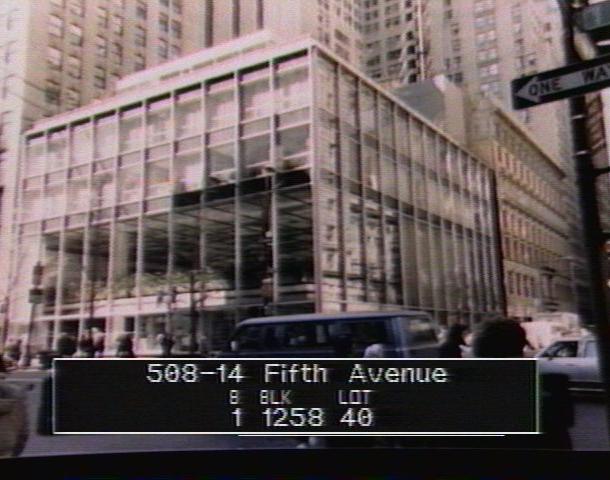
The city photographed every building for its tax records around 1940 and again in the 1980s. NYC Municipal Archives.
Written with AI from the source each entry cites, then fact-checked.
- 1900
The eight-story Ziegler Building, home to Dunhill, stands on the corner before the bank
The eight-story Ziegler Building at 510-514 Fifth Avenue, built around 1900, occupied the corner before the bank. In the 1920s and 1930s it housed the London tobacconist Alfred Dunhill along with lawyers, accountants and insurance brokers. By 1941 Mutual Life Insurance Company owned it and neighboring 508 Fifth, when Manufacturers Trust, then in a branch at 513 Fifth Avenue, began talks to lease them for a new bank building.
- 1927
Walter Salmon leases the house at 508 Fifth Avenue to build a taller neighbor
In 1927 developer Walter J. Salmon took a long lease on a converted four-story dwelling at 508 Fifth Avenue, part of this corner. Combining its zoning lot with his 500 Fifth Avenue site let him build a taller tower than the code would otherwise allow. The house was sublet to firms including Gotham Silk Hosiery and the Huyler's candy shop, and a 1944 agreement tied to his lease later limited the height of the bank that replaced it.
- 1944
Walker & Gillette file plans for a four-story Federal Classic bank here, and the bank shelves them
In October 1944 Mutual Life agreed to build the bank a new home on the site, and that December architects Walker & Gillette filed plans for a four-story building in the Federal Classic style. Wartime material limits and rent rules protecting the old buildings' tenants stalled it, and the bank canceled the plan in 1948. After negotiations it revived the project in July 1950 under Walker & Poor.
- 1951
New Korean War steel limits strand the bank with an empty eight-story building
Manufacturers Trust leased the site from Mutual Life in October 1944, but wartime limits stalled the project and the bank cancelled the plans in 1948 before reviving them in July 1950. In January 1951 the insurer delivered the Ziegler Building empty, and the day after the last office tenant left, new federal limits on steel arrived with the Korean War. Facing rent on a vacant building, the bank leased it to government agencies, and the government released steel in July 1952.
- 1953
Gordon Bunshaft talks the bank into a fresh start, and a weekend contest produces the glass-box idea
Manufacturers Trust consulted Skidmore, Owings & Merrill in 1953 on the advice of director Lou Crandall, whose Fuller Construction Company had built Lever House. The bank only wanted its old plans reviewed, but about an hour after their first meeting Gordon Bunshaft phoned Crandall to argue for starting over. Louis Skidmore then ran a weekend contest among the firm's young designers, and Charles Evans Hughes III won with a glass-walled four-story sketch.
“Bunshaft called to convince Crandall that it would be unwise to try to save a small amount of money on engineering fees…”
- 1954
A glass box with no Fifth Avenue entrance announces itself with a visible steel vault
The Skidmore, Owings & Merrill design is a clear-glass box on a 100-by-125-foot corner lot. Its Fifth Avenue front has no door and no sign; the gleaming steel vault visible through the plate glass shows what the building is, and customers enter on West 43rd Street. The second-story panes, 9 feet 8 inches by 22 feet and 1,500 pounds, were the largest then installed in any building, and Lewis Mumford likened the whole to a lantern.
“…the building’s use was to be indicated solely by the gleaming polished steel vault visible through the plate glass window…”
- 1954
The branch opens as a 'giant showcase,' in the words of the bank's president
When the branch opened in September 1954, president Horace Flanigan told the press that the glass walls gave the bank an inviting look and turned it into a giant showcase day and night, a selling idea he considered new in banking. Bunshaft likened the street floor to a store, with a ten-cents-a-check department where customers cashed checks and left fast, and heavy traffic on paydays.
“These walls give the bank a wide-open, inviting look and turn it, day and night, into a giant showcase.”
- 1954
Sculptor Harry Bertoia suspends a cloud-like artwork above the escalators
The interior designer was Eleanor H. Le Maire, and the sculptor Harry Bertoia was commissioned for the bank's artwork. Above the pair of freestanding escalators beside the Fifth Avenue windows he hung an unnamed cloud-like piece from wires. The escalator sides were clad in backlit aluminum panels with a straw-gold finish, and the original escalators were replaced in the 2010s.
Source: Wikipedia
- 1955
Savings accounts at the glass branch triple within nine months
Nine months after the glass-walled branch opened, the Times reported that its savings accounts had tripled, and its special checking and commercial accounts had doubled, compared with the old branch across the street. Vice president Harold Miner credited the glass building. The result pushed Manufacturers Trust to modernize other branches in the same style.
“…nine months after the new branch opened the Times reported that the branch's savings accounts had tripled…”
- 1985
Owners fight the first attempts to landmark the bank
The Landmarks Commission first looked at the building in 1979, when it was too new to qualify. Hearings on protecting the exterior followed in 1985 and 1986, with Manufacturers Hanover, the bank's successor, and the landlord Mutual Life opposed. Three further hearings took place across 1989 and 1990, when bank closings in the city renewed interest in saving such buildings. Designation did not come until 1997.
Source: Wikipedia
- 1997
The city designates the former bank a landmark
The Landmarks Preservation Commission designated the former Manufacturers Trust building, by then a Chase branch, on October 21, 1997. At the September 16 hearing five witnesses spoke in favor, a Chase representative also spoke, and nobody opposed. Community Board 5 had passed a resolution of support. The commission called it one of the first U.S. bank buildings to bring International Style modernism to the design of a bank.
“Five witnesses spoke in favor of designation. A representative of Chase Bank also spoke. There were no speakers in opposition to designation.”
- 2001
Chase sells the bank building after a fight with designer Elie Tahari
By 2000 Chase wanted to sell the building, where fashion designer Elie Tahari ran a design studio and sample room. The bank sued him over an alleged fire hazard, claiming he refused to install sprinklers, while a garment workers' union said it was a ploy to boost the sale price. Tahari stayed. In 2001 Chase sold the building to Tahl-Propp Equities for $24 million, and the buyer made Tahari a limited partner.
Source: Wikipedia
- 2011
Landmarks Commission protects the bank's first two floors after the Bertoia art is taken down
After Vornado bought the building in October 2010, Chase closed its branch and, as its lease required, had Harry Bertoia's second-floor sculpture taken apart. The removal alarmed preservationists, who pressed for protection of the interiors. On February 15, 2011, the Landmarks Commission designated the first- and second-floor banking spaces as interior landmarks, citing the ceilings, plans and minimalist design.
“A separate landmark designation was granted to a portion of the interior on February 15, 2011, covering the banking spaces on the first and second floors.”
Source: Wikipedia
- 2012
SOM returns to convert the bank to retail, and a settlement puts the Bertoia artwork back
After Vornado bought the building in 2010, preservationists sued over plans to remodel it, and a settlement in February 2012 had the Bertoia artwork reinstalled. Skidmore, Owings & Merrill, the original architects, worked on the conversion to retail, which relocated the escalators and restored the facade, interior columns and a replica of the luminous ceiling. The exterior had been landmarked in 1997 and the interior in 2011.
Source: Wikipedia
Further reading
- Manufacturers Trust Company BuildingWikipedia
Nearby
- 500 Fifth Avenue500 5th Avenue | 10 entries
- 520 Fifth Avenue9 entries
- Century Association Clubhouse7 West 43rd Street | 13 entries
- Salmon Tower Building11 West 42nd Street | 10 entries
- Princeton Club of New York15 West 43rd Street | 5 entries
- Mansfield Hotel12 West 44th Street | 4 entries