Century Association Clubhouse
7 West 43rd Street | also 5 West 43rd Street | Midtown | built 1891
Open on the map13 entries

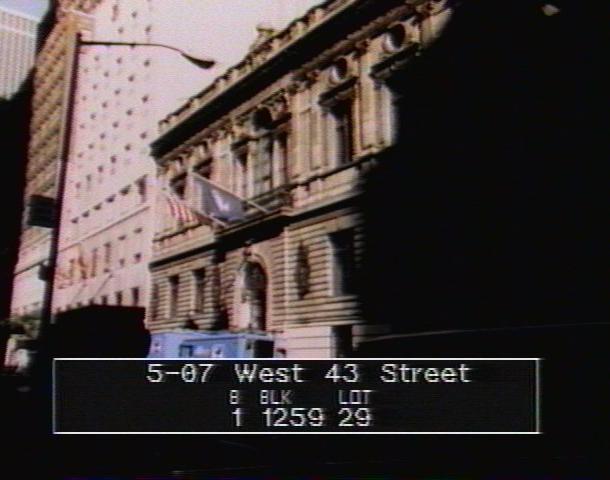
The city photographed every building for its tax records around 1940 and again in the 1980s. NYC Municipal Archives.
Written with AI from the source each entry cites, then fact-checked.
- 1889
Stanford White of McKim, Mead & White designs the Century's Italian Renaissance clubhouse
Construction began in 1889 and finished in 1891 on a four-story palazzo of granite, terra cotta and brick. Stanford White was the partner in charge for McKim, Mead & White. A two-story rusticated base and a monumental arched doorway lead up to a central Palladian window, originally an open loggia, and four wreathed round windows sit above the third-floor windows.
“Stanford White, the partner in charge of this project, was renowned for his talent as a designer…”
- 1891
The Century Association opens its new clubhouse on West 43rd Street
The club opened its new building at 7 West 43rd Street on January 10, 1891. At a business meeting presided over by Episcopal Bishop Potter, members heard the construction cost was $227,673, of which the club still owed just $7,327. A show of paintings in the new art gallery was planned for three days later, open to women only by card, since women could not belong.
Source: Daytonian in Manhattan
- 1896
Elijah Hicks, a Harlem-born hallman, begins nearly four decades of greeting Century members at the door
The club hired Elijah Hicks as hallman in 1896, and he welcomed members at the door until his death in 1934. His passing was deeply mourned: the poet Robert U. Johnson composed a sonnet to honor him, and a group of members attended his funeral in Harlem. The New York Times remarked that no one could imagine the club without him.
Source: Daytonian in Manhattan
- 1915
Theodore Marburg proposes the League to Enforce Peace at the Century
The League to Enforce Peace was created in 1915 after Theodore Marburg proposed it at the Century. The organization continued to hold its dinners at the club in 1916 and 1917, at the clubhouse on West 43rd Street.
Source: Wikipedia
- 1919
A pantry becomes the club's bar as Prohibition begins, and members keep their own liquor in lockers
When Prohibition began under the Volstead Act in 1919, the Century turned a pantry into its bar. The club neither sold nor served alcohol, but members stored their own liquor in lockers and poured for themselves at the bar, so extra lockers were added. After repeal, the first bottle served was an Italian Swiss Colony bottle signed by nine members, and it stayed on the bar for years.
“At the start of the Prohibition era, a pantry was converted into the club's bar.”
Source: Wikipedia
- 1964
Novelist Ralph Ellison joins the Century as its first African-American member elected in the 1900s
Ralph Ellison, author of Invisible Man, belonged to the Century Association from 1964 to 1994. The club's archives foundation names him the first African American elected to membership in the twentieth century. The foundation has acquired copies of more than 400 pages of Century-related material from his papers, which are held at the Library of Congress.
Source: centuryarchives.org
- 1967
The Landmarks Commission designates the clubhouse after hearings with no opposition
The Landmarks Preservation Commission designated the Century Association building on January 11, 1967. Three witnesses spoke for designation at the first hearing in May 1966, and a club representative backed it when the hearing resumed in June. Nobody spoke against. The report calls the facade New York's clearest statement of the Renaissance spirit in which Stanford White worked.
“There were no speakers in opposition to designation at either hearing.”
- 1987
A straw poll finds 71 percent of Centurions would admit women if the city law stands
In a mail ballot reported by The New York Times in 1987, 71 percent of members who replied favored admitting women if the Supreme Court upheld the city's anti-discrimination law, with 28 percent opposed. About 70 percent of the 1,900 members responded. A poll about two years earlier had split almost evenly, and a final vote was set for October 1.
Source: Internet Archive
- 1988
The Century admits women as members for the first time, after legislation forces the change
The Century kept women out of membership until 1988, even though activists had pressed the question for many years, and it changed course only after state legislation forced the issue. The club's archives foundation describes the club's main activity as conversation and says it discourages doing business on the premises.
Source: centuryarchives.org
- 1997
The Century Association Archives Foundation is formed for the club's 150th anniversary
In 1997, the club's sesquicentennial year, the Century Association Archives Foundation was set up to look after the club's records. Historian Arthur Schlesinger Jr. and Ambassador William vanden Heuvel led the effort with club archivist Henry S. F. Cooper Jr. Until then the papers had been moved between the top and bottom floors of the clubhouse, and many showed the effects of neglect.
Source: centuryarchives.org
- 2002
Members fight over a plan to add 15 guest bedrooms atop the Stanford White clubhouse
In January 2002 the club's managers proposed adding an extra floor to the building to hold 15 guest bedrooms. They said rental income was needed for the club's future; opponents balked at a $6.5 million loan and construction over two successive summers. Some members feared a hotel atmosphere. After skeptical questions at a January 8 meeting, president Louis Auchincloss postponed the vote.
Source: Internet Archive
- 2009
A purpose-built archives room is added during the fifth-floor renovation
In 2009 the clubhouse's fifth-floor renovation included a specially designed archives room. It houses the collections and the archivist's office, and it is where researchers can consult the club's historical records. The Century is unusual among New York's private clubs in employing a full-time professional archivist.
Source: centuryarchives.org
- 2011
Black-tie speeches split members over the Garrick Club tie
By February 2011 the Century was in turmoil over whether to end its reciprocity agreement with London's all-male Garrick Club, which admitted women only as guests of men. About 50 members had signed a petition. Speeches were given in black tie and treatises circulated, and the board wrote that the issue had caused uncharacteristic disharmony.
Source: Internet Archive
Further reading
- Century AssociationWikipedia
- The Century Association - 7 West 43rd StreetDaytonian in Manhattan
Nearby
- Princeton Club of New York15 West 43rd Street | 5 entries
- 520 Fifth Avenue9 entries
- Mansfield Hotel12 West 44th Street | 4 entries
- Manufacturers Trust Company Building (510 Fifth Avenue)510 5th Avenue | 14 entries
- Salmon Tower Building11 West 42nd Street | 10 entries
- 500 Fifth Avenue500 5th Avenue | 10 entries