Alexander Roux's Marble Building
110 Reade Street | Tribeca | built 1861
Open on the map5 entries

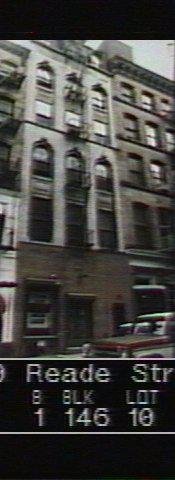
The city photographed every building for its tax records around 1940 and again in the 1980s. NYC Municipal Archives.
Written with AI from the source each entry cites, then fact-checked.
- 1861
Cabinetmaker Alexander Roux leases land from Trinity Church and has a marble-fronted building raised at 110 Reade
In 1860 Trinity Church leased the lot to furniture maker Alexander Roux, whom Daytonian in Manhattan ranks with John Henry Belter as one of the era's two costliest Victorian furniture makers. The five-story Italianate building, faced in white marble, was finished in 1861. Roux seems not to have used it himself. In 1862 a grocery occupied the ground floor.
Source: Daytonian in Manhattan
- 1871
Architect John G. Prague adds a Second Empire mansard roof to 110 Reade Street
John G. Prague was hired to modernize and enlarge Roux's building, adding a sixth floor as a slate-shingled mansard with three arched dormers. The Fire-Proof Building Co. used it in an advertisement, claiming that insurance on the building dropped by 90 cents per $100 after its fireproof lining was installed in the mansard.
Source: Daytonian in Manhattan
- 1880
Victor E. Mauger's firm at 110 Reade sells playing cards, baby food and a malaria pill
Victor E. Mauger was listed at the building by 1865 as a stationery importer with a playing card factory upstairs, and he apparently managed the building for Roux. With partner John Petrie, his firm branched into wines, Victor Baby Food (introduced around 1880), Chinkalyptus pills advertised as a cure for chills and fever, an American-made Worcestershire sauce and leg splints. Mauger and Petrie retired in 1882.
Source: Daytonian in Manhattan
- 1907
Carl H. Krieg & Co., the shoe-findings wholesaler, advertises "Everything but the Shoe" from 110 Reade
By 1904 Carl H. Krieg & Co. sold accessories and store fittings for shoe retailers from the building, and its catalog was called the most complete in the trade. The Boot and Shoe Recorder in 1907 called it the leading wholesale finding establishment of the city. The firm advertised itself as "The House of Krieg" with the tag line "Everything but the Shoe."
Source: Daytonian in Manhattan
- 1972
Living Module, Inc., designs custom interior environments from 110 Reade Street
By 1972, as Tribeca grew fashionable, the building housed Living Module, Inc., which crafted custom interiors for apartments. That year it set up a bedroom for children on the Upper West Side, which journalist Rita Reif described in the Times two years later, noting that Douglas White needed three weeks to install bridges, a bed, ladders and a basketball court. The upper floors became residences in 1982.
Source: Daytonian in Manhattan
Further reading
- The Marble-Fronted 110 Reade Street Daytonian in Manhattan
Nearby
- John H. Fraser Building112 Reade Street | 5 entries
- 104 Reade Street3 entries
- 150 Duane Street5 entries
- 148 Duane Street1 entry
- Nathaniel Fisher & Co. Building146 Duane Street | 5 entries
- De Raismes Building111 Reade Street | 4 entries