John H. Fraser Building
112 Reade Street | also 109 West Broadway | Tribeca | built 1860
Open on the map5 entries

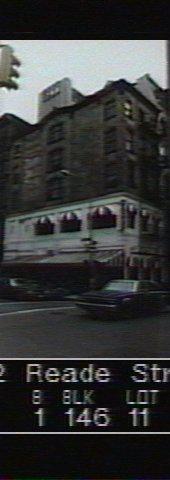
The city photographed every building for its tax records around 1940 and again in the 1980s. NYC Municipal Archives.
Written with AI from the source each entry cites, then fact-checked.
- 1860
Thatcher Payne, brother of the 'Home, Sweet Home' author, completes a store-and-loft building at 112 Reade Street
Attorney Thatcher T. Payne started building on the northeast corner of Reade Street and West Broadway in 1859, and the Italianate store and lofts opened in 1860. Its sandstone front and cast-iron storefront faced Reade Street, while the grouped arched windows on the West Broadway side drew the most attention. Payne's late brother John Howard Payne had written the song 'Home, Sweet Home'. Upstairs tenants used the side address, 113 West Broadway.
Source: Daytonian in Manhattan
- 1860
Show-case maker John H. Fraser moves in; within months, a clerk he trusted with $50 is arrested after losing it
John H. Fraser, said by the Times to have been the first show-case manufacturer in America, moved into the new building in 1860. That June his employee Henry Sayers lost a tobacco box holding a $50 bill Fraser had entrusted to him, and Sayers was arrested for larceny. He advertised in the papers, the box and bill turned up, and Justice Kelly freed him. Fraser bought the building in 1872.
Source: Daytonian in Manhattan
- 1893
A saloon takes the Reade Street storefront in 1893 and keeps it a tavern for decades
After a paint dealer went bankrupt in 1891, Friedrich Hikler leased the whole store in February 1893 for about nine years at $3,250 a year. He ran a saloon and later advertised the two unneeded basement levels for rent. From December 1902 breweries held the lease, first Peter Doelger and, from 1904, the Lion Brewery, and in 1913 Frank Vogric renamed it Vogric's Cafe, with an awning advertising Ruppert's Knickerbocker Beer.
Source: Daytonian in Manhattan
- 1903
Author Edward Earle Purinton keeps an office upstairs and weighs in on why men marry the wrong women
Edward Earle Purinton, a prolific author on a wide range of subjects, rented an upper-floor office at 112 Reade Street in 1903. Among architects and a show-case workshop, he answered a September 1903 Evening World question from columnist Harriet Hubbard Ayer about why men marry the wrong women. He argued that sympathy is the key trait of an ideal wife and put the blame for failed marriages on husbands.
Source: Daytonian in Manhattan
- 1921
After Prohibition ends the saloon, the Crescent Shoe Company moves in and the cast-iron storefront comes out
Prohibition closed the bar in 1920, and the Crescent Shoe Company moved in during 1921, joining the shoe trade that had spread through the neighborhood. Alterations that year removed the cast-iron storefront, and architect Samuel Rosenblum did more work in 1923, putting offices on the first two floors. The pediment eagle had vanished by then. A 2012 conversion produced one large apartment on each of the top three floors.
Source: Daytonian in Manhattan
Further reading
- The John H. Fraser Bldg - No. 112 Reade StreetDaytonian in Manhattan
Nearby
- Alexander Roux's Marble Building110 Reade Street | 5 entries
- 104 Reade Street3 entries
- 150 Duane Street5 entries
- 148 Duane Street1 entry
- Nathaniel Fisher & Co. Building146 Duane Street | 5 entries
- De Raismes Building111 Reade Street | 4 entries