Morris K. Jesup House
111 East 19th Street | Gramercy | built 1910
Open on the map4 entries

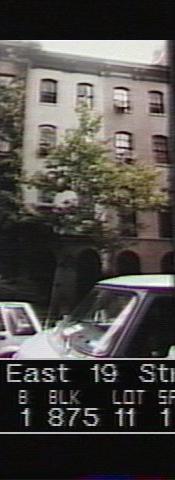
The city photographed every building for its tax records around 1940 and again in the 1980s. NYC Municipal Archives.
Written with AI from the source each entry cites, then fact-checked.
- 1855
Thomas Oakley builds twin brownstones on East 19th Street
Former congressman and judge Thomas J. Oakley erects two matching four-story Anglo-Italianate houses on vacant lots behind his own Gramercy Park residence. Unlike the steep stoops of neighboring Greek Revival rowhouses, the pair sits nearly at sidewalk level, with interiors finished in carved marble mantels and stained-glass skylights.
Source: Daytonian in Manhattan
- 1860
Banker Morris K. Jesup founds a charity while living on East 19th Street
Banker and philanthropist Morris K. Jesup, a partner in the firm Clark & Jesup, leases the house from Judge Oakley in the years before 1868. While living there he organizes the Five Points House of Industry in 1860 and later helps found the United States Christian Commission, part of a long career of large-scale charitable giving.
Source: Daytonian in Manhattan
- 1870
A funeral refusal here gives "the little church around the corner" its name
Episcopal minister William Tufnell Sabine, who succeeds the Jesups as tenant of the East 19th Street house, refuses in 1870 to hold a funeral for actor George Holland at his Church of the Atonement, saying he did not conduct funerals for entertainers. Sabine recommends a nearby congregation instead, coining the phrase that becomes the enduring nickname of the Church of the Transfiguration.
Source: Daytonian in Manhattan
- 1946
The house returns to single-family use after decades as a boardinghouse
After nearly fifty years as a rooming house, home to bachelor bankers, graphic artists and at least one novelist, the East 19th Street house is bought by Ann Kennedy in 1946 and converted back into a private residence. It has remained a single-family home ever since, one of the few on the block never divided into apartments.
Source: Daytonian in Manhattan
Further reading
- The Morris K. Jessup House - 111 East 19th StreetDaytonian in Manhattan
- The 1855 No. 111 East 19th StreetDaytonian in Manhattan
- The 1855 No. 111 East 19th StreetDaytonian in Manhattan
Nearby
- National Arts Club15 Gramercy Park South | 4 entries
- The Players16 Gramercy Park South | 11 entries
- Parker Building225 Park Avenue South | 4 entries
- 18 Gramercy Park South4 entries
- James Harper House4 Gramercy Park West | 3 entries
- Stuyvesant Fish House19 Gramercy Park South | 11 entries