National Arts Club
15 Gramercy Park South | also 15 East 20th Street | Gramercy | built 1883
Open on the map4 entries

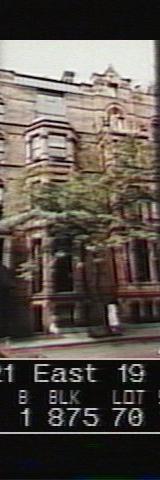
The city photographed every building for its tax records around 1940 and again in the 1980s. NYC Municipal Archives.
Written with AI from the source each entry cites, then fact-checked.
- 1876
Samuel Tilden wins the popular vote but loses a contested election
While living at his Gramercy Park townhouse, Governor Samuel Tilden ran for president in 1876 and won the national popular vote. He lost the presidency to Rutherford B. Hayes after a disputed electoral count, a resolution widely seen as marking the end of Reconstruction. Tilden had earlier built his reputation fighting the Tweed Ring and Tammany Hall.
Source: Wikipedia
- 1884
Calvert Vaux finishes joining two rowhouses into Samuel J. Tilden's mansion
Samuel J. Tilden, governor of New York from 1875, won the popular vote for president in 1876 but lost the Electoral College to Rutherford B. Hayes. He had bought No. 15 and then No. 14 Gramercy Park South in the 1860s, and from 1881 to 1884 Calvert Vaux combined them into a single Victorian mansion. Tilden fitted it with rolling steel doors and an escape tunnel, and lived there until his death in 1886.
Source: Wikipedia
- 1906
The National Arts Club moves into the former Tilden mansion
Founded in 1898 by Charles DeKay, an art and literary critic for The New York Times, the National Arts Club admitted women as full and equal members from the start. It bought the Tilden house in 1906 and has made it its clubhouse ever since. The building became a city landmark in 1966 and a National Historic Landmark in 1976.
Source: Wikipedia
- 1976
The Tilden House earns National Historic Landmark status
New York City had already designated the joined Gramercy Park townhouses a landmark in 1966, protecting the building where Samuel Tilden lived until his death in 1886. The federal government added National Historic Landmark status a decade later, in 1976, citing it as the only surviving residence linked to Tilden's life.
Source: Wikipedia
Further reading
- Samuel J. Tilden HouseWikipedia
Nearby
- The Players16 Gramercy Park South | 11 entries
- Morris K. Jesup House111 East 19th Street | 4 entries
- 18 Gramercy Park South4 entries
- Stuyvesant Fish House19 Gramercy Park South | 11 entries
- James Harper House4 Gramercy Park West | 3 entries
- Parker Building225 Park Avenue South | 4 entries