The Players
16 Gramercy Park South | also 120 East 20th Street | Gramercy | built 1845
Open on the map11 entries

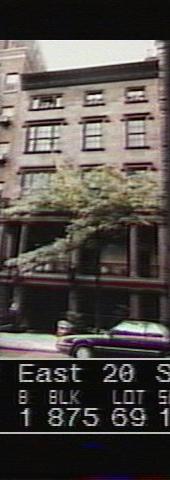
The city photographed every building for its tax records around 1940 and again in the 1980s. NYC Municipal Archives.
Written with AI from the source each entry cites, then fact-checked.
- 1865
General Robert B. Potter, shot at Petersburg, recovers in the house on Gramercy Park
Before it was a club, No. 16 was the 1847 Gothic Revival brownstone of Robert B. Potter, son of the Bishop of Philadelphia. A year before the war ended he stopped there on his way south to command a division of the 9th Army Corps. On April 2, 1865 he was shot through the body in the assault on the Confederate lines at Petersburg, and was carried back to New York to recover at his Gramercy Park home.
Source: Daytonian in Manhattan
- 1882
Judge and congressman Clarkson N. Potter dies in the house that will become The Players
Clarkson Nott Potter, who had taken the house over when his brother left for England in 1869, died there on January 23, 1882, aged 58. A lawyer, judge and civil engineer, he served in Congress from 1869 to 1875 and presided over the American Bar Association in 1881 and 1882. He left the house to his wife Virginia, who stayed six more years among neighbors such as Samuel Tilden and Stuyvesant Fish.
Source: Daytonian in Manhattan
- 1888
Edwin Booth founds The Players in his remodeled Gramercy Park mansion
The actor Edwin Booth bought this 1840s house on Gramercy Park South in 1888 and had Stanford White remodel it as the home of a new private club. The Players was established on December 31, 1888. Its founding members included Mark Twain, General William Tecumseh Sherman and the actor Lawrence Barrett.
Source: Wikipedia
- 1888
Edwin Booth keeps one photograph of his brother in his third-floor rooms
Booth kept the third floor of the new clubhouse as his own apartment, and had the fireplace from his Boston home put in there. Of all the reminders of his brother John Wilkes Booth, the assassin of Lincoln, he kept only a single framed photograph. The library on the second floor was meanwhile filling with theatrical memorabilia donated by Booth and other members.
Source: Daytonian in Manhattan
- 1888
Stanford White redesigns The Players' clubhouse interior
After Edwin Booth buys a mansion at 16 Gramercy Park South for his new club, he brings in architect Stanford White to rework its interior and part of the facade. White's 1888 renovation gives the clubhouse its lasting layout. The entryway gaslights from that era still work today, among the few remaining working gas fixtures in New York City.
Source: Wikipedia
- 1893
Edwin Booth dies in his private apartment upstairs at the club
Booth reserved an apartment on an upper floor of the clubhouse for himself and lived there. He died there on June 7, 1893, at the age of 59. The building was named a National Historic Landmark on December 29, 1962.
Source: Wikipedia
- 1962
The Players clubhouse becomes a National Historic Landmark
The federal government designates the Players' Gramercy Park clubhouse a National Historic Landmark, recognizing its connection to Edwin Booth and to American theater history. The building joins the National Register of Historic Places four years later, in 1966. The Players continues to operate as a private club for actors and other artists inside the same mansion.
Source: Wikipedia
- 1987
Members vote to let women join The Players as full members
In September 1987 the club voted to allow women full membership; before then the widows of members had only limited privileges, which began in the 1970s. The change also let the Players rent its rooms for outside functions, which city law had not allowed it to do before.
Source: Wikipedia
- 1989
Helen Hayes becomes the first woman admitted to The Players
From its founding by Edwin Booth on December 31, 1888, the club admitted only men. Members voted in September 1987 to open membership to women, and on April 23, 1989, Shakespeare's birthday, the actress Helen Hayes was admitted as the first woman member.
Source: Wikipedia
- 2000
The state attorney general investigates The Players' dealings with its library tenant
The New York State Attorney General's office opened an inquiry in 2000 into how the club dealt with the Hampden-Booth Theater Library, a tenant occupying roughly a third of the building, and with the John Drew Fund, a charity based there. The concern was that the club may have overcharged the library for upkeep and kept too much of the proceeds of a 1984 book sale. The settlement left neither side owing money and required the club to sell its Sargent portrait of Edwin Booth.
“…the club would sell its John Singer Sargent portrait of Edwin Booth to raise money…”
Source: Wikipedia
- 2013
The Players forms a preservation fund as it admits to about $4 million in debt
In June 2013 the club's re-elected president, Johnnie Planco, told members the club owed about $4 million and raised the possibility of selling the clubhouse. A city lien for $250,000 in back taxes was reported too. In October 2013 a nonprofit, The Players, 16 Gramercy Park South Preservation Fund, was formed to restore the deteriorating facade, while renting rooms and film shoots were considered as income.
Source: Wikipedia
Further reading
- The Players (New York City)Wikipedia
Nearby
- National Arts Club15 Gramercy Park South | 4 entries
- 18 Gramercy Park South4 entries
- Morris K. Jesup House111 East 19th Street | 4 entries
- Stuyvesant Fish House19 Gramercy Park South | 11 entries
- James Harper House4 Gramercy Park West | 3 entries
- Parker Building225 Park Avenue South | 4 entries