Thurber, Whyland & Co. Building
112 West Broadway | also 158 Duane Street, 110 West Broadway, 16 Hudson Street | Tribeca | built 1915
Open on the map4 entries

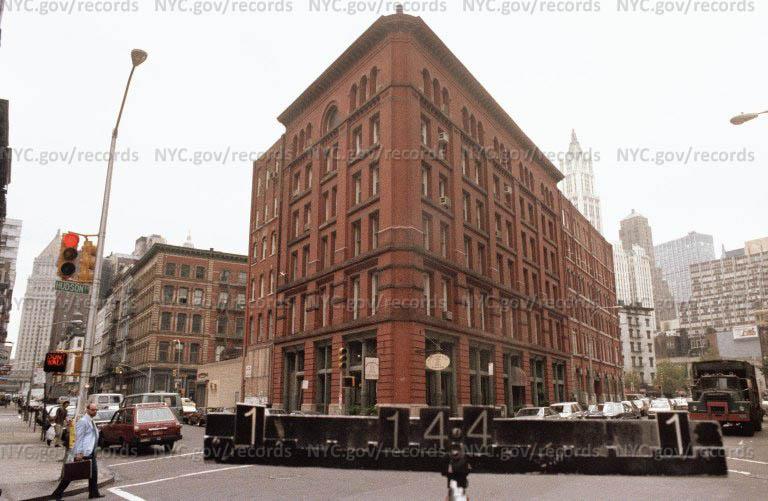
The city photographed every building for its tax records around 1940 and again in the 1980s. NYC Municipal Archives.
Written with AI from the source each entry cites, then fact-checked.
- 1874
Grocer Horace K. Thurber builds a six-story warehouse with a clock in the brickwork
Horace K. Thurber, a grocer and importer, commissioned architect Charles F. Mengelson to design a six-story neo-Grec warehouse here, completed in 1874. Broad ground-floor bays served as loading bays, and a round opening for a clock sat in the Reade Street facade. The Landmarks Preservation Commission notes that its heavy piers and large bays were typical of later warehouses in the district.
- 1890
A prominent neurologist praises the firm's coca wine
Thurber, Whyland & Co., the wholesale grocery firm that occupied the building, kept a chemist who made essences and tonics, including a Wine of Coca. On November 2, 1890, Dr. William A. Hammond told the New York Neurological Society that most coca wines were impure but praised this firm, noting that its product contained a fixed amount of cocaine.
Source: Daytonian in Manhattan
- 1894
The grocery firm collapses in the Panic of 1893 and is reorganized as the American Grocery Co.
Thurber, Whyland & Co. had branches in France and London and a price list covering nearly everything edible. The financial panic of 1893 hurt it badly, though weekly sales were still large, and the firm failed. In June 1894 it was reorganized as the American Grocery Co. Frank B. Thurber stayed on as a director but no longer as an officer.
Source: Daytonian in Manhattan
- 1921
A shoe-factory fire destroys the top floors and leads to conversion into offices
By 1921 the grocery district was turning into the shoe district, and the Merriam Shoe Manufacturing Company occupied the ground floor. On February 8 a fire in its space grew to four alarms. Glue and chemical fumes sent smoke into the Chambers Street subway station. The top floors were nearly destroyed, and a syndicate led by Louis Brodsky and Samuel Augenblick leased the ruin to remodel as offices and stores for about $300,000.
Source: Daytonian in Manhattan
Further reading
- The Thurber, Whyland & Co. Bldg - 16 Hudson StreetDaytonian in Manhattan
- Samuel A. Warner's 1891 160-162 Duane StreetDaytonian in Manhattan
Nearby
- Thurber, Whyland & Co. Building16 Hudson Street | 10 entries
- 132 Reade Street2 entries
- 150 Duane Street5 entries
- John H. Fraser Building112 Reade Street | 5 entries
- Alexander Roux's Marble Building110 Reade Street | 5 entries
- Morse & Rogers Building166 Duane Street | 5 entries