Waring's Building
117 Varick Street | Hudson Square | built 1870
Open on the map5 entries

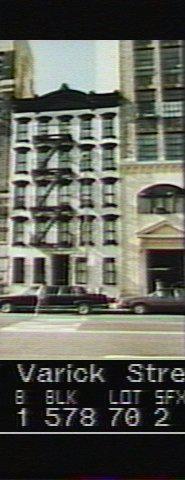
The city photographed every building for its tax records around 1940 and again in the 1980s. NYC Municipal Archives.
Written with AI from the source each entry cites, then fact-checked.
- 1869
Builder William E. Waring buys the brick house on this lot and files plans to replace it
Before the present building, a 30-foot-wide brick house stood here. In the 1830s it stood among respectable residences just north of St. John's Park and was home to Dr. James Vere. That changed after 1867, when Trinity Church sold the land around the park to the Hudson River Railroad for a freight terminal and well-off neighbors left. Waring, a well-known architect of commercial and tenement buildings, bought the house in 1869 and filed plans in December for a five-story tenement, then a term for any multi-family building except a hotel.
Source: Daytonian in Manhattan
- 1870
Waring completes a five-story Italianate building whose cornice reads Waring's Building 1870
The brick building has a central entrance flanked by two shops, with identical upper floors of segmental-arched windows on bracketed sills under molded cornices. An elaborate cast-metal cornice carries an arched pediment inscribed with its name and the year. Inside, each floor held two apartments divided by a central stair hall, rented to working-class tenants. The ground-floor shops were a dry goods store kept by William Adler and a tailor shop run by William Elling.
Source: Daytonian in Manhattan
- 1871
A thief empties William Adler's dry goods store overnight and is arrested six blocks away
William Adler opened his ground-floor dry goods store on Friday morning, February 24, 1871, to find that someone had broken in during the night and taken his entire stock, The New York Times reported. That afternoon police arrested Isaac Payor, whom the paper called a man of suspicious character, on Clarkson Street, six blocks away. He still had $300 worth of Adler's goods with him, equal to about $6,200 in 2018 money.
Source: Daytonian in Manhattan
- 1900
Nora Nethercott, a police officer's widow, lives here on about $200 a year
In 1900 Nora Nethercott, the widow of a police officer, lived in one of the apartments with her 20-year-old son. Her income was $100 a year from her late husband's pension plus another $100 as her son's guardian, roughly $6,000 a year in 2018 money. The next year the son turned 21 and the guardian payment ended, cutting her income in half.
Source: Daytonian in Manhattan
- 1920
Work starts on the Hudson River Vehicular Tunnel, and its Freeman Plaza edges up to the building's south wall
In 1920 construction began on the Hudson River Vehicular Tunnel, later renamed the Holland Tunnel. The project cleared the old St. John's Park freight terminal and replaced it with a system of ramps and approaches covering nearly seven blocks, with Freeman Plaza at its northern end. The plaza came almost up against the south wall of 117 Varick Street and brought traffic jams and honking horns, but the building kept housing blue-collar families.
Source: Daytonian in Manhattan
Further reading
- Waring's Building - 117 Varick StreetDaytonian in Manhattan
Nearby
- 32 Dominick Street House32 Dominick Street | 8 entries
- 34 Dominick Street House34 Dominick Street | 5 entries
- 36 Dominick Street House36 Dominick Street | 4 entries
- Abraham B. Vanderpoel House38 Dominick Street | 7 entries
- The Dominick246 Spring Street | 13 entries
- Chelsea Career & Technical Education High School131 Avenue of the Americas | 2 entries