32 Dominick Street House
32 Dominick Street | Hudson Square | built 1910
Open on the map8 entries

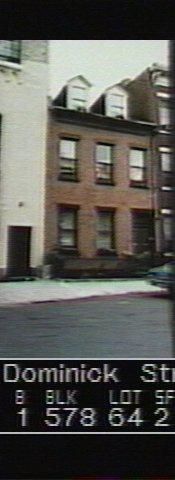
The city photographed every building for its tax records around 1940 and again in the 1980s. NYC Municipal Archives.
Written with AI from the source each entry cites, then fact-checked.
- 1826
Builder Smith Bloomfield puts up no. 32 as one of twelve Federal rowhouses on Dominick Street
On March 10, 1826, three builders bought lots from Robert and Sarah Livingston along the southern side of Dominick Street, between Hudson and Varick, and twelve brick Federal rowhouses went up that year. Smith Bloomfield, a mason, built numbers 28 to 36, including this one. Sarah Livingston had inherited the land from her grandfather Anthony Lispenard.
- 1839
Builder Smith Bloomfield, who rents out no. 32, moves to a New Jersey family farm
Smith Bloomfield, a mason who built many houses on Dominick and North Moore Streets, lived next door at no. 28 in the late 1820s and let tenants live at no. 32, among them a forwarder, John B. Gedney, in 1834, and an agent, Solomon W. Johnson, in 1856. In 1839, with his wealth built up, he moved to a farm in Metuchen, New Jersey, that his family had held for about 175 years. The 1860 census lists him as a farmer, and his estate sold no. 32 in 1866.
- 1862
During the Civil War, no. 32 serves as a polling place and one of its residents is drafted
On October 14, 1862, the New York Times told voters that 32 Dominick Street was the designated place for elections in the Fourth District of the Eighth Ward. The war then reached the house itself: on August 26, 1863, the military draft pulled the name of E. Oven, who lived here, and that of J. Manley, a neighbor at no. 34.
Source: Daytonian in Manhattan
- 1912
The Lithuanian parish of Our Lady of Vilnius takes the house as its rectory
In 1912 Elizabeth W. Morse, who had inherited the house from the carpenter John F. Wilson, conveyed it to the Church of Our Lady of Vilnius. Father Joseph Sestokas had founded the parish in 1905 to serve the city's Lithuanian Catholics, and its church, at 570 Broome Street, was built in 1910. No. 32 served as the church's rectory, and the Archdiocese closed the church in 2007.
“Wilson’s devisee, Elizabeth W. Morse, conveyed the house in 1912 to the Church of Our Lady of Vilnius…”
- 1922
Holland Tunnel works condemn lots on the block and raise Dominick Street, burying stoops
To build the Holland Tunnel, the city condemned six lots in the middle of this block in 1922 and 1923 for the tunnel entrance and raised Dominick Street, which buried the stoops of the surviving houses along the south side. Trucking traffic grew sharply and larger loft buildings went up around the neighborhood. Of the twelve Federal rowhouses built here around 1826, only four survive, one of them no. 32.
“…the raising of Dominick Street, which caused the stoops of the remaining houses on the south side of the block to be buried…”
- 1947
A car stolen outside the rectory is recovered with seven bullet holes after a police shootout
On January 13, 1947, George Gruniskas, who lived in the church rectory here, had his car stolen from the curb outside. On January 27, the car was spotted parked at a curb by patrolmen William Allmendinger and Ernest Vohs, from the East 67th Street station, who and approached with drawn pistols, and the occupants fired at them instead. The officers emptied their pistols as the car pulled away, a chase wound through the Upper East Side to East 83rd Street, and the gunmen abandoned the car and fled on foot. Gruniskas got his car back with seven bullet holes in it.
Source: Daytonian in Manhattan
- 2007
The Archdiocese closes Our Lady of Vilnius, the Lithuanian parish whose address was 32 Dominick Street
On February 27, 2007, the Archdiocese of New York announced that Our Lady of Vilnius, a national parish founded in 1905 for Lithuanian Catholics, was closed effective immediately, following an announcement on January 19. Its statement gave the parish address as 32 Dominick Street, across from the Holland Tunnel entrance. It said Sunday and holy-day Masses drew six to thirty people and were said in English because the priest did not speak Lithuanian.
Source: archny.org
- 2012
The city landmarks nos. 32, 34 and 36 Dominick Street, with no. 32 the best preserved of the trio
On March 27, 2012, the Landmarks Preservation Commission designated nos. 32, 34 and 36 Dominick Street, three of Manhattan's oldest houses. No. 32 is the best Federal-style example of the trio; it keeps its original height of two and a half stories, its brick laid in Flemish bond, and a high peaked roof with dormers. Nos. 34 and 36 each gained a third story and an Italianate cornice in 1866, and a fourth survivor, no. 38, was judged too altered to designate.
Source: Village Preservation
Nearby
- 34 Dominick Street House34 Dominick Street | 5 entries
- 36 Dominick Street House36 Dominick Street | 4 entries
- Abraham B. Vanderpoel House38 Dominick Street | 7 entries
- Waring's Building117 Varick Street | 5 entries
- New York City Fire Museum278 Spring Street | 5 entries
- Thomas S. Jaycox House284 Hudson Street | 5 entries