Abraham B. Vanderpoel House
38 Dominick Street | Hudson Square | built 1901
Open on the map7 entries

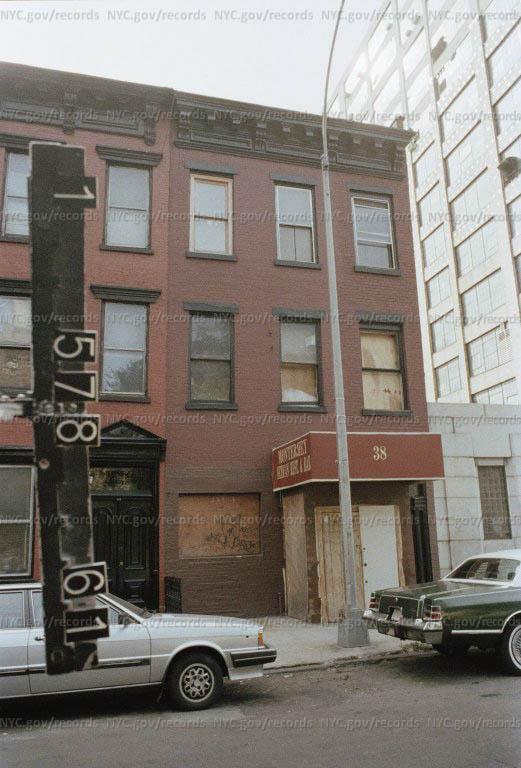
The city photographed every building for its tax records around 1940 and again in the 1980s. NYC Municipal Archives.
Written with AI from the source each entry cites, then fact-checked.
- 1826
Builder Azariah Ross buys the lot and puts up No. 38 as one of twelve Federal row houses
Around 1826 builder Azariah Ross constructs Nos. 38 to 46 on the south side of Dominick Street, part of a row of twelve Federal-style brick houses between Hudson and Varick Streets. Smith Bloomfield built Nos. 28 to 36 and Joshua Brush the last two. Ross and the other two builders bought their lots from Robert M. and Sarah B. Livingston by deeds dated March 10, 1826; Sarah had inherited the land from her grandfather Anthony Lispenard.
“Nos. 28 to 36 were built by Smith Bloomfield, Nos. 38 to 46 by Azariah Ross and Nos. 48 and 50 by Joshua Brush.”
- 1827
Customs officer Abraham B. Vanderpoel moves his family into the new house
Abraham Barent Vanderpoel, a custom house officer born in 1788, moves his family into the house in 1827; he and his wife Harriet Goodwin would have three children. By 1840 the house is home to Isaac N. Seymour, treasurer of the Delaware & Hudson Canal Company, whose family stays through 1858. In 1867 the street's odd and even numbers were flipped, turning old No. 39 into No. 38.
Source: Daytonian in Manhattan
- 1886
Owner Phebe Trusdell has the attic raised to a full story with a fashionable Italianate cornice
By 1886 the Federal style had fallen out of fashion, and a notice in the Real Estate Record & Guide said Phebe Trusdell, the owner of record, had hired J. Hankinson's Son to replace the attic with a full floor. The $1,100 job added an Italianate cornice but left the 1826 doorway alone, and it stayed essentially unchanged through at least 1940. By the 2010 renovation the doorway was gone; as a nod to it, two Ionic columns were added, and the entablature is inscribed 'Post Modern' in Greek letters.
Source: Daytonian in Manhattan
- 1937
Future Tammany Hall boss Carmine De Sapio lives here until his marriage in 1937
Carmine Gerard De Sapio, born in 1908, lives in the house with the De Sapio family and helps load freight at his father's trucking business. Wearing dark glasses for life after an eye inflammation in his teens, he rises as a lieutenant in Daniel Finn's Huron Club and in 1937 founds the rival Tamawa Club to challenge Finn. That year he also marries Theresa Natale and moves out; by 1949 he is the boss of Tammany Hall.
Source: Daytonian in Manhattan
- 1940
A shipping clerk from the house and eight coworkers are arrested over $50,000 in stolen liquor
One resident, a shipping clerk born in 1914, worked for the Equitable Trading Corporation, a Hudson Street liquor wholesaler. In 1936 he and eight other employees began a scheme to boost their pay at the company's expense, and it ran for several years. The New York Times reported the arrests on July 13, 1940, saying the group had taken about $50,000 worth of liquor over four years.
Source: Daytonian in Manhattan
- 1990
Alison on Dominick Street takes over the ground-floor restaurant space and stays until 2002
The Capone and De Sapio families turned the ground floor into a restaurant in 1954; around 1987 the space became Sagebrush Canyon, with live jazz. Alison on Dominick Street opened around 1990, and The New York Times described its atmosphere as harmonious and comfortable, with soft lighting it found very seductive. It served until 2002, and a 2010 renovation turned the house back into a single-family home.
Source: Daytonian in Manhattan
- 2012
Landmarks Commission designates No. 38's three neighbors but drops No. 38 from its calendar
Chair Robert Tierney recommended declining to landmark 38 Dominick Street for lack of Federal-era details and materials, while protecting Nos. 32, 34 and 36. Co-owner Adrienne Atkinson had told the June 2011 hearing that the facade was radically altered, with little original Flemish bond brick left, and that raising the street grade for the Holland Tunnel in the 1920s had truncated it and removed the stoop. The commissioners agreed unanimously, taking No. 38 off the calendar.
Source: citylandnyc.org
Further reading
- The 1826 Abraham B. Vanderpoel House - 38 Dominick StreetDaytonian in Manhattan
Nearby
- 36 Dominick Street House36 Dominick Street | 4 entries
- 34 Dominick Street House34 Dominick Street | 5 entries
- 32 Dominick Street House32 Dominick Street | 8 entries
- Waring's Building117 Varick Street | 5 entries
- Thomas S. Jaycox House284 Hudson Street | 5 entries
- New York City Fire Museum278 Spring Street | 5 entries