Masjid Malcolm Shabazz
119 Lenox Avenue | also 102 West 116th Street, 102B West 116th Street, 102C West 116th Street | Harlem | built 1960
Open on the map10 entries

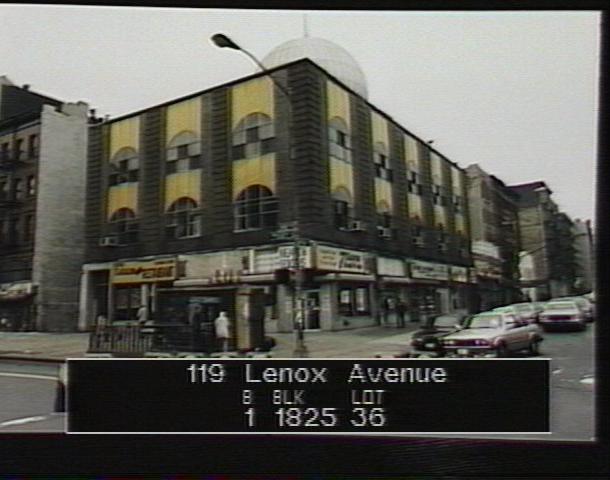
The city photographed every building for its tax records around 1940 and again in the 1980s. NYC Municipal Archives.
Written with AI from the source each entry cites, then fact-checked.
- 1905
The Lenox Casino, designed by Lorenz F. J. Weiher, hosts Socialist meetings and is raided in 1912 over films
The Lenox Casino at 102 West 116th Street, the earlier building on the lot where Mosque No. 7 later met, was built in 1905 to designs by Lorenz F. J. Weiher. It served as a venue for Socialist Party gatherings and theatrical performances. In 1912 it was raided for showing films described as illegal.
Source: 6sqft
- 1954
Malcolm X is named minister of Nation of Islam Temple No. 7 when it meets in the former Lenox Casino
Temple No. 7 of the Nation of Islam opened at the Harlem YMCA in 1946, then moved to the old Lenox Casino at 102 West 116th Street. It was a storefront in 1954 when Elijah Muhammad named Malcolm X its minister. In January 1964 Muhammad stripped Malcolm of his offices and promoted James 3X to lead Mosque No. 7, and Malcolm founded a Sunni mosque of his own.
Source: Wikipedia
- 1965
Mosque No. 7 is firebombed in a dynamite blast after Malcolm X's assassination
By 1964 Malcolm X had stopped preaching at Mosque No. 7 and opened a separate Muslim Mosque instead. After his assassination in 1965, a firebomb and dynamite blast destroyed Mosque No. 7, according to the 6sqft history of the building. Wikipedia adds that the Nation of Islam then moved the congregation to 106 West 127th Street.
Source: 6sqft
- 1972
A crowd of 1,000 gathers outside Mosque No. 7 and police let a dozen suspects leave the basement
On April 14, 1972, after Officer Philip Cardillo was shot inside the mosque, an angry crowd of about 1,000 gathered outside and a riot went on for three hours. To end it, police let a dozen suspects in the mosque's basement go unidentified and shifted the investigation to the 24th Precinct. A 2009 NYPD Confidential column says blame for that release was still being assigned along racial lines.
Source: nypdconfidential.com
- 1972
Within days of the Cardillo shooting, the NYPD bars officers from entering Mosque No. 7 without a supervisor
After Officer Philip Cardillo was shot at the mosque, the police department issued written rules within days for 16 sensitive locations, Mosque No. 7 among them, forbidding officers to enter without a supervisor. A 2009 NYPD Confidential column notes that an unwritten agreement with the mosque had already existed. The rules were read so strictly that, after the mosque objected, ballistics technicians were kept from gathering evidence for the next two years.
Source: nypdconfidential.com
- 1972
A false police call lures officers into Mosque No. 7, where Patrolman Phillip Cardillo is fatally shot
At 11:41 a.m. a caller claiming to be a detective reported an officer in trouble at 102 West 116th Street. Patrolman Phillip Cardillo and his partner Vito Navarra answered, joined by two more officers, and metal doors closed behind them as dozens of Fruit of Islam members confronted them. Cardillo was shot and died on April 20. Deputy Police Commissioner Benjamin Ward ordered white officers out, and 16 held suspects were released on a promise to return that was never kept.
Source: qgazette.com
- 1974
Louis 17X Dupree, dean of the mosque's school, is indicted in Officer Cardillo's death
In 1974, two years after the shooting, Louis 17X Dupree, who was dean of the mosque's school, was indicted for Officer Cardillo's murder. The indictment appears to have come from the work of two retired detectives who, while working for banks, arrested an informant, Foster Lee Thomas, for fraudulent use of stolen credit cards; he gave evidence against Dupree. With no ballistics evidence to refute him, Dupree argued at trial that another officer shot Cardillo or that Cardillo shot himself. He was ultimately acquitted.
Source: nypdconfidential.com
- 1976
The mosque is redesigned and renamed Masjid Malcolm Shabazz for Malcolm X
After Elijah Muhammad's death in 1975, his son Wallace D. Muhammad steered the Nation of Islam toward Sunni Islam. Sabbath Brown redesigned the building, and in 1976 Wallace Muhammad renamed the mosque Masjid Malcolm Shabazz in honor of Malcolm X, who had preached there until 1964.
Source: Wikipedia
- 1980
A Manhattan grand jury faults the NYPD's handling of the Mosque No. 7 shooting investigation
In 1980 a Manhattan grand jury under District Attorney Robert Morgenthau issued a report on the 1972 shooting that sharply criticized the police. It found the investigation had been cut short out of fear of unrest, with the short-term goal of preventing disorder outweighing the long-term interests of justice. Citing the release of the suspects, it also faulted the department for inexcusable detective procedures.
Source: nypdconfidential.com
- 1989
Louis Farrakhan names Muhammad Abdul Aziz, convicted in Malcolm X's killing, the mosque's security chief
In 1989 Nation of Islam leader Louis Farrakhan appointed Muhammad Abdul Aziz as chief of security. Aziz had been found guilty in the 1965 killing of Malcolm X yet maintained that he was innocent. The New York Times read the move as an effort to clear Aziz's name and push for the investigation to be reopened, and his conviction was overturned in 2021.
“…who had been convicted of the 1965 murder of Malcolm X but proclaimed his innocence, as chief of security for the mosque…”
Source: Wikipedia
Further reading
- Masjid Malcolm ShabazzWikipedia
Nearby
- Graham Court1921 Adam Clayton Powell Jr Boulevard | 11 entries
- New Bethel Way of the Cross Church of Christ23 West 118th Street | 4 entries
- Hotel Cecil and Minton's Playhouse150 St Nicholas Avenue | 12 entries
- Mt. Olivet Baptist Church201 Lenox Avenue | 2 entries
- St. Thomas the Apostle Church258 West 118th Street | 5 entries
- Lincoln Correctional Facility31 Central Park North | 9 entries