Hotel Cecil and Minton's Playhouse
150 St Nicholas Avenue | also 206 West 118th Street | Harlem | built 1910
Open on the map12 entries

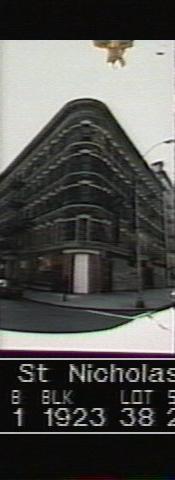
The city photographed every building for its tax records around 1940 and again in the 1980s. NYC Municipal Archives.
Written with AI from the source each entry cites, then fact-checked.
- 1896
Julius Munckwitz completes the Hotel Cecil as a Renaissance Revival family hotel for Harlem
The five-story Hotel Cecil, designed by Julius F. Munckwitz in buff brick, limestone and terra cotta, was finished by December 1896 at St. Nicholas Avenue and West 118th Street. A 1898 advertisement promoted fireproof suites of two to five rooms, and personal references were required. Within a year the hotel was bought by Sarah Hewitt, wife of the former mayor Abram Hewitt.
- 1933
The Scottsboro Boys' Defense Club accuses the Hotel Cecil of refusing a Black guest
The landmark report notes that during the Harlem Renaissance the hotel's owners were slow to welcome Black guests. In 1933 the Scottsboro Boys' Defense Club publicly accused them of turning a man away because of his race. By 1940 the policy had changed, and the Cecil became a regular stop for Black musicians and travelers.
“In 1933, they were accused by the Scottsboro Boys' Defense Club of refusing to "accommodate a negro ... because of his race.”
- 1938
Saxophonist Henry Minton opens a club in the Hotel Cecil
Henry Minton, a tenor saxophonist who had been the first Black delegate to the musicians' union Local 802, opened Minton's Playhouse in the Hotel Cecil in 1938. He meant it as a welcoming place for working musicians. The club ran for more than three decades before closing in 1974, and it reopened under the Minton's name in 2006 and again in 2013.
Source: Wikipedia
- 1941
Kenny Clarke and Thelonious Monk lead the house band where bebop takes shape
Manager Teddy Hill hired drummer Kenny Clarke in 1941, and Clarke formed a house band with pianist Thelonious Monk. Minton's Monday night jam sessions, in the old hotel dining room, became a proving ground where Dizzy Gillespie, Charlie Christian and others worked out bebop. The 1896 Renaissance Revival hotel by Julius F. Munckwicz was designated a city landmark on June 27, 2023.
Source: nyc.gov
- 1941
The Cecil enters the Negro Motorist Green Book and stays in it for twenty years
From 1941 to 1961 the Hotel Cecil appeared in consecutive editions of the Negro Motorist Green Book, the guide Black travelers used to find friendly lodging. Trumpeter Miles Davis later remembered the hotel as first class, with fair rates and large, clean rooms. Many of the musicians who played at Minton's next door stayed upstairs.
“From 1941 to 1961, it was listed in consecutive editions of the Negro Motorist Green Book…”
- 1941
Columbia student Jerry Newman records Minton's jam sessions on a portable disc machine
In spring 1941 Jerry Newman, a Columbia University junior, repeatedly lugged a cumbersome portable disc recorder to Minton's and to Clark Monroe's Uptown House on West 134th Street. The low-fidelity recordings caught jazz in transition, moving away from dance music and swing as bebop was beginning. The landmark report says Newman made about 23 recordings, some of which were later broadcast and released on 78 rpm records.
“Made during spring 1941, these low-fi recordings capture the beginnings of bebop, when jazz was transitioning away from dance music and swing.”
- 1942
Charlie Parker and Dizzy Gillespie become fixtures at Monday jam sessions
As guitarist Charlie Christian's nightly appearances end with his death in March 1942, saxophonist Charlie Parker and trumpeter Dizzy Gillespie become central figures at Minton's Monday night jam sessions. The informal cutting contests, alongside the house band of Thelonious Monk and Kenny Clarke, draw Roy Eldridge, Lester Young, and Ben Webster to the Harlem club. The late-night sessions help forge the fast, harmonically complex style that becomes known as bebop.
Source: Wikipedia
- 1948
The New Yorker tells how a bass lesson at Minton's gave bebop its name
In 1948 New Yorker writer Richard O. Boyer reported that the word bebop came into being at Minton's. In his account, Dizzy Gillespie was coaching a bassist on the last two notes of a phrase, and when the player kept missing them, Gillespie sang the syllables himself. The landmark report adds a rival tale, from Hot Lips Page, crediting Fats Waller.
“It was at Minton's that the word "bebop" came into being. Dizzy was trying to show a bass player how the last two notes of a phrase should sound.”
- 1959
James Brown's Famous Flames rehearse in the Cecil's basement during an Apollo engagement
During James Brown and the Famous Flames' April 1959 engagement at the Apollo Theater, some or all of the group stayed at the Hotel Cecil. Singer Bobby Byrd recalled that they used the hotel basement to pull their voices together and work out routines. The Cecil was a favorite of touring gospel, doo-wop and soul acts.
“…we were staying at the Cecil Hotel. They had a basement down there where we rehearsed, got the voices together and worked out the routines.”
- 1974
Minton's Playhouse closes after three decades as a jazz proving ground
The club that Henry Minton opened in the Hotel Cecil in 1938, and where bebop took shape in the 1940s, shuts its doors after roughly 30 years in business. By the late 1960s it had lost the cutting-edge reputation that once drew Charlie Parker, Dizzy Gillespie, and Thelonious Monk. The space would not reopen as a jazz club again until 2006.
Source: Wikipedia
- 1988
The Hotel Cecil reopens as supportive housing for homeless men and women
In 1987 the Harlem Urban Development Corporation, a state subsidiary, acquired the vacant Hotel Cecil and agreed to restore it. Roberta Washington was the renovation architect, and the building reopened in 1988 as supportive housing for homeless men and women. It now holds about 89 residential units, along with office and commercial space.
- 2023
The city designates Minton's Playhouse a landmark
The Landmarks Preservation Commission designates the building an official New York City landmark, decades after its run as the incubator of bebop under Henry Minton, Teddy Hill, and the house band of Thelonious Monk and Kenny Clarke. The club had already been revived twice since its 1974 closing, reopening in 2006 and again in 2013 under businessman Richard Parsons as an upscale jazz club and restaurant. The designation cements its place in Harlem's musical history.
Source: Wikipedia
Further reading
- Minton's PlayhouseWikipedia
Nearby
- St. Thomas the Apostle Church258 West 118th Street | 5 entries
- Graham Court1921 Adam Clayton Powell Jr Boulevard | 11 entries
- Washington Apartments2034 Adam Clayton Powell Jr Boulevard | 2 entries
- Masjid Malcolm Shabazz119 Lenox Avenue | 10 entries
- Mt. Olivet Baptist Church201 Lenox Avenue | 2 entries
- New Bethel Way of the Cross Church of Christ23 West 118th Street | 4 entries