Graham Court
1921 Adam Clayton Powell Jr Boulevard | also 1925 Adam Clayton Powell Jr Boulevard, 1921 Adam C Powell Boulevard | Harlem | built 1901
Open on the map11 entries

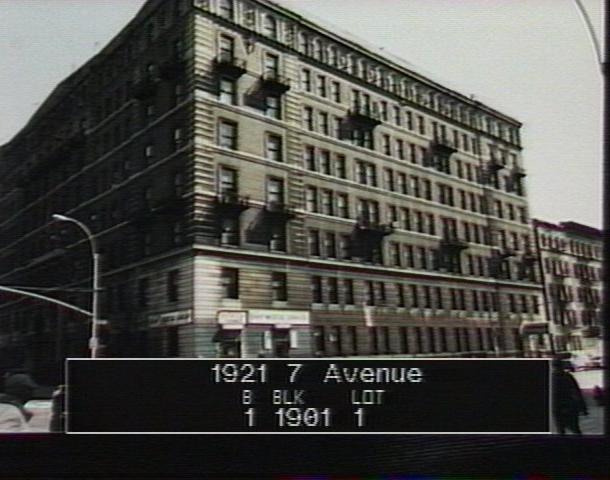
The city photographed every building for its tax records around 1940 and again in the 1980s. NYC Municipal Archives.
Written with AI from the source each entry cites, then fact-checked.
- 1899
William Waldorf Astor becomes a British subject as his Harlem apartment project is proposed
In 1899 the New York Tribune noted a sharp demand for buildings like William Waldorf Astor's proposed Harlem improvement, the future Graham Court. Astor had moved his family to England right after taking over the family estate in 1890 and became a British subject in 1899. He nonetheless financed lavish hotels and apartment houses in New York, including Graham Court, the Astor Apartments and the Apthorp.
- 1901
Tenants of business and professional families pay $900 to $2,000 a year for suites of up to 19 rooms
Graham Court's residents were mainly from the business and professional classes. Rents ran from $900 to $2,000 a year for suites that in some cases had as many as 19 rooms, according to the landmark report. The courtyard plan brought light and air to every apartment, and the suites had the latest conveniences, including elevators.
“Residents, primarily from the business and professional classes, rented suites (some with as many as 19 rooms) at rents ranging from $900 to $2000 a year.”
- 1901
Graham Court's palazzo-and-courtyard design becomes a model for later luxury apartment houses
Clinton & Russell modeled Graham Court on an Italian Renaissance palazzo, wrapping the building around a central courtyard. The landmark report calls it the firm's first apartment house in this style and sees it as a forerunner of big Renaissance-style apartment blocks on the Upper West Side, including the Belnord and Clinton & Russell's own Apthorp. The report says it helped mark the end of the era of smaller luxury French flats.
“Graham Court, the first of Clinton & Russell's apartments in this style, can thus be seen as a precursor to numerous large Renaissance-inspired apartment buildings…”
- 1901
William Waldorf Astor builds the Graham Court apartments
Developer William Waldorf Astor commissions Graham Court, which architects Clinton and Russell build between 1899 and 1901 at a cost of about $500,000. The eight-story building is designed in the mode of an Italian palazzo around a large interior courtyard, with eight elevators and about 800 rooms.
Source: Wikipedia
- 1933
Graham Court is among the last big Harlem apartment houses to integrate
Graham Court remains in the hands of the William Waldorf Astor estate until 1933 and is among the last major apartment buildings in Harlem to integrate. One account says it first opens to Black residents in 1928, while another says it takes no Black tenants until new management arrives in 1933. Many prominent Black residents then move in.
Source: Wikipedia
- 1945
Graham Court resident James Pemberton leads a baseball integration protest
James Pemberton, a Harlem member of the state assembly who lives at Graham Court with his wife Edna, leads protesters at Yankee Stadium on opening day in 1945, pressing for the integration of baseball. Another resident, physician Dr. Cyril Dolly, organizes the Consolidated Tenants League to protect tenants.
Source: Wikipedia
- 1979
A pharmacist buys the tax-delinquent building for $55,000 after the city takes it over
The city took Graham Court in 1978 after its owner stopped paying taxes. In 1979 Mohammed Siddiqui, a pharmacist, bought it from Bankers Trust and the Astor Trust, paying $55,000 and agreeing to cover $150,000 in back taxes. In the six years he owned it, a court-appointed administrator helped the tenants run the building.
“In 1979, Mohammed Siddiqui, a pharmacist, bought the building for $55,000 and a promise to pay $150,000 in back taxes.”
Source: Wikipedia
- 1984
The city designates Graham Court a landmark
The New York City Landmarks Preservation Commission designates Graham Court a city landmark on October 16, 1984. It describes the building as a leading reminder of how Harlem developed around 1900 and as a major achievement in the history of New York apartment-house design.
Source: Wikipedia
- 1986
A landlord pays $933,000 in back taxes hours before foreclosure and then sells to Leon Scharf
By 1986 the city moved to foreclose on owner Mohammed Siddiqui for $933,000 in unpaid taxes, which would have let tenants buy their apartments for $250 each. In mid-February, only hours before the foreclosure became final, Siddiqui used a four-month grace period to pay the full amount. He then sold the building for $2 million to Leon Scharf, who said he would spend $1 million on improvements.
“…in mid-February, only hours before the foreclosure was to become final, the landlord ... handed $933,000 to city tax collectors to reclaim the building…”
Source: Wikipedia
- 1990
Graham Court appears in New Jack City and Jungle Fever
In 1990, producer George Jackson uses Graham Court as the backdrop for a crack factory in the film New Jack City. The next year, Spike Lee shoots his film Jungle Fever in a unit of the building that is now home to interior designer Sheila Bridges.
Source: Wikipedia
- 1996
The Landmarks Commission lets the owner replace Graham Court's 400 original mahogany windows
In 1996 the city's Landmarks Preservation Commission gave the landlord permission to put in new windows, after an inspection found that a fifth of the windows could not be repaired. The plan called for aluminum windows to replace the building's 400 original mahogany ones. A tenants association survey in 2000 found only two of 55 respondents wanted replacement, and tenants suspected a bid to justify rent increases.
“In 1996, the landlord received permission from the New York City Landmarks Preservation Commission to install new windows after an inspection found that 20 percent of them were beyond repair.”
Source: Wikipedia
Further reading
- Graham CourtWikipedia
Nearby
- Hotel Cecil and Minton's Playhouse150 St Nicholas Avenue | 12 entries
- Masjid Malcolm Shabazz119 Lenox Avenue | 10 entries
- St. Thomas the Apostle Church258 West 118th Street | 5 entries
- Mt. Olivet Baptist Church201 Lenox Avenue | 2 entries
- New Bethel Way of the Cross Church of Christ23 West 118th Street | 4 entries
- Washington Apartments2034 Adam Clayton Powell Jr Boulevard | 2 entries