Public School 67 (High School of the Performing Arts)
120 West 46th Street | also 114 West 46th Street | Times Square | built 1894
Open on the map13 entries

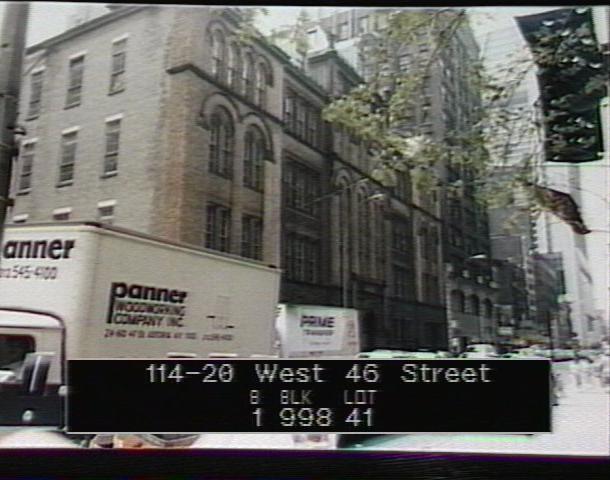
The city photographed every building for its tax records around 1940 and again in the 1980s. NYC Municipal Archives.
Written with AI from the source each entry cites, then fact-checked.
- 1890
The Grand Central Stables lot is bought for a public school
The large lot at 114 to 120 West 46th Street, near Longacre Square, the center of the carriage-making trade, was occupied by the Grand Central Stables until 1890. As the neighborhood filled with commercial buildings, apartments and immigrant families, the Board of Education learned in November 1890 that the stables site was being rented, and a month later its committee noted the city had bought the land instead.
Source: Daytonian in Manhattan
- 1894
C. B. J. Snyder's first known school design, P.S. 67, rises in Romanesque Revival style
Public School 67 was designed in 1891, the first year Charles B. J. Snyder served as the Board of Education's Superintendent of School Buildings, and built in 1893 and 1894. It follows the Romanesque Revival style of his predecessor, with contrasting brick and stone and round arches. The plan called for 36 classrooms to hold 2,016 pupils, serving a dense neighborhood of brownstones and tenements.
- 1896
The New-York Evening High School opens in P.S. 67 for working students
The Board of Education announced on July 1, 1896 that an evening high school, the New-York Evening High School, would start up inside Public School 67. Many tenement children had to work in shops and factories during the day, so the free night classes focused on manual arts such as architectural, mechanical and freehand drawing. The New York Times noted in 1898 that the classes served architects, machinists, stonecutters, masons and carpenters.
Source: Daytonian in Manhattan
- 1902
Three fires at the school turn out to cover a theft of schoolbooks
A fire on the morning of December 9, 1902 sent about 300 children marching out, and two more fires started the next afternoon in paper piled under teachers' desks on the second and third floors. Firemen said the two afternoon fires had been deliberately set, and $700 worth of Latin and Greek grammar books had vanished. Three days later police arrested Andrew M. Copeland, a 74-year-old second-hand book dealer, and four accomplices; he had bribed assistant janitors and a schoolboy to box up the books.
Source: Daytonian in Manhattan
- 1906
P.S. 67 joins the High School of Commerce, with 1,700 pupils
In 1906 Public School 67 joined with the High School of Commerce, which offered daytime classes similar to the night school's trade-oriented courses. Enrollment at the time was 1,700 pupils. The night school had already added business subjects, and by early 1903 its typewriting classes were filling on opening night.
Source: Daytonian in Manhattan
- 1909
The Times reports that P.S. 67 teaches children with disabilities the regular curriculum
In 1909 P.S. 67 introduced classes for disabled children, an innovation reported in The New York Times on March 21. The article explained that the regular public school curriculum was followed and that the children shared in the educational advantages given to the others. A group then called the Association of Teachers of Crippled Children had been quietly formed in December 1908 to arouse interest in such children's welfare in the city's public schools.
Source: Daytonian in Manhattan
- 1912
Transferred P.S. 51 boys stage a strike outside the school
Fifty boys from Public School 51, on West 54th Street, were transferred to P.S. 67 because of overcrowding, even though they were close to graduating. Sixteen-year-old John Colton, captain of their basketball team, led a walkout, and the boys spent the day outside with banners reading that Public School 51 was on strike. Police moved them away rather than arrest them, the principal contacted some of their parents, and the boys' demands were eventually met.
Source: Daytonian in Manhattan
- 1921
Three boys wreck a classroom and stab the goldfish, earning a headline about murder
On Saturday, March 12, 1921, 13-year-old Mike Botto and two schoolmates climbed in a window to get even after Botto was disciplined by Assistant Principal Amy Blenenfeld. They tore up report cards, covered the walls and floor with ink drawings, and stabbed the seven goldfish in her classroom, leaving the bodies in her desk. A detective visited each boy's home on March 18, and the New York Herald ran the headline 3 Kids Caged for Gold Fish Murder.
Source: Daytonian in Manhattan
- 1946
Educator Franklin Keller picks the old P.S. 67 for a school of performing arts
Dr. Franklin J. Keller ran a performing arts program at the Metropolitan Vocational High School on the Lower East Side but decided that a Times Square location was essential. The Board of Education pointed him to 120 West 46th Street, a small former elementary school still used by the U.S. Maritime Commission at the end of the war. The New York Times announced the proposal in June 1946.
- 1948
The School of Performing Arts opens here, with Helen Hayes and Martha Graham advising
Principal Franklin J. Keller wanted a performing-arts school in the Times Square district, and the old school building, then used by the U.S. Maritime Commission, was among the buildings the Board of Education suggested. An advisory commission that included Helen Hayes, Margaret Webster, Walter Damrosch and Martha Graham planned a day split between academics and studio work for about 620 students. Graduates of the school include Al Pacino, Rita Moreno, Liza Minnelli, Ben Vereen, Suzanne Pleshette and Dom DeLuise.
- 1982
The Landmarks Commission designates the High School of the Performing Arts building
The Landmarks Preservation Commission designated the former P.S. 67 as the High School of the Performing Arts on December 21, 1982. Its report called the building a handsome Romanesque Revival school and the earliest known design by C. B. J. Snyder. It added that after World War II the building was revived for the performing arts school, whose graduates include many leading performers.
- 1988
A fire during renovation guts the old school building
In the winter of 1988, while the vacant building was being renovated, a fire gutted it and left a burned-out shell. The ruins were not demolished, and the interiors were rebuilt. The building then became a girls-only annex of Murry Bergtraum High School teaching business courses, and in 1995 it took the name Jacqueline Kennedy Onassis High School for International Careers.
Source: Daytonian in Manhattan
- 1995
The rebuilt school is renamed for Jacqueline Kennedy Onassis
After the 1988 fire left only a shell, the interiors were rebuilt and the building became a girls-only business annex of Murry Bergtraum High School. In 1995, a year after the former First Lady's death, it took the name Jacqueline Kennedy Onassis High School for International Careers. It now admits boys as well as girls and teaches international business, hospitality and tourism, accounting, drama and dance.
Source: Daytonian in Manhattan
Further reading
- Jacqueline Kennedy Onassis High School for International CareersWikipedia
- Public School 67 - No. 120 West 46th StreetDaytonian in Manhattan
Nearby
- Americas Tower1177 Avenue of the Americas | 8 entries
- Lyceum Theatre149 West 45th Street | 13 entries
- Church of St. Mary the Virgin145 West 46th Street | 9 entries
- Hudson Theatre139 West 44th Street | 13 entries
- Hotel Gerard123 West 44th Street | 4 entries
- Belasco Theatre111 West 44th Street | 13 entries