121 Heberton Avenue
Port Richmond | built 1861
Open on the map5 entries

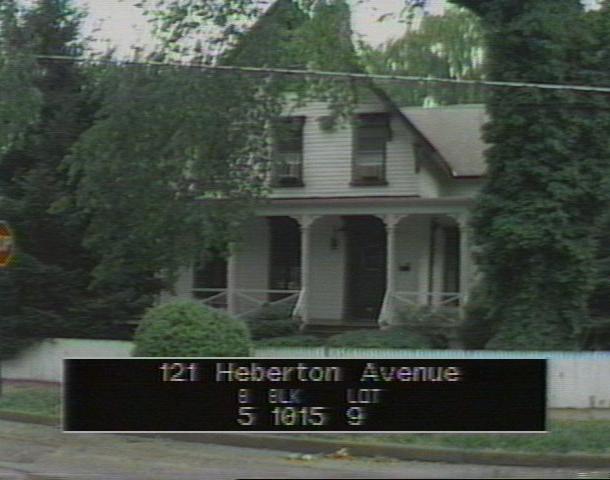
The city photographed every building for its tax records around 1940 and again in the 1980s. NYC Municipal Archives.
Written with AI from the source each entry cites, then fact-checked.
- 1859
Builder James G. Burger designs a rare Rustic-style villa from pattern books
Carpenter-builder James G. Burger put up this house around 1859-61, adapting the English Rustic Cottage in Gervase Wheeler's Homes for the People (1855) and borrowing from designs by Calvert Vaux and Samuel Sloan. It has a cross-gabled roof with deep eaves on carved braces, a wraparound veranda, angled side bays and bracketed window surrounds. The Landmarks Preservation Commission called it an exceptional survivor of the style in New York City.
“The overall form of the building and some details appear to be based on a design for an "English Rustic Cottage…”
- 1861
Creditors force a sale and abolitionist oysterman John J. Housman takes the house
James G. Burger, who had gone to California in the 1850 Gold Rush, was in debt by 1861, and creditors pushed his real estate into a foreclosure sale in May. Just before it, creditor Captain John J. Housman, a prosperous oysterman and abolitionist, arranged to buy this house; the sheriff's deed came in September 1861. Housman picked skilled pilots from the oyster fleet for the Union Army's advance up the James River.
“By 1861, he was in financial difficulties and his creditors forced a foreclosure sale of his real estate in May.”
- 1888
Port Richmond's school superintendent Emil Bottger rents the house
Records suggest the Housman family never lived here and instead rented the house out, likely at a high rent given its spot facing the park. Staten Island directories show that from at least 1888 to 1892 the tenant was Emil Bottger, who ran the Port Richmond schools as superintendent. The blocks facing the park were then considered among the most beautiful and desirable parts of Port Richmond.
- 1892
Saloon keeper and village trustee Robert Brown buys the house
In January 1892 Robert Brown bought the house from Jacob Housman. Brown and his wife Matilda were Irish immigrants who settled in Port Richmond around 1866, where he ran a saloon across the street from this house's back yard, joined the Bennett Street volunteer fire company and served as a village trustee before consolidation. Their son Thomas C. Brown, a lawyer from 1898, became a Municipal Court justice in 1904.
- 1915
Court clerk and Democratic leader Robert S. Brown makes the house his home
By 1915 Robert S. Brown, the eldest son, had inherited the house and was living in it with his wife and family. He had left his contracting business to become a court clerk, serving more than 22 years as clerk of the Special Sessions, and with his brother Thomas was one of Staten Island's Democratic Party leaders. Members of the family stayed on after his death until the house was sold during World War II.
“Robert S. Brown who had inherited 121 Heberton Avenue was living there with his wife and family.”
Nearby
- Port Richmond Library75 Bennett Street | 5 entries
- 29 Cottage Place4 entries
- Public School 20 Annex160 Heberton Avenue | 5 entries
- Reformed Church on Staten Island54 Port Richmond Avenue | 10 entries
- Temple Emanu-El984 Post Avenue | 2 entries
- John De Groot House1674 Richmond Terrace | 4 entries