Reformed Church on Staten Island
54 Port Richmond Avenue | Port Richmond | built 1844
Open on the map10 entries

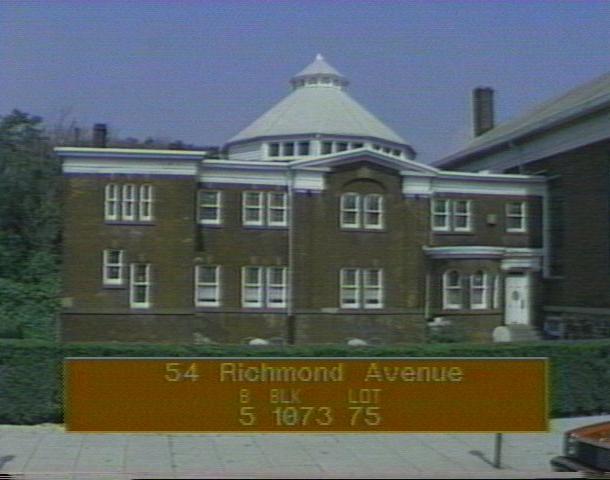
The city photographed every building for its tax records around 1940 and again in the 1980s. NYC Municipal Archives.
Written with AI from the source each entry cites, then fact-checked.
- 1785
A Revolutionary and a Tory lead the rebuilding of the church after the British occupation
After the war, the North Side congregation resolved to replace the church it had lost under British occupation. Its president, Joshua Mersereau, had been one of the island's leading Revolutionaries, while its treasurer, Gozen Ryerrs, had been a leading Tory; together they headed the building committee, a pairing the landmark report calls a deliberate move toward reconciliation. The earlier church on this lot, with a brick front and stone side walls, went up in 1787-88.
“Mersereau had been one of the leadin g Revolutionaries on the island and Ryerrs was one of the leading Tories…”
- 1816
Governor Daniel D. Tompkins joins the church and has its front door moved for his pew
Daniel D. Tompkins, who had appointed the pastor Peter I. Van Pelt chaplain to the troops on Staten Island in the War of 1812, joined the congregation when he moved to the island. Seeking a big pew in the middle of the earlier church, as suited a governor, he persuaded the consistory to shut the main door on Port Richmond Avenue and open one in the steeple's north wall. To reach it, he bought and donated a strip of land 32 by 110 feet.
- 1835
Pastor Peter Van Pelt resigns over an adultery accusation, and James Brownlee begins 55 years
Van Pelt, pastor since 1802, was forced out after he was accused of adultery with someone who belonged to the North Church. Shaken by the scandal, most of the consistory resigned, and the North and South churches together were left with 93 members. The church then brought in James Brownlee, a young Scottish Presbyterian minister, who remained its pastor until 1890.
- 1844
Builder James G. Burgher replaces the old church with a Greek Revival temple front
James G. Burgher, the lowest of three bidders, built the new church. The old building was pulled down in August 1844, the new one was ready for paint by October, and the pews went in in March 1845. The 49-by-85-foot brick church, trimmed in brownstone and wood, has a recessed entrance porch with two freestanding columns between corner pilasters, the distyle-in-antis type, and the landmark report says it appears to be the only surviving example on Staten Island.
“In August 1844, the old building was demolished and by October 1844 the new building was complete d and ready to paint…”
- 1884
Women of the congregation win the right to speak and vote at church meetings
Until 1884, women members in regular standing could only share their views through letters that men read aloud to the congregation. That year they won the right to address and vote at any meeting of the congregation requiring a vote. In the 1890s the church's women formed a Chapel Auxiliary, which helped set up the Port Richmond Day Nursery and the Central Relief Association.
- 1898
Magician and architect Oscar S. Teale designs the church's Akron Plan Sunday school
The Sunday school wing was the work of Oscar S. Teale, a church specialist who was also an amateur magician, president of the American Society of Magicians, and a friend of Harry Houdini, with whom he exposed fraudulent mediums. Here Teale built a horseshoe-shaped auditorium ringed by partitioned galleries, with a parlor, offices and a passage to the church. His last and best-known work was Houdini's memorial in Cypress Hills Cemetery, unveiled in 1927.
“Teale also was an amateur magician who served as the president of the American Society of Magicians, and with his friend Harry Houdini…”
- 1900
Benjamin Perine, Staten Island's last man born into slavery, dies at 104 after years worshipping here
Benjamin Perine kept worshipping at this church until he died at 104. No man on Staten Island was older, and he was the last person there born into slavery. His brother Fortune and Fortune's wife Hettie were church members. According to Morris's History of Staten Island, their mother, an enslaved woman, lies in an unmarked grave in the church cemetery.
- 1926
A pastor and a rabbi hold a joint service here for Richmond's 150th anniversary
The Rev. Otto L. Mohn and Rabbi I. A. Milner of Temple Emanuel in New Brighton brought their two congregations together for a combined service at this church. The occasion was Richmond's Sesquicentennial.
- 1929
A spark from a lumberyard fire sets the church's bell tower ablaze
Two months after the Rev. Frank S. Fry was installed, a spark from a fire at a nearby lumberyard ignited the bell tower, badly damaging it and leaving water and smoke damage at the front of the church. Staten Island architect James K. Whitford, a Port Richmond resident, rebuilt the tower to its earlier look and cut away the interior galleries. The church was rededicated on Sunday, September 15, 1929.
- 1937
Nearly 1,000 mourners, including Senator Robert F. Wagner, attend FCC chairman Anning Prall's funeral
Anning S. Prall, who chaired the Federal Communications Commission and helped lead the Democrats on Staten Island, belonged to this congregation. His funeral here drew almost 1,000 people. Among them were Senator Robert F. Wagner, Congressmen James O'Leary and John O'Connor, and a crowd of bankers, industrialists and officials from the state, city and county.
Further reading
- Reformed Church on Staten IslandWikipedia
Nearby
- Port Richmond Library75 Bennett Street | 5 entries
- 121 Heberton Avenue5 entries
- Public School 20 Annex160 Heberton Avenue | 5 entries
- 29 Cottage Place4 entries
- Temple Emanu-El984 Post Avenue | 2 entries
- John De Groot House1674 Richmond Terrace | 4 entries