Pershing Square Building
125 Park Avenue | also 100 East 42nd Street | Murray Hill | built 1923
Open on the map13 entries

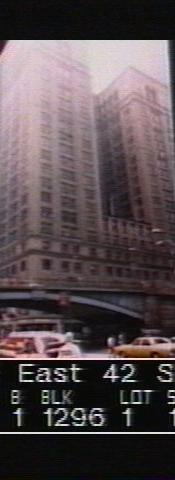
The city photographed every building for its tax records around 1940 and again in the 1980s. NYC Municipal Archives.
Written with AI from the source each entry cites, then fact-checked.
- 1868
Two hoteliers open the Westchester Hotel, which grows into the Grand Union, on the future Pershing Square Building lot
Simeon Ford and Samuel P. Shaw started the Westchester Hotel at 42nd Street and Park Avenue in 1868; within months Cornelius Vanderbilt began buying land nearby for the Grand Central Depot. They kept adding neighboring houses, and the hotel, renamed the Reunion and then the Grand Union, eventually filled the whole blockfront. Ford, an after-dinner speaker who collected prints of old New York, managed it for nearly half a century. The lot later became the site of the Pershing Square Building.
Source: Daytonian in Manhattan
- 1900
A congressman staying at the Grand Union Hotel is found dead on the 41st Street sidewalk
New York Congressman Charles A. Chickering, a regular guest at the Grand Union, had dinner brought to his room one rainy night in 1900 while suffering badly from rheumatism. The next morning a milkman found his body on the 41st Street sidewalk below his fourth-floor window. The Tribune said he either jumped or fell, but noted the fire escape had a railing four feet high. His family and friends rejected suicide, and his secretary believed it was an accident. The hotel stood where the Pershing Square Building rises today.
Source: Daytonian in Manhattan
- 1902
A dynamite blast in the Park Avenue subway trench wrecks the Grand Union Hotel and fatally injures two employees
On January 27, 1902, workers digging the subway trench beside the Grand Union Hotel, on the future Pershing Square Building site, tried to dry damp dynamite by lighting loose powder, setting off about half a ton. Eight people died at once and four more later, and hundreds were hurt by flying glass and rock. The Evening World called the hotel badly wrecked, and housekeeper Nellie Lynch and head cleaner Delia Marr were fatally injured. A second blast on February 6 hurled rocks against the hotel again.
Source: Daytonian in Manhattan
- 1914
The city begins condemning the Grand Union Hotel site and specifies foundations for a 25-story building
In February 1914 the Public Service Commission started condemnation proceedings for the Grand Union Hotel site, which is now this lot, so that a diagonal subway station could connect the IRT's downtown and uptown sections. Because the land proved very expensive, the commission specified that the station's foundations be able to carry a twenty-five-story structure, to help recoup the cost. In May 1915 the hotel site was dug out as a staging area and access point for subway construction.
- 1919
Pershing Square is named, and the old Grand Union Hotel site is briefly slated for a Victory Hall
In December 1918 the Board of Aldermen named the stretch of 42nd Street in front of Grand Central for General John J. Pershing. In 1919 groups proposed turning the cleared Grand Union Hotel site, where the Pershing Square Building would later rise, into a memorial plaza, and the idea became a plan for a three-story Victory Hall. In February 1920 Aldermen president Fiorello La Guardia came out against it, wanting the valuable land back on the tax rolls, and the city's May 1920 auction of the site drew no bids.
- 1920
Developer Henry Mandel's syndicate buys the hotel site for $2.9 million
In July 1920 a syndicate led by the builder Henry Mandel offered $2.9 million for the site, $100,000 above the city's reserve price. Mandel, born in Ukraine in 1884 and brought to the United States at age three, formed the Pershing Square Building Corporation that September and held 60 percent of its stock. He later built One Park Avenue, Parc Vendome and London Terrace before the Depression forced him into bankruptcy in 1932.
“In July 1920 developer Henry Mandel heading a syndicate of investors offered $2,900,000 for the Grand Union, $100,000 over the reserve price…”
- 1921
John Sloan hands his drawings to York & Sawyer for a $10,000 payment and an associate architect credit
In September 1921, after the Board of Standards and Appeals approved the building, its owning corporation hired York & Sawyer to take over the project. Sloan, just starting his own practice and short of resources for so large a job, gave up his drawings and shared his ideas in return for credit as Associate Architect and $10,000, deducted from York & Sawyer's usual fee. He had earlier supervised War Department construction and commanded an Army Air Service squadron.
“…to turn over his drawings and share his ideas with York & Sawyer in exchange for a credit as Associate Architect and a $10,000 payment…”
- 1921
The city grants a variance that makes this the last tall New York building without setbacks
When John Sloan filed plans in May 1921 for a 22-story tower with no setbacks apart from a light court, the Fifth Avenue Association sued to block it under the 1916 zoning law. Sloan told the Board of Standards and Appeals that altering the subway-station foundations already in place would be hard, expensive and probably dangerous. The board ruled that the city had effectively sold the lot as a site for a 25-story building and granted a variance. As a result the Pershing Square Building became the last tall building in New York built without setbacks.
- 1922
The Department of Buildings orders a special report on the stability of the decorative brick facade
The building's brick was laid in decorative patterns, using projections and varied sizes, and Francisco Mujica called it one of the first skyscrapers to use brick cladding for decoration. Because the treatment was so unusual, the Department of Buildings demanded a special stability report on the facade in October 1922. Atlantic Terra Cotta cast the terra cotta in small pieces, and many were deliberately roughened before firing to give a rugged texture.
- 1924
The formal dedication waits until May 1924 so General Pershing can attend
Although the building was finished in 1923, its formal dedication ceremonies were put off until May 1924 so that General Pershing could be there. The Landmarks Preservation Commission reads the sculpted figures at the fifth story, one with a cornucopia and a caduceus and the other with a sword and a laurel wreath, as marking both a monument to the victory in World War I and a business building devoted to peace and prosperity.
- 1928
John Sloan wins a lawsuit over the pay York & Sawyer promised him for the Pershing Square work
When financing came through in May 1922, Edward York asked John Sloan to remain as architect in charge. Sloan was to prepare the drawings, oversee York & Sawyer's draftsmen as they produced working plans, meet prospective tenants and handle contractors and city and transit officials. York & Sawyer promised him additional pay and then went back on it; a lawsuit followed and was decided in Sloan's favor in 1928.
“…promised Sloan additional compensation for this work, and then reneged, resulting in a lawsuit that was ultimately decided in Sloan's favor in 1928…”
- 1943
American Airlines moves its executive offices into the tower, which later takes American Can's name
The tower filled quickly: by January 1923, before it was finished, 60 percent was leased, including to International Paper and the Royal Baking Powder Company. The New York State Republican Party kept offices there from the 1930s into the early 1940s, and American Airlines took four floors for its executive offices in 1943. When American Can leased more space in 1945, the building was renamed the American Can Building, a name it kept until 1970.
- 2016
The city designates the Pershing Square Building a landmark despite calls to delay over transit concerns
At the July 19, 2016 hearing, a representative of the owner raised concerns and asked the Landmarks Preservation Commission to wait. Council Member Daniel Garodnick supported designating the building but pointed to transportation issues the MTA was reviewing. Eight speakers backed designation, including representatives of Borough President Gale Brewer and Community Board 5, while four urged delay and two spoke in opposition. The commission designated the building on November 22, 2016.
“A representative of the owner expressed concerns about the designation and asked the Commission to delay its decision.”
Further reading
- Pershing Square BuildingWikipedia
Nearby
- Bowery Savings Bank Building110 East 42nd Street | 12 entries
- Chanin Building380 Lexington Avenue | 11 entries
- 101 Park Avenue9 entries
- Grand Hyatt New York109 East 42nd Street | 12 entries
- Grand Central Terminal89 East 42nd Street | 23 entries
- One Grand Central Place60 East 42nd Street | 7 entries